
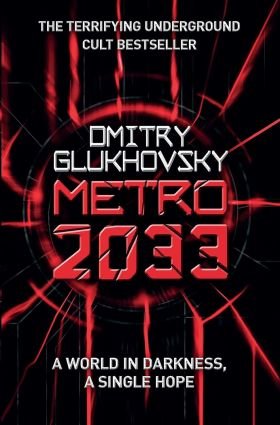
Metro 2033 (book 1 of 3) by Dimitri Glukhovsy (book review).
Metro 2033 by Dmitry Glukhovsky is a post-apocalyptic science fiction horror thriller set within the Moscow Metro system that will, one hopes, put a few people off the idea of ever fighting a nuclear war. Originally made available for free on the author’s website, the novel became popular enough to secure mainstream publication in Russia before finding an international audience. It has already spawned a successful video game series, a film adaptation has been discussed for years, and who knows what comes next? A stage musical perhaps. The reason for its success is the same as it always is: it is a very good story.
The Moscow Metro system is an extraordinary feat of engineering and one of the modern world’s great achievements. Some stations resemble underground palaces, while many others are magnificent examples of Soviet-era architecture. In 2033, however, the world above has been reduced to radioactive rubble by nuclear war. A few thousand survivors cling to existence beneath the city, growing mushrooms, breeding pigs and chickens, and sending scavengers known as stalkers to the surface in search of supplies. These expeditions must contend not only with radiation but also with a variety of deadly mutated creatures.
Because travelling through the tunnels is dangerous, individual stations have developed their own cultures, traditions and political systems over the years, making them resemble tiny independent nations. Only traders and stalkers regularly move between them.
The story is told through a tight third-person perspective. Our hero is Artyom, a twenty-year-old who was born on the surface and retains vague memories of a happier world. As a child, he was handed over by his dying mother to a stranger named Sukhoi, who became his adoptive father. They live at VDNKh, the northernmost inhabited station on its line.
Several years earlier, Artyom and some friends ventured towards the Botanical Gardens and opened a hatch leading to the surface. When confronted by something strange and terrifying, they fled, leaving the hatch open. Since then, VDNKh has lived under a growing threat. The mysterious beings known as the Dark Ones are slowly advancing through the tunnels. They appear to possess psychic abilities capable of filling humans with fear, despair and madness before they even attack. Artyom seems more resistant to these effects than most.
Hunter, a legendary stalker and troubleshooter for the Metro administration, investigates the threat. Before leaving, he tells Artyom that if he does not return, Artyom must travel to the heart of the Metro, find a man named Melnik and deliver a warning. Hunter never comes back.
Artyom sets out on his mission and, through his eyes, we discover the strange and dangerous world of the Metro. Along the way he encounters an extraordinary range of characters, communities and ideologies.
Artyom is an ordinary, decent young man thrust into extraordinary circumstances. He struggles repeatedly. At the lowest point of his journey, he finds himself wandering through a deadly tunnel unarmed, naked and covered in human excrement. From that point onward, things can only improve. Hunter, Melnik and the other stalkers serve as mentors and heroic figures, battle-hardened veterans accustomed to confronting danger. Other characters embody various political and religious philosophies, many inherited from the old world and others born from the unique pressures of underground survival.
The older generation, who still remember life before the war, often come across as bitter, melancholy or angry. Compared to the Metro, the old world seems almost impossibly luxurious.
The characters frequently engage in lengthy conversations, telling stories and debating ideas in a manner that is relatively uncommon in Western thrillers. This occasionally slows the pace but also adds considerable depth. Likewise, Glukhovsky devotes significant space to describing the architecture, economics and daily life of the Metro stations. The result can feel almost Dickensian at times, with dense passages of detail that might intimidate some modern readers. Yet the novel has attracted millions of them, so clearly it is doing something right.
I am sure Metro 2033 would make an excellent action film because the surface-level narrative lends itself perfectly to visual storytelling. However, as with adaptations of Dune, Starship Troopers, The Godfather or The Dirty Dozen, readers of the original novel will inevitably gain a far richer understanding of the world, characters and ideas.
I enjoyed it enormously and its central message remains as powerful now as when it was written. Nuclear war is a very bad idea. Let us try not to have one.
Eamonn Murphy
May 2026
(pub: Gollancz, 2011. 464-page paperback. Price: £8.99 (UK). ISBN: 978-0-57508-625-8).
Check out the publisher: Gollancz