
There are certain places in life that feel faintly wrong. An empty shopping centre five minutes before opening. A motorway service station at three in the morning. The carpet department of a furniture warehouse where nobody seems to have visited since the fall of the Berlin Wall.
Now imagine one of those places stretched to infinity.
That’s the premise behind Backrooms, the long-awaited feature adaptation of the internet creepypasta that somehow evolved from a grainy online image into a full-blown horror phenomenon. The fact that the film exists at all feels faintly absurd. It’s rather like discovering somebody has successfully adapted a strange dream you once had after eating too much cheese.
Yet against all expectations, director Kane Parsons has managed to pull it off. Mostly.
For readers fortunate enough not to have spent the last few years tumbling down internet rabbit holes, the Backrooms are a supposedly endless dimension of yellow-lit office corridors, abandoned rooms, humming fluorescent lights and architectural mistakes. Imagine if reality were designed by a committee of bored accountants and then copied incorrectly by an alien intelligence working from memory.
The result is one of the strangest horror films to emerge in years.
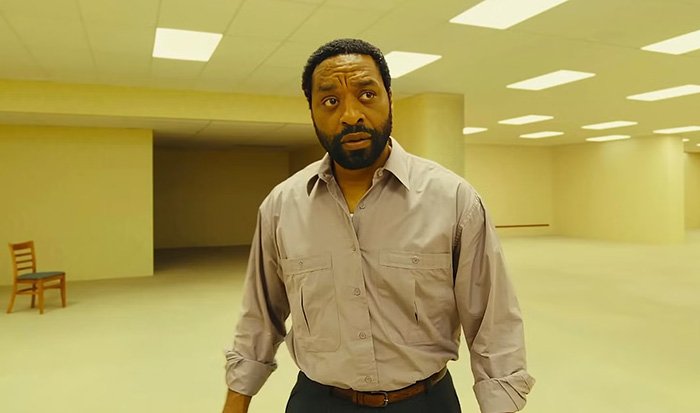
The story follows Clark (Chiwetel Ejiofor), a struggling furniture shop owner whose life is already collapsing nicely before reality decides to make matters worse. After discovering a mysterious portal hidden in his basement, he finds himself wandering into the Backrooms, an impossible labyrinth of endless liminal spaces filled with uncanny furniture, unsettling entities and enough existential dread to keep a therapist employed for several lifetimes. Conveniently, his therapist, Dr Mary Kline (Renate Reinsve), soon finds herself drawn into the mystery as well.
Now, if you’re expecting jump scares every three minutes and a demon leaping out of a cupboard shouting “Boo!”, you may leave disappointed.
Backrooms belongs to that rarer species of horror film that doesn’t want to frighten you so much as gently sandpaper your sanity.
The film’s greatest achievement is atmosphere. Endless yellow corridors stretch away into infinity. Pools appear in places where pools absolutely should not exist. Rooms seem familiar and wrong at the same time. Parsons understands that true horror often lies not in monsters but in architecture. The most terrifying thing in the film may well be a badly lit corridor leading somewhere you don’t want to go.
The influence of filmmakers such as David Lynch is impossible to miss. At times the film feels like Eraserhead wandered into an IKEA showroom and got lost. There are also echoes of The Shining, Severance, and those peculiar dreams where you’re late for an exam despite having left school thirty years ago.
Remarkably, Parsons avoids the temptation to explain too much. Modern horror often suffers from a chronic fear of ambiguity. Every monster gets a backstory. Every mystery receives a PowerPoint presentation. Here, much remains tantalisingly unknowable.
Well… mostly.
The film occasionally stumbles whenever it starts explaining its mythology. An evil corporation called Async is studying the Backrooms and attempting to map them, because apparently every horror story now requires a secret organisation with questionable ethics and a budget larger than Luxembourg’s GDP. The more the film talks, the less interesting it becomes.
Fortunately, the talking is regularly interrupted by scenes of people wandering through impossible spaces while dreadful things loom in the distance.
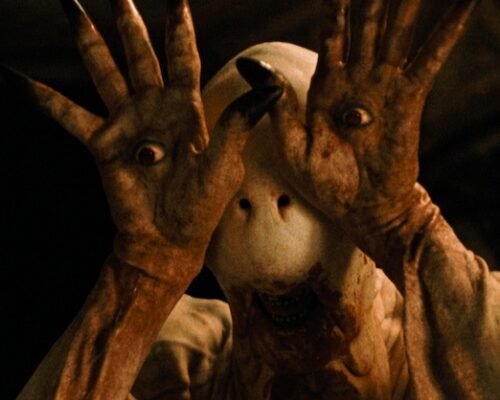
The creature design deserves special praise. The central Lifeform is disturbing not because of what it does but because of what it resembles. Like much of the Backrooms themselves, it feels almost human while remaining fundamentally wrong. It’s the cinematic equivalent of seeing somebody wearing your face slightly incorrectly.
Ejiofor delivers a strong performance as a man slowly surrendering to obsession, while Reinsve brings warmth and intelligence to material that could easily have become exposition-heavy nonsense. Together they anchor a film that often threatens to float away into pure nightmare logic.
The strangest compliment I can pay Backrooms is that it feels genuinely new. Horror has spent the last decade recycling possessed dolls, haunted nuns, cursed videotapes and increasingly angry ghosts. Parsons instead asks a more unsettling question: what if space itself hated you?
The answer turns out to be surprisingly effective.
By the final act, reality has become so distorted that viewers may find themselves eyeing office carpets, hotel corridors and furniture showrooms with renewed suspicion. The next time you’re wandering through an empty department store looking for the toilets, don’t be surprised if you suddenly feel a little nervous.
After all, if Backrooms teaches us anything, it’s that somewhere beyond that next yellow corridor lies an infinite maze of fluorescent misery.
And frankly, that’s still less terrifying than trying to assemble a flat-pack wardrobe from memory.

Join the conversation (0)