
Editor Roy Thomas admits in his editorial that two major articles in this issue of Alter Ego squeezed out much of the magazine’s usual content. Looking at the cover, with its prominent banner proclaiming ‘1950s Marvel Super-Hero Revival!’, it is not difficult to work out what those articles are about.
Before going any further, it is worth noting that many early TwoMorrows publications were produced with dual covers. If you are hunting for back issues on auction sites, you may well be shown the reverse cover, or even an advertising cover, rather than the main front cover. Do not assume the image displayed accurately reflects the issue’s primary subject matter.
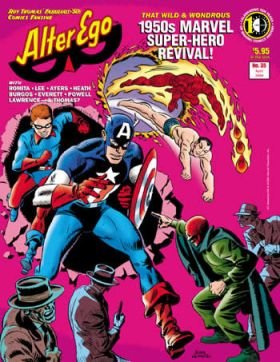
To the main feature, then. Roy Thomas opens with an article recounting his first encounter with the revived Timely/Marvel heroes Captain America, the Human Torch and the Sub-Mariner. Back in the 1950s, there was no organised fandom and few sources of information beyond the comics themselves. It is therefore easy to understand how Thomas initially misread Bill Everett’s signature, either because of the artist’s handwriting or the printing standards of the day. Most comic fans have probably made similar mistakes over the years.
Given that these characters had been absent from publication for some time, Thomas’s excitement at seeing them return is entirely understandable. I remember reading some of those Sub-Mariner stories reprinted in Marvel Super-Heroes during the 1960s without really appreciating their historical significance. For example, I had no idea Namor had once lost his famous ankle wings, only regaining them through the Rejuvenator and thereby returning to parity with a certain wing-footed DC hero.
Jim Amash interviews John Romita Sr. about his time at Timely during the 1950s, including his work on Captain America and his experiences in the bullpen alongside other artists. The interview also provides useful insight into Stan Lee’s habit of having artwork retouched or corrected to improve its appearance. Considering that Romita later became Marvel’s art director while simultaneously drawing The Amazing Spider-Man, it is remarkable just how much work he managed to juggle.
Roy Thomas’s interview with comic artist Dick Ayers focuses on the period when Ayers inherited The Human Torch strip. Ayers altered the way the Torch’s flames were depicted, only to have original creator Carl Burgos step in and insist on changes. Whether this intervention came directly from publisher Martin Goodman or editor Stan Lee remains unclear.
Speaking of Stan Lee, Thomas also interviews the man himself. Lee immediately admits that his memory is less than perfect, and many of his recollections about former colleagues are understandably vague. Even so, firsthand testimony from someone who was actually there remains invaluable.
Flip the magazine over and Jim Amash interviews cartoonist Al Jaffee about his time at Timely during the late 1950s. Given considerable freedom by Stan Lee, Jaffee was able to create virtually any funny-animal story he wished. He readily admits that he could never draw serious characters particularly well. His stories about life in the humour department, along with the practical jokes played in the bullpen, are often hilarious. Not all the jokes were one-sided, either. Jaffee also explains that the move from staff positions to freelance work was largely driven by the simple fact that freelancing paid better. His observations about Stan Lee are especially revealing, showing Lee’s determination to produce the best-looking comics possible while generally allowing talented creators to get on with their work.
The first part of writer Bill Schelly’s interview with South African comics historian John Wright explores his childhood and his love of American comic books. There are some fascinating parallels with the British experience. Comic books often arrived in both countries as ship ballast before being sold locally. One question I have always wondered about is what those ships carried back to America in exchange. British books? South African publications? Something else entirely? It is one of those curious historical details that never seems to get explained.
Have I given you enough reasons to seek out a copy? I certainly hope so.
GF Willmetts
May 2026
(pub: TwoMorrows Publishing. 82-page illustrated magazine. Price: $10.95 (US). ISSN: 1932-6890. Digital edition available direct from the publisher for $4.99 (US).)
Check out the websites: www.TwoMorrows.com and Alter Ego #35
Join the conversation (0)