

Lee Cronin’s The Mummy unwraps grief, gore and enough bandages to bankrupt Boots (Mark Kermode film review).
There are certain things cinema simply cannot leave buried. Dracula rises every decade or so for another nibble, Frankenstein gets rebooted whenever Hollywood spots some spare lightning, and somewhere in the distance a wolfman is always preparing to remove his shirt dramatically beneath a full moon. Now it is the mummy’s turn again, shambling back into theatres wrapped in trauma, family grief, and what appears to be several industrial miles of screamingly unpleasant skin parchment.
Lee Cronin’s The Mummy is not, and this has been stressed so often it may qualify as a legally binding chant, connected to the Brendan Fraser adventure films. In fact, the internet spent months asking whether Fraser might appear, only for Blumhouse’s social media accounts to repeatedly insist: no, Brendan Fraser is not in this film. One imagines this message being carved into stone tablets and hurled from a pyramid.
Instead, director Lee Cronin, previously responsible for the gloriously splattery Evil Dead Rise, has approached the material from an entirely different angle. Gone are the swashbuckling sandstorms and charming rogue archaeologists. This version asks an altogether less comforting question: what if a mummy film was actually horrible?
The answer, judging by the trailers and audience reactions, is “very.”
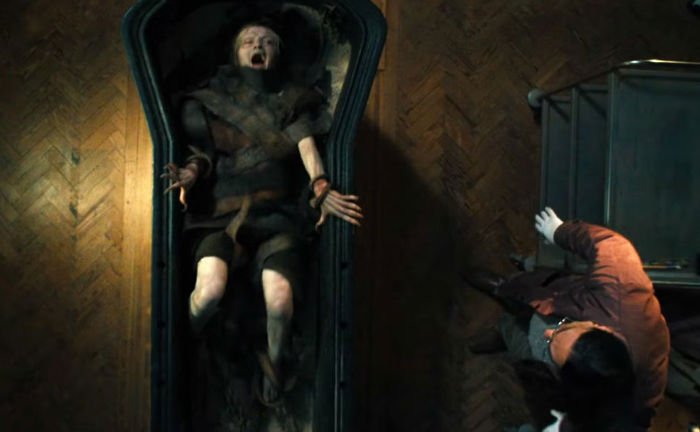
The story follows Charlie Cannon, played by Jack Reynor, a journalist whose daughter Katie vanished years earlier after being abducted in Egypt. Eight years later she returns home, wrapped in ancient parchment, mute, traumatised, and carrying what appears to be a supernatural demon infestation of the sort normally excluded from standard home insurance policies.
From there, the film descends into family horror with the grim determination of a cursed lift. Self-mutilation, possession, ancient cults, demonic rituals, desecrated corpses and Morse-code messages tapped from inside coffins all arrive in rapid succession. Somewhere beneath the gore is a deeply personal story about grief and family trauma, inspired partly by Cronin processing the death of his own mother. Which makes this perhaps the first Mummy film to emerge from the intersection of ancient Egyptian mythology and unresolved bereavement counselling.
The cast includes Laia Costa, May Calamawy, Natalie Grace and Verónica Falcón, with Calamawy’s detective Dalia Zaki rapidly becoming the sort of person horror audiences desperately cling to because she appears capable of making sensible decisions under pressure. This alone places her in the top one percent of horror protagonists.
Visually, the film looks determined to avoid every familiar mummy cliché. Cronin reportedly researched bog bodies, preserved remains, North African imagery and religious symbolism to create a new version of the monster. The result is less “regal undead pharaoh” and more “someone excavated pure nightmare from beneath a municipal car park.”
Critics have been divided, although horror fans often treat bad reviews as an endorsement badge roughly equivalent to a pentagram-shaped Michelin star. Some reviewers praised the film’s gore and emotional weight, while others complained it mistakes relentless unpleasantness for genuine terror. A few seemed personally exhausted by the experience, which, in fairness, is not always a criticism in horror cinema. Nobody leaves a proper nightmare saying, “What a restful ninety minutes.”
Here at SFcrowsnest magazine, we rather admire the sheer nerve of trying to reinvent The Mummy as a bleak supernatural family tragedy with demonic body horror. Universal once treated mummies as shambling curses in dusty tombs. Stephen Sommers turned them into blockbuster rollercoaster villains. Cronin’s version appears to have wandered in from a support group carrying scissors and existential dread.
There is also something gloriously uncommercial about the film’s willingness to become genuinely strange. Ancient demons named Nasmaranian. Flesh inscribed with sacred text. Children behaving like tiny satanic sleeper agents. Scorpions inserted into throats. Morse code messages tapped from within supernatural imprisonment. One can almost hear studio executives quietly asking whether perhaps somebody might like to crack a joke and chase treasure instead.
Still, horror has always thrived when it mutates. The best monster films reflect the fears of their era. The old mummy films feared ancient curses and colonial trespass. This one fears family collapse, inherited trauma, bodily decay, and the terrifying suspicion that your child might return home from a terrible experience carrying something far worse than emotional baggage.
Mark Kermode has now delivered his own video review of the film, stepping bravely into the tomb to determine whether Cronin’s reinvention deserves resurrection or immediate ceremonial reburial beneath several tonnes of cursed sandstone. Either way, the film has succeeded at one thing already: after decades of cinematic mummies lumbering about like dusty pensioners searching for a bus stop, they are frightening again.
And frankly, that may be the biggest monster miracle of all.
