

The Infinity Box by Kate Wilhelm (book review).
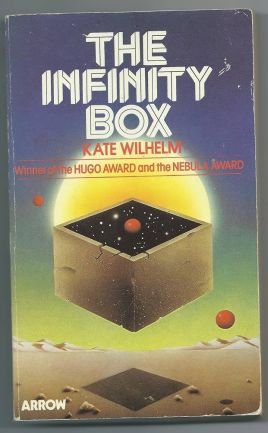
‘The Infinity Box’ is a ten-story anthology by Kate Wilhelm, all written in the early 1970s. This paperback is a second printing. The opening story, from which the book takes its title, is practically a novelette, running to 67 pages. The thing is, I don’t think it’s her strongest piece. Written in the first person, Eddie Laslow runs a two-man electronics firm with his wife, Janet, producing specialised devices. A new neighbour, the widow and professional photographer Christine Warnecke Rudeman, comes across as rather frail. Somehow, a psychic link develops between her and Eddie, calling him when she’s in trouble. In many respects, this is downplayed, with neither of them quite understanding what is happening.
In many respects, Wilhelm writes descriptively well and shows a keen insight into everyday American life at the time. Oddly, she could have written straight drama fiction just as effectively, but chose science fiction instead.
‘The Time Piece’ shows the retirement of accountant Richard Weiss and the troubles within his family. He discovers that, by adjusting his watch, he can travel into the past and attempts to prevent his daughter’s marriage to a man who will become a hopeless husband, with limited success. There’s a certain irony at play. As you read, it’s obvious Wilhelm places more emphasis on everyday events than on anything spectacular.
The same applies to ‘The Red Canary’, where Tillich wrestles with the red tape involved in obtaining medication for his young granddaughter. I particularly liked the scene where he is told to count and formally acknowledge receipt of fourteen tablets. There are actually thirteen, but he has to agree to what he is told. You get the sense that Wilhelm either experienced or knew of such situations.
By now, it should be clear that Wilhelm is something of an acquired taste, or rather that some of her stories work better than others, especially fifty years on. You also have to take into account how many of her characters smoke, which was far more common at the time.
If anything, the brief write-ups on the back cover identify the plots more quickly than the stories themselves. In ‘Man Of Letters’, the writer Warner appears to create realities through his fiction, but this idea is so understated that it barely surfaces, although the ending would be worthy of Harlan Ellison.
‘April Fools’ Day Forever’ is nearly novelette length, and it takes a while before its focus becomes clear. Eventually, it centres on eugenics, presented in a rather forceful way, restricting certain people, including diabetics, from reproducing. With current knowledge, and likely even then, both types of diabetes are not always genetically linked and can arise spontaneously. Eugenics is a disturbing concept, as it removes traits without understanding what else may be lost from the gene pool.
The last three stories, ‘The Fusion Bomb’, ‘The Village’ and ‘The Funeral’, veer away from the title concept and focus more on people. I do think Wilhelm was experimenting here. The evolution of swearing in dialogue was also shifting at the time, and she explores that, albeit in a fairly restrained way. In ‘The Funeral’, the emphasis leans more towards adolescence and puberty.
As I said, Wilhelm is very much an acquired taste, and whether you enjoy her work will depend on your preferences. I’m less certain about her myself, but that doesn’t mean she isn’t worth reading, if only to sample a different style of science fiction.
GF Willmetts
April 2026
(pub: Arrow Books, 1979. 318-page paperback. Price: varies. ISBN: 0-09-910510-0).