
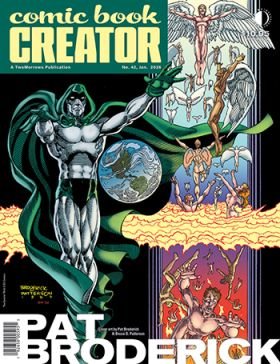
Comic Book Creator #42 March 2026 (magazine review).
One thing I like about ‘Comic Book Creator’ is it often coughs up interviews of creators I’ve never heard of but insights into when and where they grew up. A case in point is Shary Flenniken, an underground comicbook artist in the 1960s. She provides insight into not only the movement but also how it moved with the beatniks. I liked her describing how a group of artists each did a panel, creating a story without planning. Organised chaos.
Before the main event, there are many smaller pieces again, so please forgive me if I skip over anything, but I have read everything.
One of them has editor/writer Jon B. Cooke focusing on ‘Esquire magazine, March 1972′, which was a superhero special but with new characters done by comic book regulars brought in by Herb Trimpe. So, we have Bernie Wrightson, Jeff Jones, Barry Windsor-Smith, Ralph Reese, and Alan Weiss. There are the opening pages from each of them here at full size. I did look up the original magazine, but the cost is really expensive.
Cook interviews Paul Buhle about his influence on ‘Mad’ magazine, which ultimately led to Buhle co-writing a book on Harvey Kurtman. He divided his time between interviewing radical people and contributing to the magazines as well. I tend to see these pieces as something I’m never likely to read but prepared to learn from.
Of course, the real payload is the two interviews with comic book artist Pat Broderick. It’s a little confusing at the beginning, where the opening pages for each are side by side, but it looks like there was a need to showcase the western art of ‘Bronze Star’ across the two pages. In the first interview, Greg Biga discusses with Broderick how he started in Tampa and continues to live in the same area today. His ability to maintain an advertising job while developing his comic book career should serve as a lesson for all you aspiring artists; having more than one job is essential when starting out. No matter how talented you are, have something you can fall back on. As such, Broderick admits that you get hard times and lose being the flavour of the month and need to be flexible.
As such, he has also worked in animation and teaching and gone full circle with a Mike Barr-scripted ‘Bronze Star’ comic book recently. His work at Marvel and DC Comics has been extensive, including the likes of the Micronauts, Captain Marvel, Firestorm, Captain Atom, and the Legion of Super-Heroes. It appears that he consistently faced challenges, supported by his association with Neal Adams’ Crusty Bunkers. His suggestion for upcoming artists to learn to draw on paper before moving on to digital is to at least ensure they might have something to sell at comic conventions.
Cook’s follow-up interview is filling in some of the gaps from the first, which was done three years earlier. I loved his comment, based on his own teaching experience, that schools’ expertise is in creating morons. Broderick’s insights include the comic book industry and advertising, making for intriguing reading. I did look up ‘Bronze Star’, and it looks like it’s sold out at the moment. Hopefully, the interest here gives it a second printing because Broderick’s art is quite catching.
Have you ordered this issue yet?
GF Willmetts
April 2026
(pub: TwoMorrows Publishing. 82 page illustrated magazine. Price: $10.95 (US). ISSN: 401-783-1689. Direct from them, you can get it for $10.95 (US))
check out websites: www.TwoMorrows.com and https://twomorrows.com/index.php?main_page=product_info&cPath=98_132&products_id=1851
