

The Early Del Rey is another substantial volume in Doubleday’s series collecting the formative works of Golden Age science fiction writers, complete with autobiographical notes scattered between the stories. Isaac Asimov, Frank Belknap Long, Jack Williamson and Fred Pohl all received the treatment, and here we have Lester Del Rey’s contribution. :contentReference[oaicite:0]{index=0}
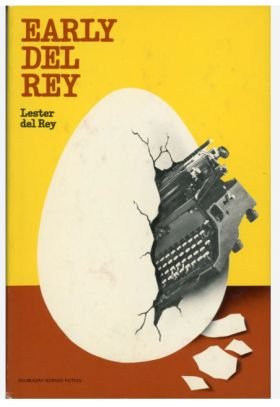
Del Rey was not a compulsive writer and, by his own admission, drifted into the profession almost by accident. A voracious reader of science fiction magazines, he once threw an issue across the room in disgust at the poor quality of one story. His girlfriend challenged him to do better, and he promptly discovered what we would now call a lucrative side hustle.
‘The Faithful’ (Astounding Science Fiction, April 1938), written in response to that challenge, is narrated in the first person by Hungor Beowulf XIV, one of many highly intelligent dogs bred by humanity who can also speak. Humanity has largely destroyed itself and the dogs are barely surviving, hampered by the inconvenient lack of hands and a lingering dependence on the vanished human race. It is a slightly silly premise but not bad for a first story, and John W. Campbell, editor of Astounding, accepted it with a cheque for forty dollars, launching Del Rey’s career. Del Rey freely admits he was not approaching writing cold, having devoured magazines such as Writer’s Digest and written numerous fan letters. Campbell may well have recognised his name, which certainly would not have hurt.
The next couple of stories were rejected, so Del Rey more or less gave up, not especially bothered by the setback. Campbell, however, wrote asking for more material and Del Rey responded with ‘Helen O’Loy’, a classic robot story frequently anthologised ever since. Reinvigorated, he tried other markets but generally remained loyal to Campbell throughout the 1940s.
‘Cross Of Fire’ (Weird Tales, April 1939) concerns a man who has forgotten he is a vampire and cannot understand why everyone reacts so strangely to him. It is competently handled, though not exceptional.
‘Anything’ (Unknown, October 1939) offers a cynical portrait of small-town America, narrated by Luke Short, editor of the local newspaper. A mysterious man in a brown suit arrives looking for work and claims he will do anything in exchange for bread and milk. Unfortunately for everyone else, he appears brilliant at absolutely everything, promptly disrupting the entire local economy.
‘Habit’ (Astounding Science Fiction, November 1939) revolves around a rocket race from Mars to Jupiter and back again for a huge cash prize. It is entertaining, although Del Rey later regretted a massive error in his ballistic calculations which rendered the story scientifically impossible. Most readers, then or now, probably would not care. Plenty of science fiction has spaceships darting around the galaxy with little concern for plausibility, although some writers, like Heinlein, were meticulous enough to spend days calculating a single rocket manoeuvre.
‘The Smallest God’ (Astounding Science Fiction, January 1940) feels more like fantasy than science fiction. Dr Arlington Brugh keeps a small rubber figure of Hermes on his desk as a lucky mascot. One day, he fills it with radioactive potassium chloride to stop it toppling over and the little god promptly comes to life. Telepathic communication with a nearby cat and dog helps Hermes understand the world around him. The premise is undeniably daft, but the story is charmingly handled.
‘The Stars Look Down’ (Astounding Science Fiction, August 1940) is an extremely American tale of rugged individualism, entrepreneurship and criminality in pursuit of humanity’s future among the stars. Erin Morse and Gregory Stewart are rival visionaries determined to carry humankind into space. Erin is the decent wealthy heir spending his fortune on noble goals, while Gregory clawed his way up through the munitions industry and controls vast industrial interests through intimidation and violence. He is also bitter because the woman he loved married Erin and later died giving birth to Erin’s son. The rivalry reminded me somewhat of Robert Silverberg’s To Live Again, although I found Erin’s continued friendship with Stewart rather implausible given Stewart’s behaviour.
‘Doubled In Brass’ (Unknown, January 1940) is a sequel to ‘Coppersmith’, not included in this collection, about Ellowan Coppersmith, a metalworking elf living among humans. This time, he meddles in a romantic entanglement to ensure a girl chooses the correct suitor. Apparently, girls like bad boys. So I am told.
‘Reincarnate’ (Astounding Science Fiction, April 1940) follows Thorne Boyd assisting physicist Allan Moss in constructing a nuclear generator for financier John Abbott. Boyd is all set to marry Abbott’s daughter Joan when a terrible accident leaves him trapped in a robot body. Yes, that is technically a spoiler, but the real interest lies in how Del Rey explores the emotional and social difficulties of existing as a metal machine. Del Rey dismisses the ending as corny in his notes. I thought it rather sweet.
‘Carillion Of Skulls’ (Unknown, February 1941) is a strange horror story set in an abandoned amusement park where decapitated bodies keep turning up. A possible nisse may be involved, while protagonist Ann Muller continually loses her memory. I found the whole thing rather opaque.
‘Done Without Eagles’ (Astounding Science Fiction, August 1940) concerns a passenger trip to Mars aboard the Kickapoo, where Captain Lee Rogers must endure interference from former heroic captain Court Perry and Perry’s four-armed mutant super-genius son. A solid “men at work” story.
‘My Name Is Legion’ (Astounding Science Fiction, June 1942) is a thinly disguised tale about Hitler attempting to escape as Germany collapses, aided by a scientist with a device capable of producing multiple duplicates of the Führer. There is, naturally, a catch. Del Rey wanted to counter the idea that tyrants are necessarily fools or lunatics. Often they are simply consumed by a lust for power. Still relevant today, unfortunately, although wartime readers apparently disliked the story.
‘Though Poppies Grow’ (Unknown Worlds, August 1942) is a fantasy about a First World War soldier somehow returning to life in Washington in 1942. Pleasant enough and very much a product of its era.
‘Lunar Landing’ (Astounding Science Fiction, October 1942) begins with a remarkably realistic moon mission. Pilot Nemo Grey, four feet ten inches tall and weighing only eighty pounds, was discovered years earlier on a riverbank suffering total amnesia. His rocket, the Moth, is sent to rescue a previous lunar expedition that has crashed. The plot develops nicely and the characters are convincing, although modern readers may find the ending rather silly. Good fun nevertheless.
‘Fifth Freedom’ (Astounding Science Fiction, May 1943) examines conscientious objection during wartime. Tommy Dorn, mocked as a “Conchy”, is shunned at Workcamp 2013-E, although newcomer Jimmy Lake respects his decision. Jimmy himself cannot fight because of polio. Romantic complications and changing circumstances eventually challenge Tommy’s beliefs. Del Rey admits he, too, was swept up in wartime patriotism despite attempting to remain rational.
‘Whom The Gods Love’ (Astounding Science Fiction, June 1943) features an American pilot who develops superhuman powers after a bullet lodges in his brain, allowing him to manipulate cosmic forces. Psychic powers were extremely fashionable in science fiction at the time.
‘Though Dreamers Die’ (Astounding Science Fiction, February 1944) serves as a prequel to Robert Moore Williams’ ‘Robots’ Return’. Del Rey admired the original story and imagined what might have preceded it. A robot-crewed colony ship leaves Earth for the stars and events unfold badly. An enjoyable yarn.
‘Fool’s Errand’ (Science Fiction Quarterly, November 1951) is a time travel story involving Nostradamus. Apparently it took Del Rey quite some time to sell it.
‘The One-Eyed Man’ (Astounding Science Fiction, May 1945) actually contains two eyes, the title being a reference to H.G. Wells. Aaron Bard, inventor and father of the Dictator, has created “Psychicompellors”, devices capable of educating a twelve-year-old child instantly. Successful children become functioning adults. Failures become mindless zombie slaves. A dark tale about family, control and freedom.
‘And The Darkness’ (Out of This World Adventures, July 1950) depicts mutant survivors after a global catastrophe struggling to preserve the human race despite only eleven people remaining alive. The message is simple: never surrender hope.
‘Shadows Of Empire’ (Future combined with Science Fiction Stories, July-August 1950) concerns Earth abandoning its Martian colony. Campbell rejected it for being too atmospheric and moody, prompting Del Rey to write the more action-oriented ‘Unreasonable Facsimile’ (Future Science Fiction, July 1952), involving an android replacement for a Martian councillor. Campbell rejected that one too, presumably because he considered the theme overused. Editors. Impossible creatures.
‘Conditioned Reflex’ (Future combined with Science Fiction Stories, May 1951) portrays a strained father-son relationship in a post-war world where survival depends on scavenging ruined cities for lost technology. Another solid story.
‘Over The Top’ (Astounding Science Fiction, November 1949) features tiny astronaut Dave Mannen stranded on Mars after his rocket fails during landing. Del Rey himself was short and seems quietly hopeful that smaller men might prove ideal astronauts because they require less food, water and air. NASA, sadly for him, disagreed.
In ‘Wind Between The Worlds’ (Galaxy Science Fiction, March 1951), a scientist invents matter transmission and Earth is invited into a Galactic Federation. Vic Peters works troubleshooting problems for Teleport Interstellar, whose technology has transformed civilisation and destabilised economies. Alien races are technologically superior but forbidden from sharing their knowledge because human sociology lags far behind human science. Naturally, a catastrophic teleporter accident threatens everything.
Overall, it is a very good collection. Why did Lester Del Rey never quite reach the towering fame of Asimov, Heinlein, Clarke or Bradbury? One reason may be his habit of using multiple pseudonyms. Fred Pohl and Henry Kuttner did the same to their detriment. Readers remember names, and constant changes damage recognition. Asimov attached his memorable surname to everything, while Heinlein reserved pseudonyms mainly for weaker material sold to lesser magazines. Del Rey also lacked the obsessive drive of some contemporaries. He openly admits he often ignored writing for months or years while pursuing other work. Eventually, agent Scott Meredith convinced him it was his true vocation and he became a full-time professional writer. This collection gathers stories from those uncertain first twelve years while he was still discovering his voice.
The downside of these ‘Early’ collections is that they rarely contain the writer’s very best stories, those having already appeared in other anthologies. The upside, vastly outweighing that problem, is the autobiographical material and practical writing advice scattered throughout. Brilliant stories can intimidate aspiring writers because they seem impossible to match. Early stories that are merely good rather than transcendent encourage you to think: perhaps I could do this too. And perhaps you can.
Eamonn Murphy
May 2026
(pub: Doubleday and Company, 1975. 424-page hardback. Price: varies. ISBN: 978-0-38502-740-3).

Join the conversation (0)