
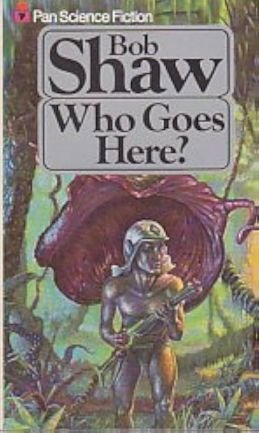
In 2386, the Space Legion recruits people who want to forget their pasts. The process is wonderfully simple: sign up and have your memories erased. In Warren Peace’s case, most of his memories are removed. Did I mention that Who Goes Here? is writer Bob Shaw’s satire? That did not really sink in for me until I looked more closely at the lead character’s name. It only becomes clear near the end of the book that “Warren Peace” is an alias. Logical, really. Why would anyone keep their real name when it might allow their new self to uncover a past they can no longer remember?
The Legion’s method of space travel is particularly unusual. Their transport vessels move by teleporting themselves 250 feet at a time in a continuous chain of jumps, allowing them to cross vast distances and depart just as rapidly once they have delivered the military forces.
For a while, I assumed we would mainly follow Peace’s military career, but that only lasts through a couple of campaigns before he is granted some rest and recreation on Aspatria, the very world where his former self chose to erase his memories. His leave lasts a grand total of four hours, although that may not be based on Earth time, and he has very little money because much of his pay has already gone towards his paper clothing. Inflation clearly runs riot in this future. He also possesses a Blue Parrott model, which points him towards a nightclub and sets much of the plot in motion.
From here on, a great deal becomes spoiler territory. Peace grows increasingly desperate to discover who he once was, fearing he may have been a truly terrible individual. Along the way, he encounters the inventor of a time machine, travels back to a point before his Legion recruitment, and attempts to uncover the truth about his former identity. Naturally, this raises the possibility of erasing his own existence entirely, which complicates matters somewhat.
In many respects, Who Goes Here? is a very quick read. Well, at least it was for me. Other readers may spend more time untangling Shaw’s wordplay and the implications hidden beneath the humour. Shaw gleefully toys with science fiction conventions and tropes throughout the novel, poking fun at the absurdities of war, rebellion and authority, while showing how unconventional behaviour, even accidental unconventional behaviour, can completely derail supposedly rational systems.
I have not read a huge amount of Bob Shaw’s work, but if what I have described appeals to you, then he is definitely an author worth seeking out. There is a sly intelligence at work beneath the comedy, like finding a custard pie hiding a philosophy degree.
GF Willmetts
May 2026
(pub: Pan Science Fiction, 1979, from a 1977 release. 173-page paperback. Price: varies. ISBN: 0-330-25609-2)
Join the conversation (0)