
This edition of Alter Ego, as you can tell from the cover, focuses on Shazam! or, rather, the original Captain Marvel and his family when they were brought into DC Comics years after DC had successfully sued Fawcett Comics in the 1950s. However, the transition was far from smooth, as writer P.C. Hamerlinck explains in his look at the history.
Editor Julius Schwartz took over the Superman titles when Mort Weisinger retired and was subsequently handed the Captain Marvel titles when DC acquired them. He didn’t want them, nor did he appreciate C.C. Beck, the artist who had originally drawn the Big Red Cheese, pointing out what was wrong with the scripts and making changes that he felt strayed from the character’s established legend.
If you’re too young to remember, DC Comics editors had a habit of micromanaging almost everything, which inevitably led to clashes. I do think it would have been interesting if Schwartz had made Beck a sub-editor and simply let him get on with it, but that was never going to happen. To be fair to Beck, he had a point. He didn’t want the Shazam! title to resemble the rest of DC’s superhero stable and was determined to preserve its unique identity. Whether that approach would have allowed it to find a substantial readership again, we’ll never know.
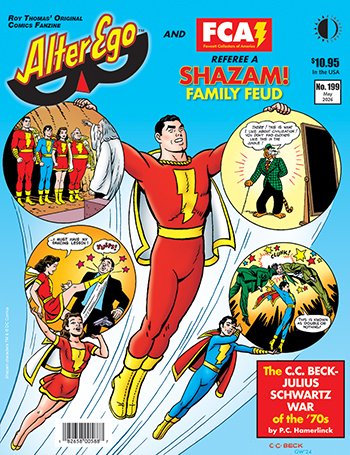
Writer Shawn Clancy examines the two testimonies given by Fawcett editor Bill Parker during DC Comics’ lawsuit over Captain Marvel, providing fascinating insights into the character’s creation. Amusingly, Fawcett initially didn’t want a team book because they believed readers would struggle to keep track of multiple characters. That concern clearly didn’t last long. This is a particularly interesting article and well worth your attention, especially when you learn that Cary Grant was the original inspiration for Captain Marvel’s appearance.
Michael T. Gilbert’s Mr. Monster column takes a look at letterer Ken Bruzenak and his work on, well, Mr. Monster, or more accurately, the comic book of the same name. In many respects, it serves as a reminder that human letterers still bring something distinctive to the medium and deserve to be used from time to time.
The final section of the magazine is devoted to Spartan Printing, better known as World Press, which printed comics for most of the major publishers as well as a wide range of commercial contracts, particularly after acquiring other printing companies. Richard J. Arndt interviews Pam Lowry and her son Robert about her experiences working there. Both are relatives of comic-book writer Gary Friedrich.
It might seem an unusual subject choice, but the interviews are fascinating. Reading Lowry’s recollections, you do wonder whether World Press had ever heard of air conditioning. Then again, her descriptions of frequent paper cuts on her arms make parts of the job sound more like industrialised torture than printing.
As usual, there’s plenty to read here, but there are also some genuinely fresh insights that make this issue especially worthwhile.
GF Willmetts
June 2026
(pub: TwoMorrows Publishing. 82-page illustrated magazine. Price: $10.95 (US). ISSN: 1932-6890. Direct from the publisher, you can obtain it for $10.95 (US).)
Check out the websites: www.TwoMorrows.com and https://twomorrows.com/index.php?main_page=product_info&cPath=98_55&products_id=1833

Join the conversation (0)