

Woman Alive by Susan Ertz (book review).
In Woman Alive, Doctor Selwyn, a man, is mentally transported from 1935 to 1985, where he inhabits the consciousness of his future self and sees events entirely from that later Doctor Selwyn’s point of view, although he has no control over what happens. The good doctor achieves this feat with the help of an Italian mystic called Ugolino Spero but, frankly, the means are unimportant. It is all, as Stevenson once said of Dr Jekyll’s formula, “so much hugger-mugger”. What matters is the story.
A grey mist descends over the 1935 Selwyn and he awakens within the mind of the 1985 Selwyn, who is walking down Whitehall in London when a five-year-old girl suddenly collapses dead in the street beside him. Selwyn covers her face with a handkerchief and walks on, knowing one of the death cars will soon collect her body. The vehicles roam the streets silently while their crews clear away victims, all of whom are buried at sea, the only practical solution because there are so many dead and all of them are female.
The United States of Europe split into two great factions, one of which attacked the other using fast aircraft carrying gas bombs. Those killed by the attack generated a disease fatal only to women, and it spread rapidly across the globe. Women died in their millions and many men committed suicide at the prospect of humanity’s extinction. Despair hangs over the world.
Fortunately, one woman remains alive. Selwyn discovers Stella Morrow, a farmer’s daughter from Gloucestershire, sleeping peacefully in a flat. She had undergone an experimental treatment designed to immunise her against all disease and, against all odds, it worked. Now she is the only surviving woman on Earth. Selwyn, clearly a man from the upper reaches of British society, contacts the Prime Minister and Cabinet, who are willing to do absolutely anything for Stella. Unfortunately, Stella was abandoned by her true love in favour of a glamorous actress and now wants neither husband nor children. She has little affection for men, viewing them as brutes who have ruined the world through greed, folly and war. If only women had been in charge, she argues. Can the British government persuade her to give humanity a future? I liked Stella and, as one of my closest friends is a Gloucestershire farmer’s daughter, I can personally vouch for the sturdy common sense and honesty of the breed.
Woman Alive is a quiet, thoughtful and interesting novel that pits nationalism against pacifism and strongly suggests which path humanity ought to choose. It is also that rarest of modern literary treasures: a genuinely quick read. What the novel lacks in excitement and dramatic twists, it compensates for with decent characters and some intriguing technological and social developments imagined for 1985, most of which, sadly, never arrived. Everything runs on abundant wireless power transmission and buildings are constructed from beautiful, malleable glass. The unskilled, displaced by technological advances, are employed maintaining parks and gardens so that flowers bloom everywhere. Advances in biology allow mothers to select the sex of their children, making it possible for Stella to produce only the daughters needed to rebuild civilisation, there already being no shortage of men.
All wonderful ideas, but the politics of 1985 remain depressingly similar to those of 1935, with nationalism rampant and superpowers using ever more advanced technology to wage war. The flaw in the novel, something only obvious with hindsight, is that women have since gained significant political influence and it has not dramatically transformed the world. Perhaps they still do not hold enough power. More likely, it is because the sort of women who succeed in politics are rarely as grounded and sensible as nice Gloucestershire farm girls.
It is mildly amusing to compare this 1935 science fiction novel with the SF appearing in the American pulp magazines of the same era. Susan Ertz, a literary figure with considerable success in her day, probably looked towards writers such as Aldous Huxley as a model for the genre. Across the Atlantic, pulp authors preferred Edgar Rice Burroughs, mad scientists, evil aliens, space pirates and robots. It is also rather amusing that the author of this pacifist novel was married to British Army officer Major John Ronald McCrindle. Perhaps he was the one who cured her of any romantic illusions about war. People who have actually fought in wars often become disillusioned with them. It is usually the draft dodgers with suspiciously convenient bone spurs who are desperate for another conflict.
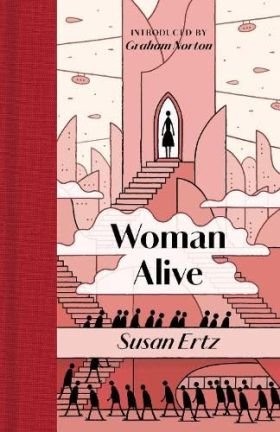
The credits claim the book is illustrated by Tom Gauld, which is slightly misleading because the only illustration is the cover artwork itself. At first, I assumed this might be a graphic novel adaptation. There is also a pleasant introduction by Graham Norton, who proves considerably sharper than his chat show persona might suggest. Credit to Manderley Press for reviving this forgotten work. Hopefully it finds a modern audience. Definitely worth a look and absolutely essential reading for Gloucestershire farmers’ daughters.
Eamonn Murphy
May 2029
(pub: Manderley Press, 2026. 145-page enlarged paperback. Price: £19.99 (UK). ISBN: 978-1-0686613-6-5)
Check out the website: www.manderleypress.com
