
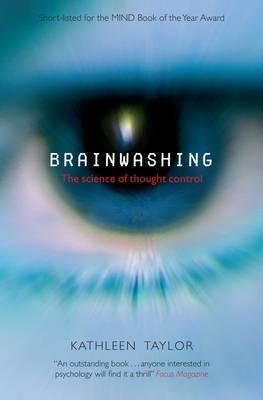
I pulled this book, Brainwashing by Kathleen Taylor, quite a while back and have finally worked it into my reading schedule. As it comes through Oxford University Press, it has the traditional academic look: the main text ends on page 268, followed by a pile of notes, further reading, and a hefty index. Ironically, this kind of format can itself feel like a form of brainwashing, because unless you’re used to it, you might well put the book back on the shelf if you spotted it in a bookshop.
Taylor points out that the term ‘brainwashing’ wasn’t used until 1950, when CIA operative Edward Hunter identified conditioning techniques used on released American POWs by Maoists. The Chinese referred to it as xi-nao (or hsi-nao). In reality, the concept goes much further back, encompassing attempts to persuade people to change their beliefs, sometimes through extreme means. Protestant priests, for instance, were tortured into converting back to Catholicism. Taylor provides several examples and even brings in George Orwell’s 1984, so there’s a clear genre connection.
From the opening chapter, it becomes obvious that brainwashing is essentially conditioning the mind into accepting ideas often diametrically opposed to prior beliefs.
I’m going to pick out a few points from the book in the hope you’ll read it for yourself, as some of it strikes particularly strong chords. As a Type One diabetic, the rapid change in my diet when I was diagnosed has made me somewhat immune to food advertising, largely because it would raise my blood sugar too high and I rather like staying alive. Taylor shows how advertising manipulates choice, even if not always towards a specific product. There’s also the way cold callers can get under your skin by asking about your health simply to get you talking. Whether that’s just exploiting sociability or something more calculated, I’ll leave you to decide. Personally, I tend to reply with something not found in any script they’ve been given.
When it comes to education, we are all malleable to teaching techniques or we wouldn’t learn anything at all. Objectively, malleability is both our greatest strength and our greatest weakness.
The way people can be conditioned without realising it is a form of brainwashing is rather startling, especially when Taylor discusses how behaviour, even criminal intent, can be influenced by factors such as diet. You probably don’t want to dwell too long on the additives in fast food. It might have been harmless enough when such meals were occasional treats, but regularly?
The middle section of the book focuses on how the brain works and how conditioning operates. From a Type One diabetic perspective, I used to refuse offers of food or drink when out, which often caused confusion because it goes against social convention. From my perspective, such offers could be harmful, even if unintentionally. Being free from convention makes it easier to observe behaviour objectively. Historically, offering food or drink has been seen as a sign that you mean no harm. Well… unless you were Claudius’ grandmother, Livia.
When you consider the various sects that still exist, albeit largely beneath media attention these days, they often draw in the curious, who are already halfway towards accepting new beliefs. Taylor explains in the third section how isolating followers from family, friends, and previous interests makes persuasion far easier.
I do wonder if the term ‘brainwashing’ is entirely appropriate. Perhaps ‘brain conditioning’ is more accurate. Like hypnosis, it works best on those who are susceptible, encouraging them to act in ways they already lean towards, rather than forcing them entirely against their nature. If you’re told something will torture you, you’re more likely to agree with your torturer than resist outright. Taylor cites several fictional examples but omits Len Deighton’s The IPCRESS File, both the 1962 novel and the 1965 film, which arguably offers a stronger depiction of conditioning and its effects than A Clockwork Orange.
The final chapter looks at how to avoid being brainwashed. Consider that the next time you feel compelled to buy something you’ve seen on television or social media (other platforms are available). Repetition is what embeds ideas. That, essentially, is conditioning. I have to confess that, after reading this, it isn’t always manufacturers driving this process but advertising companies that know exactly which psychological levers to pull. It explains a great deal about blanket advertising and prime placement strategies. When you consider how television channels price their advertising slots, it’s clear they understand this very well.
From Taylor’s descriptions, I come across as fairly strong-willed, which probably won’t surprise regular readers, largely because I have a habit of questioning everything, or at least the motivation behind it. That doesn’t make me immune, though, as evidenced by the various multi-part encyclopaedias I used to collect, but I do keep a firm grip on my tastes.
The book was first published in 2003, and a lot has changed since then. It would be fascinating to hear Taylor’s thoughts on how much conditioning and brainwashing now occurs through social media, particularly given its addictive qualities, especially among younger users.
This is a book well worth adding to your reading list, as it highlights just how vulnerable we all can be, particularly in modern society. If there’s a criticism, it’s the size of the text. About 8-point, if I’m not mistaken, and when Taylor includes quotations it gets even smaller, so make sure you read it in a good light. Society will always exert some level of conditioning, but this book helps you decide how much of it you’re willing to accept.
GF Willmetts
April 2026
(pub: Oxford University Press, 2004. 324-page, lightly illustrated and indexed small-format paperback. Price: varies. ISBN: 978-0-19-820478-6)




Join the conversation (0)