
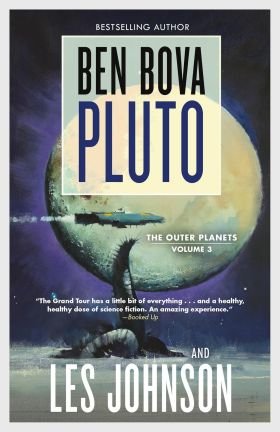
Pluto: 3 (Outer Planets Trilogy) by Ben Bova and Les Johnson (book review).
Ben Bova needs little introduction. He published well over 100 books across various genres and was especially well known for his series, The Grand Tour, of which Pluto is the final volume. Bova received many awards and became editor of Analog Science Fact & Fiction after the death of John W. Campbell. This reviewer has read several of Bova’s books, including parts of The Grand Tour, and has always found them to be an intoxicating blend of plausibly hard-edged SF and convincing human drama. Sadly, Bova himself passed away in 2020 as the mighty COVID-19 struck. Now Les Johnson has used Bova’s work to complete the final part of the series.
Les Johnson has already authored several SF novels. He is also a noted futurist who, in his day job, works at NASA’s Marshall Space Flight Center in Alabama on solar sail propulsion technology. Furthermore, Johnson previously collaborated with Bova on Rescue Mode (2014), so there is already some precedent for this final collaboration.
It quickly becomes obvious that Pluto forms the concluding part of a trilogy about the outermost planets, following Neptune and Uranus. From context, we can gather that humanity has discovered its first evidence of intelligent extrasolar life in those earlier books. The evidence consists solely of long-dead ruins. There are also signs that something wiped out the alien civilisation responsible for them.
As Pluto opens, we are introduced to Dr Aaron Mikelson. Following a devastating accident that crippled his body, this scientist was merged with an AI named Marlene. The only way to save him was a radical procedure that transferred his consciousness into a robotic form. Over time, Mikelson’s personality dominated and effectively annihilated Marlene. Haunted by guilt, he searches his memory banks for traces of her in the hope of reconstructing her personality.
Meanwhile, his rover body is exploring Pluto and has detected an unusual neutrino source emanating from beneath the ice. The science research vessel Tombaugh, whose team includes Mikelson, has repeatedly signalled him to return, but he refuses to acknowledge them. In his cold, calculating arrogance, he has no desire to share the discovery. Instead, he simply continues his research while ignoring the other scientists.
As a result, the research vessel calls in the United States Space Force vessel Aurora and Major Dr Larry Randall. This dynamic fellow is tasked with retrieving the errant scientist. To do so, he pilots a tank-like conveyance with the gloriously cumbersome name Landing Craft, Vehicle and Personnel. Along for the ride are Dr Abigail Grigsby, Mitsui Arashi the avionics engineer, and Bashar al-Salam, the engineering technician. Abigail is from the Tombaugh; the others are with Space Force.
They soon catch up with Mikelson, who explains he has discovered this strange neutrino emission. Abigail quickly agrees it is worth investigating, as the neutrino pattern resembles matter-antimatter annihilation, albeit on a small scale. While Randall does not forget that he was called in because of Mikelson’s intransigence, it is clear the scientist has uncovered something of enormous importance.
Unfortunately, Mikelson’s cold detachment and towering arrogance soon become impossible to ignore. Because his consciousness now inhabits machinery, he no longer requires sleep and thinks roughly three times faster than an ordinary human being. As a result, he tends to regard the human scientists as plodding dolts eager to steal his credit. Naturally, this becomes a major issue as the story progresses.
The neutrino source lies some two kilometres beneath the ice, so the scientists decide to drill down to whatever is producing it. In due course, this leads to even greater discoveries, while Mikelson’s obsessive determination to remain and study events places the Tombaugh and her crew in increasing danger.
None of this would be especially compelling if the characters were not written so humanely. Randall has a loving family back on Earth and becomes deeply conflicted when a mutual attraction develops between him and Abigail. As Randall is seconded to the Tombaugh, he gets to know both the science team and the crew. The captain proves helpful, while most of the scientists are at least cordial, although some are distinctly abrasive.
Mikelson, meanwhile, develops a grudging respect for Randall after they work together on Pluto, which creates friction with the head of the science team, Dr Bridenstein. While Bridenstein is generally helpful to Randall, Mikelson regards her as a fraud who takes credit for the work of others. Suffice it to say, Mikelson is not especially good at making friends.
I have previously noted that many of Bova’s books do not really feature outright villains. Often, characters become antagonistic simply because their goals clash, even when everyone is ultimately striving towards a worthwhile end. Quite frequently, the real threat comes from the hostile environments of the Solar System itself.
Mikelson occupies an intriguing middle ground. He is not evil, merely staggeringly arrogant and borderline sociopathic. His insistence that potentially dangerous situations must be studied at close quarters simply because he himself can survive them, even when ordinary humans might not, creates some genuinely tense moments.
However, while there are many good ideas in Pluto, there are also quite a few unanswered questions. Much like 2001: A Space Odyssey, humanity encounters the tools of alien civilisations while the aliens themselves remain inscrutable. While this approach works as part of a larger series, it does leave the final denouement feeling slightly unsatisfying.
Les Johnson clearly understands Bova’s writing style and does an admirable job of producing a novel that feels, for the most part, like a genuine Bova volume. It is difficult to pinpoint exactly where the differences lie, but there is a subtle distinction somewhere beneath the surface. Perhaps the human drama lacks a little of Bova’s emotional intensity. Perhaps the exploration of the alien artefacts never becomes quite as satisfying as one hopes. Nonetheless, Johnson deserves considerable credit for delivering a facsimile that feels about 95% authentically Bova. No small feat in the literary necromancy department.
Can I recommend this book? Yes, indeed I can, although I would recommend reading some earlier Bova volumes first. This reviewer has also covered Mercury and Titan, both earlier entries in The Grand Tour, and both slightly stronger than Pluto. Start with a pure Bova novel and, if you enjoy what you find there, then make the voyage onwards to Pluto.
Dave Corby
May 2026
(pub: TOR, 2025. 288-page hardback. Price: $32.99 (US), £22.00 (UK). ISBN: 978-1-25029-665-8)
Check out the website: https://torpublishinggroup.com/pluto/?isbn=9781250296658&format=hardback