

‘Inconstant Moon’ is a Larry Niven anthology of eight stories, mostly written in the 1960s. Back in the early 1970s, when this book was first released, I felt Niven’s anthologies were often hit and miss, as though he was still exploring his ideas before settling into his stride. I can’t recall reading this particular volume at the time, although I’ve read most of his other books from this period. Most of the stories here are set within his ‘Known Space’ reality, albeit across different time periods.
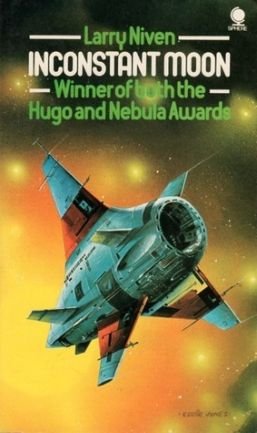
The title story, ‘Inconstant Moon’, has a key problem. A writer and amateur astronomer is up late and notices the Moon glowing unusually brightly. He phones his girlfriend, Leslie, who lives elsewhere, to confirm what he’s seeing. They realise the Sun is undergoing a massive solar flare — not going nova, as suggested on the back cover — and conclude that the end of the world is imminent, deciding to enjoy the remaining couple of hours. Although the exact date isn’t given, the story was written in 1971. Even so, there’s a serious flaw. Light from the Sun takes about eight minutes to reach Earth, as would a solar flare. You wouldn’t have time to wander around town contemplating your fate.
‘How The Heroes Die’ has an interesting premise, with fourteen men on Mars and no women. One of them, Lew Harness, makes a pass at Jack Carter, a judo expert, who retaliates by striking him in the throat, accidentally or otherwise killing him. The others turn on Carter, who escapes in a Mars buggy, smashing out of the dome and forcing the others to carry out emergency repairs. Travelling at 25mph with extra oxygen, Carter flees, pursued by Alf Harness, Lew’s brother, who has less oxygen but relentless determination. The ending isn’t particularly clear as to what ultimately happens. The following story, ‘At The Bottom Of The Hole’, revisits the Mars base, with Garner — a Belter, or asteroid miner — discovering that all the men are dead. Neither story provides a fully satisfying conclusion.
‘One Face’ features a damaged spaceship arriving in the far future, where its crew and 24 passengers must work out how to survive in a Solar System after the Sun has expanded into a red giant and then contracted again. Niven seems to be experimenting here, as characters are identified mainly by first name and profession, which feels a little simplistic, especially given how often people change roles. Even so, it’s one of the stronger stories in the collection.
‘Becalmed In Hell’ follows a two-person crew orbiting Venus and collecting samples. Howie is fully human, while Eric consists only of a brain operating the spacecraft, tethered to a fuel balloon. When the ship’s thrusters fail, they are forced to descend into Venus’s cloud cover and eventually land. It falls to Howie to diagnose the problem, which may be linked to Eric’s own confidence. A clever and engaging story.
The final story, ‘Death By Ecstasy’, features Gil Hamilton, also known as ‘Gil the Arm’. Having lost his arm while working as a Belter, he declines a mechanical replacement and instead develops a telekinetic ‘phantom’ arm with limited strength but slightly extended reach. When he later returns to Earth and receives a regrown organic arm, the telekinetic one remains, giving him his nickname. If that isn’t confusing enough, he also works for ARM — the Amalgamation of Regional Militia — later renamed the United Nations Police. He is called in to investigate the death of a fellow Belter, Owen Jennison, who had become an ‘electric head’ via a droud implant stimulating his brain. Much of the plot would be a spoiler, but it does highlight the kinds of crimes present in this universe. I’m still puzzled why organ theft persists when organic replacements can be regrown.
A number of these stories are written in the first person, so the lead characters’ names are not always given. Overall, I still find the collection somewhat uneven. What likely earned Niven his reputation and awards was the way he developed his ‘Known Space’ setting in later works. None of the stories here feature the alien species he later became known for, suggesting these were written before humanity had spread far enough to encounter them.
‘Inconstant Moon’ is probably one of the lesser-known entries in Niven’s bibliography. If you’re collecting his work, it’s worth noting that copies are still available.
GF Willmetts
April 2026
(pub: Sphere Books, 1974. 200-page paperback. Price and edition: varies. ISBN: 0-7221-6383-5)



Join the conversation (0)