

Hello everyone,
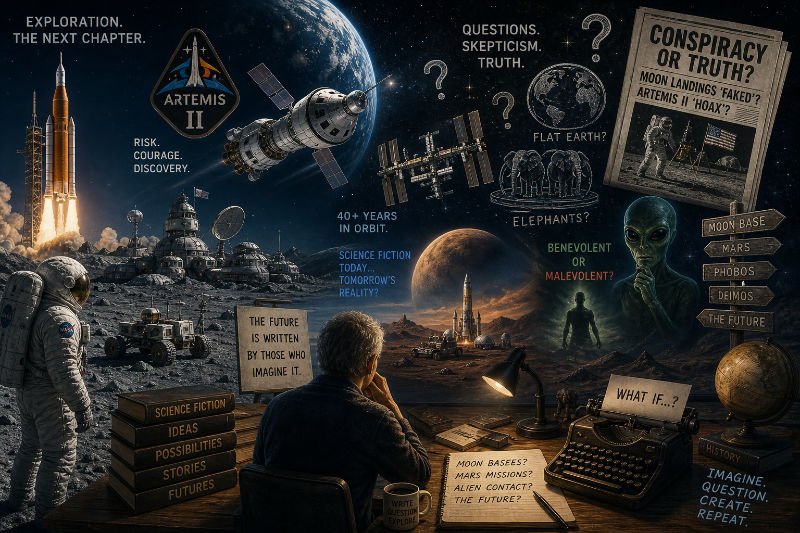
Now here’s a quandary for you. We’ve had people disbelieving that the Apollo missions to the Moon happened. Now it’s happening with the Artemis II mission. If it’s a conspiracy, it must involve a lot of people, not to mention their families, and cost so much to keep them all quiet that it would be cheaper simply to go to the Moon. It’s hardly surprising that some of the same people also believe the Earth is flat. No sign of the elephants supporting it, or why the Earth is exempt while the Moon is round.
Every generation has such sceptical people. Even more remarkable is that they actually believe in the Internet, or they wouldn’t use it. So there are some limits to their scepticism. If satellites transfer Internet signals, then why not take the small extra step and accept that we’ve had manned space stations in orbit for the past 40 years?
If they only believe what they see with their own eyes, then stage magicians must really fool them. The same applies to our genre films. If we could employ real extra-terrestrials for science fiction films, why aren’t they at world premieres or having their life stories ghostwritten and published? I wonder if they have flat planets. Producing counter-arguments isn’t difficult when ‘fake’ evidence is so flimsy.
Who wouldn’t have watched Artemis II take off? Who wouldn’t have their hearts in their mouths hoping for success? Space travel is a dangerous business. Launches and landings are always the hardest parts, and there are still two more missions planned before another Moon landing. I saw all six of the Apollo landings. If it’s proven that the Moon has enough water, how long before a permanent moon base? Compared to a planned trip to Mars, that would be a sinecure. Based on the time it takes to get there, I doubt there would be a round trip without landing. The moons Phobos or Deimos would be the more likely staging points. It’s a lot easier to go down to Mars from there because you can select different landing locations. A lot of planning lies ahead. All fodder for science fiction until it happens. It would certainly revise our thoughts about Mars and any future stories.
In many respects, science fiction reflects the social periods of its time, even when set in the future, each with defining moments. Our ideas about spacecraft changed when mankind ventured into space. No more contained rockets but multi-stage designs. Futures that once looked too white and clean became grungy and polluted. Smaller computers and mobile phones changed every genre. Anything that significantly alters our reality will create changes in fiction. Science fiction is no exception. It has to adapt and look forward, even in the science fiction age we are currently living in. At present, SF feels as though it is stalling, partly because agents steer writers towards more commercially viable fantasy, and partly because few are thinking beyond global warming. It doesn’t need a fictional solution so much as a belief that mankind will survive beyond it.
Of course, predicting future change is a lot harder now. How can we anticipate the future of terrestrial technology, let alone future problems, when everything is changing so rapidly? So we have to consider where mankind is likely to go next. Establishing bases on the Moon and Mars will either prove SF authors right or wrong, but either way, it will change things. Whether it follows familiar patterns remains to be seen. Well, at least until the first crime is committed on an off-world colony.
The same would apply to our first extra-terrestrial contact. Will it follow science fiction templates or be something even stranger, considering all the possibilities we’ve explored so far? There aren’t that many broad outcomes: benevolent or malevolent. There isn’t much in between, except that the latter could exterminate mankind. There would also be interesting questions if they resemble any of the designs used in SF literature, films, or television. We could easily misinterpret their behaviour either way.
The worst-case scenario would be discovering that we are latecomers and that alien civilisations have come and gone long before us. I’ve pointed out before that intelligence may be one of nature’s cul-de-sacs, so it might not have arisen elsewhere. Would they have experienced their own global warming or nuclear war? In either case, I doubt their technology would have survived. We have plenty of examples here of how quickly things decay or how nature reclaims.
If survival is the key issue, then we have to show that we can mature as a species and focus on problems beyond our own immediate concerns. That’s not going particularly well right now. The most we can hope for is that we learn from current events and don’t repeat them. That’s unlikely to happen perfectly, but we can hope.
Going back to the introduction, the real problem is that there are genuine conspiracies out there, but they tend to be revealed eventually and are rarely global in scope, usually confined to particular countries. So focusing on the real rather than the fake saves a lot of energy.
Thank you, take care, good night and why would elephants be so much bigger than their real-world counterparts?
Geoff Willmetts
editor: www.SFCrowsnest.info
A Zen thought: Did you get it?
What Qualities Does A Geek Have: Heavy thinking is a way of life.
The Reveal: Weather deserves to be inconsistent.
Computer Reveal:
I now have a five-day plan when it comes to my laptop. If I think I’ve resolved a problem, I let the computer run for five days in case it recurs. Case in point was what caused my computer to boot up properly. Occam’s Razor kicked in. As I always suspected signal interference and had been blocking cable interference, the one thing I hadn’t considered was the Wi-Fi socket. It’s not something you can shield with plastic, but a direct cable to the router solved it. A completely out-of-the-box solution — and an even bigger surprise that it worked. One side effect was that the connection to the back-up computer was lost, which also needed a cable. Not a major problem; it just meant bringing the router into the living room rather than running two cables back to its original position. If you try this, use a flat white cable so you can see it clearly, watch your footing, and use clips to secure it safely to the wall.
Observation:
I can understand the move to sending passcodes to your phone rather than using passwords, but it assumes everyone has a mobile phone. Maybe I’m missing something, but where was the announcement that this would spread so rapidly?
Feeling Stressed: Deservedly so.
Join the conversation (0)