
The Falling Sky: The Talmont Trilogy book 3 by David Hair (book review).
Can six sexy swordspeople and sorcerers save the Talmont Empire from the apocalypse planned by its founder? That’s the big question in The Falling Sky, book three of The Talmont Trilogy by David Hair.
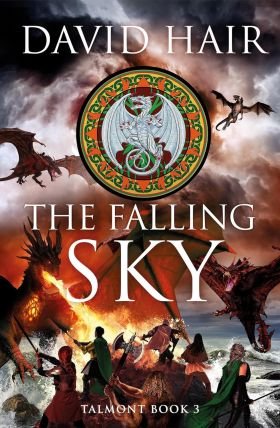
There’s no point in reading the third part of a trilogy, or even a review of it, if you haven’t read the first two. I can recommend The Burning Land and The Drowning Sea, as both are excellent fantasy novels that nicely set up this gripping conclusion.
The setting is the world of Coros, where the Talmont Empire has been ruled by the descendants of Jovan Lux for two centuries. He founded both its political and religious institutions. What’s more, he’s still alive, planning the end of the world and his own second coming. Long ago, he killed most of the benevolent Sanctor Wardens who used to rule and transformed their multifaceted magic system into a violent form of energy known as the glyma.
Wielding the glyma, the Knights of the Vestments of Elysia Divina keep order and crush dissent, powering their weapons with elobyne shards scattered generously across the empire. The Vyr, who also wield magic, oppose the empire, setting fire to crops, villages and towns because only fire can destroy the elobyne shards, which they claim are draining the life from the land and causing severe environmental damage.
Romara Challys and her band of knights, the Falcons, discover that the Vyr might be right and set off on a quest to find the truth. Unfortunately, as with tobacco companies and social media barons, those at the top already know about the harm they are doing and want it kept secret, so Romara and her team become wanted criminals.
After two books and a thousand pages of hair-raising adventures that split them up, the Falcons are reunited in the fortress town of Hyastar. They are besieged by huge armies and the terrifying immortal Serrafim, corrupt winged beings who wield powerful magic and are hard to kill. Jovan Lux himself leads the Serrafim, but their deadliest warrior is Vazi Virago, champion of champions, a troubled woman, Jovan’s new mate and a key player in the drama.
Luckily, all the heroes found true love in book two. Romara loves Gram, Soren loves Elindhu and Jaydn loves Aura. They even have a fair amount of sex. The villains have plenty of sex too, but without any love, which is one way you can tell they’re evil. The Falling Sky is not full of explicit scenes, far from it, but it’s mentioned often enough for the reader to know what’s going on. Did you know that romantasy is now the top-selling fantasy genre?
Mickey-taking aside, I thoroughly enjoyed it. The gallant heroes face overwhelming odds and make speeches that are sometimes downright corny, but corny in a sincere way. They’re not on the side of the angels, because the angels are the baddies here, as is organised religion. The one true faith founded by Jovan Lux, and the holy book he wrote, bears a not inconsiderable resemblance to the dominant religion of the West, and you can tell that David Hair isn’t especially fond of it.
Jovan’s face, ‘long-haired, bearded, serene and gentle’, staring down at worshippers from every cathedral, is a bit of a giveaway. To be fair, his book does promise that, in the last days, fire will rain down from the heavens and the best people will be saved, and he tries to deliver on that promise, although his definition of “the best people” might not tally with yours or mine. I also noticed a rather large hint that the Knights of the Vestments of Elysia Divina are a metaphor for the Knights Templar.
It’s clear that the ordinary people serving Jovan are sincere believers, often doing good as they see it. The Falcons themselves were once devotees of the religion, killing heathens for their god until they learned the truth. It’s the founder and the upper echelons of the institutional church that are rotten, not the lay people.
Some minor complaints, for balance. There are a few glitches in the editing. ‘I can more too’ on page 41 is missing a ‘do’, and a massive stone platform that ‘seemed to floated in the air’ on page 108 should surely ‘float’. David Hair also puts 21st-century values into the mouths of people in a medieval setting. One man’s views are described as ‘outdated, misogynistic, imperialist and usually downright stupid’, according to his female commander. Romara delivers a speech congratulating her team on being ‘inclusive’. It’s all very nice but doesn’t quite fit. You didn’t catch Conan worrying about misogyny and inclusivity. Nor even Elric.
Silly carping aside, it’s a terrific trilogy and I thoroughly recommend it to all readers of epic fantasy. It ticks all the tropes you want and, even when it borders on corny, it’s refreshing to have noble heroes doing the right thing. A bit of idealism doesn’t go amiss in these cynical times when, as the author notes in a short preface, the baddies seem to be in charge of the real world.
Eamonn Murphy
April 2026
(pub: Arcadia, 2026. 496-page hardback. Price: £25.00 (UK). ISBN: 978-1-52943-315-9)
Check out the websites: www.arcadia-books.co.uk/titles/david-hair/the-falling-sky/9781529433159/ and www.davidhairauthors.com