
Ian Watson RIP: another one of the greats gone (author news).
The science fiction world has dimmed a little this week with the passing of Ian Watson, a writer whose work never quite behaved itself, and was all the better for it.
Born in St Albans in 1943, Watson’s early life gave little indication that he would go on to become one of the more intellectually playful and quietly subversive voices in British science fiction. An accounts clerk at a shipping firm is not, traditionally, the larval stage of a speculative fiction career, but Watson soon escaped spreadsheets for scholarship, heading to Balliol College, Oxford, and then out into the wider world to teach in Tanzania and Tokyo. One suspects those years abroad fed the sense, present in much of his work, that reality is negotiable and culture is a kind of shifting story we tell ourselves.
By the mid-1970s, Watson had done what many dream of and few manage: he stepped away from academia and into full-time writing. He didn’t so much dip a toe into science fiction as dive in headfirst, bringing with him an unusual fascination with language, cognition, and the strange machinery of the human mind. His debut novel, The Embedding, went on to win the Prix Apollo, and remains one of those books that makes readers pause mid-page and think, “Hang on, science fiction can do that?”
It was a career marked not by repetition, but by restless curiosity. From The Jonah Kit, which won the BSFA Award, to later works such as The Flies of Memory, Watson’s fiction often explored big ideas without losing its sense of narrative adventure. He could be playful, provocative, occasionally downright odd, but always interesting. In a genre that sometimes leans towards the familiar, Watson preferred to take the scenic route through the unfamiliar.
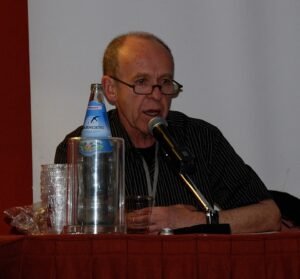
He was also, quietly, a pioneer. In 1980, he and American writer Michael Bishop produced Under Heaven’s Bridge, one of the first transatlantic novel collaborations, hammered out not through email or shared documents, but via typewriters and the post. It’s the sort of detail that feels almost like science fiction now.
Watson’s reach extended beyond novels. He wrote short stories, essays, and even contributed to the screen story of A.I. Artificial Intelligence, that curious blend of Kubrickian thought experiment and Spielbergian emotion. He also left his mark on the sprawling universe of Warhammer 40,000, bringing his distinctive voice to a franchise not always known for philosophical restraint.
Yet for all the breadth of his work, there was something consistently human at its core. Watson’s stories often circled questions of identity, belief, memory, and meaning, not as abstract puzzles, but as lived experiences. Even when dealing with aliens, future technologies, or surreal transformations, there was always a sense that he was really writing about us.
Away from the page, those who knew him speak of a man who matched his fiction: witty, warm, and just a little bit unpredictable. Tributes, including a heartfelt message from fellow writer Mike Allen, have painted a picture of a “roguish, wry spark of joy,” which feels like exactly the sort of phrase Watson himself might have appreciated.
In later years, he made his home in Gijón, Spain, continuing to write and collaborate, including work with Italian surrealist Roberto Quaglia and the Waters of Destiny series with Andy West. Even as the genre evolved around him, Watson remained distinctly himself, never quite fitting into neat categories and never seeming particularly bothered by that fact.
Here at SFcrowsnest magazine, we have always had a soft spot for writers who refuse to colour inside the lines, and Ian Watson was very much one of those. His work invited readers to think a little harder, imagine a little further, and occasionally scratch their heads in the most satisfying way possible.
He leaves behind a remarkable body of work, a family who clearly meant the world to him, and a genre that is richer, stranger, and more thoughtful for his presence.
Ian Watson died on 13 April 2026, just shy of his 83rd birthday. Somewhere, one suspects, he would be amused by the idea that while time may have caught up with him, his ideas are still happily running ahead.