

Alter Ego #196 November 2025 (magazine review).
This issue of ‘Alter Ego’ devotes another 55 pages to Eddy Zeno’s second part, a look at the Superman artists who ghosted for artist Joe Shuster as his eyesight was failing him. The cover points at Wayne Boring and Win Mortimer, but there is a lot more covered inside. Looking at the art samples here has changed my mind about Curt Swan. I initially believed that the odd ribcage design giving Superman a barrel chest was unique to Curt Swan, but many other artists had been using this style long before him. The Wayne Boring cover best displays it. Of course, during that time, there were fewer examples of muscular men to reference, which resulted in barrel chests and disproportionately sized arms and legs. If anything, today’s heroes tend to go in the opposite direction and have muscles where they shouldn’t have any.
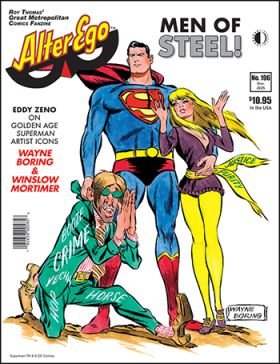
I should point out that this isn’t a whistle-stop tour of the artists, as each gets a lot of page space. One interesting point about Superman is that after appearing on the cover of Action Comics #1, National Periodicals waited for a reaction before putting him again on the cover of #7, which shows, really, that they had no idea what they had.
By far the biggest section is devoted to Wayne Boring, and he was still working way into his 80s for both Marvel and DC Comics, if not on comic books, then selling commissions. He’s learnt how to watercolour, which he said improved his art no end. Seeing the samples of his art here over the years, like a lot of comic book artists, his strength lay in composition. He’s also another artist who didn’t read the entire script sent to him but is doing it panel by panel. This approach places significant trust in the writer to anticipate all the challenges for the artist, but I do wonder how many new comic book artists attempt this method today.
Michael T. Gilbert’s Mr Monster continues his look at the varying logos for the W. Morgan Thomas ‘Mr Mystic’ comic strip. It does show how much a logo can be played with, although you would have to ask what the readers felt back then. If you compared it to Will Eisner’s ‘Spirit’, where he incorporated the logo into the panel, you would expect that in a different contrast. Just doing the logo has a different sort of daring.
Lastly, writer Carl Lani’Keha Shinyama goes up the number of original Captain Marvel appearances in his original run, some 892 times, far more than Superman’s 541 times in the 1950s. To do that with the 1960s characters would be more challenging to count, although this might encourage some of you out there to try. If you choose to do so, it would be beneficial to store the information in a database, allowing you to monitor specific titles and issues over time. Anyway, he also assesses the number of Captain Marvel villains’ appearances, which are obviously a lot fewer, although Dr Shiva had 149. Black Adam only had one appearance! What is more telling is the number of one villain appearances, and Shinyama looks at five of them whom he considered should have appeared again in this issue and the remaining ones next time. As if names like Thor or Spider-Man would ever catch on.
Maybe not the usual mixed bag for this addition of ‘Alter Ego’, but for a learning curve, still a lot to read.
GF Willmetts
March 2026
(pub: TwoMorrows Publishing. 82 page illustrated magazine. Price: $10.95 (US). ISSN: 1932-6890. Direct from them, you can get it for $10.95 (US)).
check out websites: www.TwoMorrows.com and https://twomorrows.com/index.php?main_page=product_info&cPath=98_55&products_id=1832
