

# Back Issue #24 review
This early issue of Back Issue deals with magic-based comic-book characters. Oddly, although there is an excellent interview by Michael Eury with comic-book artist Michael Golden, Golden only ever drew one issue of Doctor Strange and wasn’t particularly keen on drawing superheroes. You would never have thought that from seeing his work on The Micronauts.
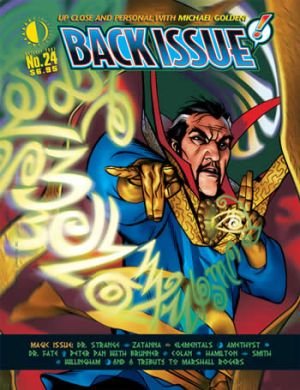
Writer Allan Harvey’s look at Dr Fate and his revival in the 1970s highlights a problem with the character. Like many comic-book fans, my memories of him come largely from the JLA/JSA team-ups. He was a powerful magical character, but without any particularly distinctive way of expressing his abilities. He simply pointed and energy appeared.
Therein lies the problem. Characters can be immensely powerful, but they still need a distinctive way to express their powers. Doctor Strange relies on incantations, many of which the reader comes to recognise. How could Dr Fate compete with that?
I only have vague memories of Amethyst, Princess Of Gemworld, although Jim Kingman fills in some useful details. Mordru, who later became a nemesis of the Legion Of Super-Heroes, was born in one of its realms and appeared in the later series. That alone might have some of you completists hunting down those issues.
Writer Roger Ash looks over comic-book artist Marshall Rogers’ career and his time on Doctor Strange, written by Steve Englehart and inked by Terry Austin, in an attempt to increase the Sorcerer Supreme’s sales figures. Seeing the notes exchanged between Rogers and Austin about returning Strange to the roots of Steve Ditko’s costume design shows just how much it had drifted over the years.
Dan Johnson interviews comic-book artist Frank Brunner about his time on Marvel Premiere and the revival of Doctor Strange’s own title. Brunner liked the bi-monthly schedule because the book remained somewhat under the radar of Marvel’s best-sellers.
Working with writer Steve Englehart, they explored Doctor Strange investigating God and managed to get away with it under Stan Lee by faking a letter from a priest. It’s a classic story, but one well worth reading again.
Johnson also interviews Gene Colan and Paul Smith about their respective periods working on Doctor Strange. There is some discussion of the costume, with Colan admitting that he used a ballet book featuring Mikhail Baryshnikov as reference for some of his poses.
I only have a vague memory of DC Comics’ Silverblade and of reading it, largely because of Gene Colan’s artwork, as writer Tom Stewart gives us the title’s history.
Writer Dewey Cassell looks at Peter Pan And Wendy, written by Andy Mangels with artwork begun by P. Craig Russell, but which failed when its issues never reached print. Again, I have a feeling this article needed somewhere to be published rather than fitting especially neatly into this particular theme.
Writer John Wells looks at the life of Zatanna as developed by writer Gardner Fox, including her rescue of her father, Zatara, although relatively little thought seems to have been given to what should happen with her afterwards.
She gained a fan in Mike Friedrich before he became a professional writer, and he later sought opportunities to use her while working at DC Comics.
Gerry Conway explains one of the problems with having any magically powered character on a team: they can make the group top-heavy because, potentially, they can do almost anything. Don’t forget that magic is also one of Superman’s few weaknesses.
Zatanna’s need to cast spells by speaking words backwards probably gives her an inherent limitation. It looks fine in print, but how often have you actually tried pronouncing those backwards words rather than simply working out what she is saying?
Lastly, writer Brian K. Morris looks at Comico and other companies’ handling of The Elementals, created by Bill Willingham, who eventually left both the book and its second volume. A team of four resurrected people given powers based on the elements are hardly magicians, although they are still essentially a superhero team.
It might look as though I have a downer on this issue, but consider how much I’ve written about it. It certainly made me think about the characters and, particularly, their weaknesses.
Don’t forget that the focus of this issue is mostly on humans with magical abilities rather than stage magicians using sleight of hand, so Mandrake the Magician isn’t included.
You do have to wonder where the Spectre fits into all this, considering that he was the ghost of Jim Corrigan. The same applies to Deadman.
It would also have been nice to see other-dimensional beings such as Dormammu, Umar and Eternity considered, although I suspect you would need an entire issue of Back Issue just to cover Doctor Strange’s enemies.
Other characters, such as Ghost Rider, probably had their own issues devoted to them, although this early in Back Issue’s run there wasn’t much reference to where particular subjects had been covered previously.
However, there is a lot of good artwork here, and who doesn’t want that?
GF Willmetts
August 2026
(pub: TwoMorrows Publishing. 82-page illustrated magazine. Price: $10.95 (US). ISSN: 1932-6904. A digital copy is available directly from the publisher for $4.99 (US).)
Check out websites: www.TwoMorrows.com and TwoMorrows Back Issue #24
Join the conversation (0)