

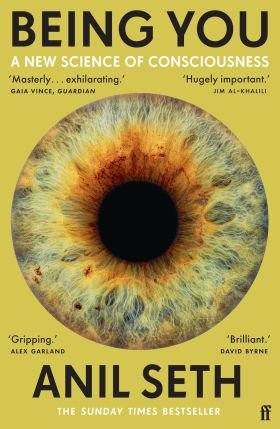
Being You: A New Science Of Consciousness by Anil Seth (book review).
Now this book, ‘Being You: A New Science Of Consciousness’ by Anil Seth, is looking at you. Actually, that’s what makes your conscious mind tick. His initial look at how anaesthetic can remove his mind for a time during medical operations shows how fragile it is.
As a type 1 diabetic, I know the effects of low blood sugar on the brain. People know we diabetics can go into a coma when our blood sugar dips low; what is less well-known is the ‘whiteout’, where the body goes on automatic and the mind is effectively asleep when the blood sugar slowly dips. The first few times I experienced this, I was thankfully revived by my mother feeding me, which left large gaps in my memory; however, I was quite compliant, similar to those who are brainwashed. I also discovered that my autonomic reflexes could kick in to protect me when needed…eventually. Therefore, I must fit a book like this into my reading schedule, even if it doesn’t cover this topic.
As Seth explores what shapes our minds, he also demonstrates how our senses can be misleading. Seth provides examples such as the invisible gorilla, which you can test yourself on YouTube, and demonstrates how we can enhance our perceptions. Loved the horse picture. Distraction demonstrates how we can overlook important details, illustrating that it involves more than just a conjurer’s trick.
Seth also covers experiments that seem to disprove things. A digital watch was rigged to display time quickly in order to observe when its wearer was in a stressful situation, during which time appeared to slow down; however, the wearer perceived it at a ‘normal’ speed, which did not occur. When I was young, I experienced a moment of ‘slow time’ while miscalculating a jump over a wall, which allowed me enough time to prevent it from landing on my neck. I doubt if I would have had time to look at a watch; it just gave me the opportunity to make a decision. In fact, I was operating at the speed of a neural system. I see it as a safety feature, but not everyone has it.
Oddly, his examination of out-of-body experiences in hospitals overlooked the practice of medical staff placing a large sign on top of cupboards to test if the OOB patient could see it from above. Perception without vision is an odd thing because then you have to consider how it’s done at a distance. If it truly worked, a blind person wouldn’t have to rely more on their other senses.
There’s a lot to digest here, but spend your time reading because a lot of this book will make you think. It also addresses philosophical issues related to the relationship between perception and existence. Oddly, Seth never uses ‘I think, therefore I am’.
He examines various mammals to determine if they are self-aware and also considers the importance of being cautious about anthropomorphism and anthropocentrism, which both impose human values on animals. The obvious test of marking an animal and seeing if it can recognise itself in a mirror always depends on it knowing what a mirror is. I would question that, starting with whether it recognises reflection. I mean, how often do animals look at their reflections in water? The normal reaction to a reflection is to see it as a threat to itself first. Seth concentrates on mammals because we all have similar brains. Then he examines octopus intelligence, which is radically different from mammalian intelligence but still demonstrates self-preservation in dangerous situations and a desire to escape, prompting deep reflection.
Lastly, Seth has examined artificial intelligence and cites various film robots and computers, although he overlooked ‘Forbidden Planet’s Robbie the Robot’, who is likely the original AI, predating Marla from ‘Metropolis’. All the film examples he presents illustrate the outcomes rather than the processes that led to those results, which raises the question of why flaws were not identified and addressed earlier. Hopefully, real life will be more cautious. All SF can do is provide warning signs. He acknowledges that we still have a long way to go before we have self-aware AI, underscoring the importance of ethical considerations and safety measures in AI development.
You’ll notice that much of my review often responds to Seth’s writings, which is beneficial because it indicates that he is provoking my thoughts. He does say many beneficial things that you’ll want to compare to your experiences. The fact that we can discuss our consciousness is a demonstration of self and how we are similar in thinking non-vocally. We should compare our similarities and identify the sources of our particular talents, as this will help us understand what makes our brains different from one another, including how our unique experiences and environments shape our cognitive abilities and perspectives. There’s a lot to learn from this book, and if you can question what you believe based on it, then it’s also an important read.
GF Willmetts
March 2026
(pub: Faber, 2022. 358 pages actually 276 pages of text before notes and bibliography lightly illustrated small enlarged paperback. Price: varies. ISBN: 978-0-571-33772-9).
check out website: www.faber.co.uk
