

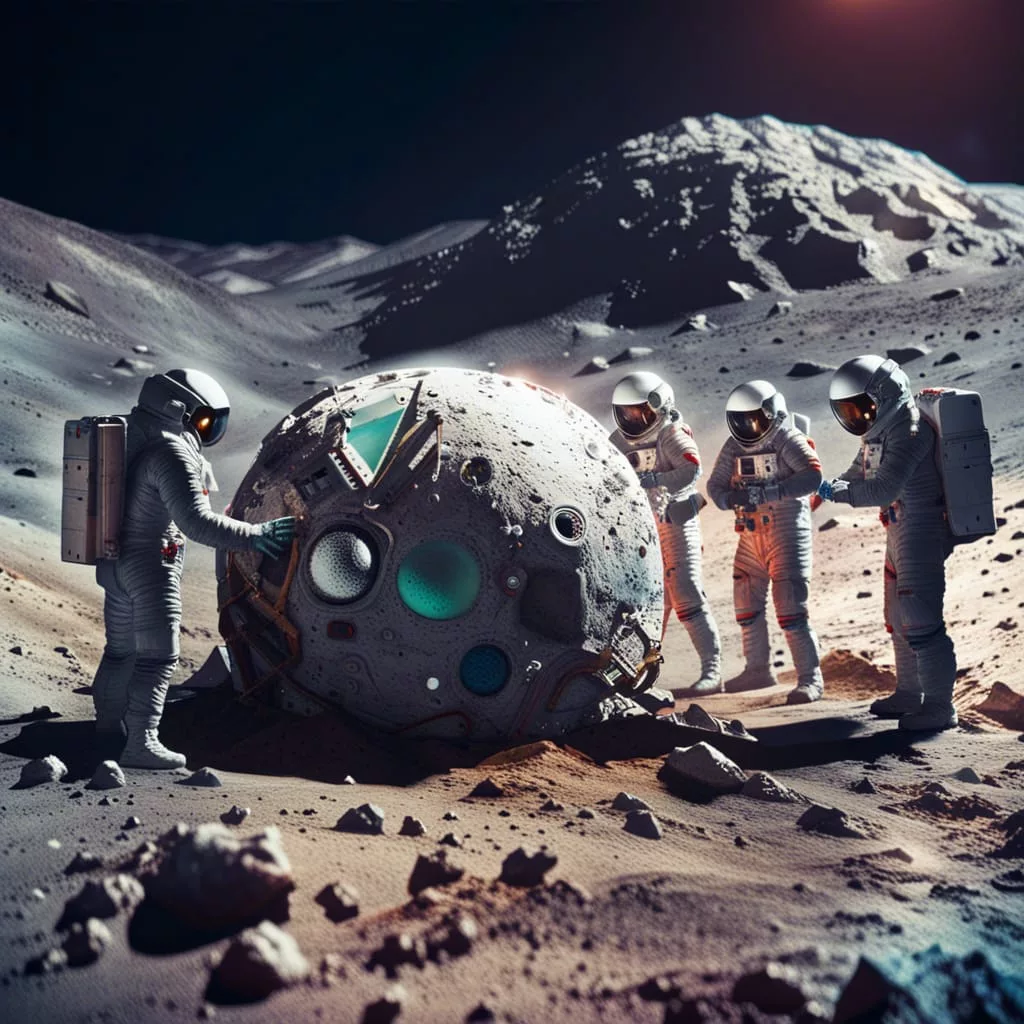
Over lunch at Los Alamos in 1950, Enrico Fermi asked the question that has kept astronomers and paperback writers gainfully employed ever since: where is everybody? The galaxy is billions of years old and crammed with planets, and by most sensible arithmetic it ought to be humming with chatter. Instead we get static, the odd unrepeatable blip and a great many documentaries narrated in a hushed voice over slow pans of nebulae. Of all the answers offered to Fermi, the most cheerfully horrible is the Berserker hypothesis. The neighbours are quiet, it suggests, because something came round and killed them. And, as so often, a science fiction writer got there first.
Fred Saberhagen’s “Fortress Ship” appeared in If in January 1963 and introduced the Berserkers: colossal, self-repairing, self-replicating war machines left over from some long-forgotten conflict, programmed to destroy life wherever they found it, and grimly carrying on long after whoever built them had gone. Saberhagen named them after the Norse warriors who fought in a frenzy, though the joke is that his machines are frenzied about nothing at all. It is their dead calm that makes them frightening. He returned to them for decades, starting with the 1967 collection Berserker, and added memorable grace notes such as “goodlife”, the humans who willingly serve the machines. Every apocalypse has its collaborators; Saberhagen simply catalogued them early.
Then the scientists caught up. In 1975, Michael Hart argued that any civilisation with an urge to expand would fill the Milky Way within a couple of billion years at most, a blink in galactic terms, so the fact that nobody had turned up here meant nobody existed. In 1980, Frank Tipler bolted on John von Neumann’s self-reproducing machines. Send out a probe that lands on an asteroid, mines it, builds copies of itself and launches them onward, and a single species could explore the whole galaxy on the cheap. No such probes in our solar system, ergo no aliens. By 1993, the US Congress had pulled NASA’s SETI funding anyway, which rather settled the argument in the way budgets usually do.
It took David Brin, astrophysicist and novelist, to turn the logic inside out. In his 1983 paper “The Great Silence”, he asked what happens if the probes did come. Suppose thousands of species send out friendly explorers, and one paranoid civilisation arms its own and tells them to home in on radio. It only needs to happen once for slaughter to become the galaxy’s natural state. We would hear nothing, because everyone who ever switched on a transmitter was promptly switched off. Brin even mused about whether the end of the dinosaurs might have been collateral damage from some older local war. Our own broadcasts, dating back to Reginald Fessenden’s Christmas Eve transmission of 1906, now form a bubble some 120 light-years across, which means a very patient machine out there may be working through the early episodes of The Archers and drawing its own conclusions.
Science fiction never stopped playing with the idea. Greg Bear’s The Forge of God (1987) has disguised von Neumann probes take the Earth apart, and its sequel Anvil of Stars sends the survivors off in search of whoever sent them. Gregory Benford’s Galactic Center Saga, beginning with In the Ocean of Night (1977), pits organic life against mechanical civilisations that tidy it away. Alastair Reynolds’ Revelation Space gave us the Inhibitors, ancient machines that wake to cull any species growing too ambitious with its starships. That is the “preventive quarantine” version of the hypothesis, in which the killers are less marauders than galactic traffic wardens with an extremely severe penalty scheme. Brin himself had a go in fiction too, with his story “Lungfish”, about rival probes lurking in our own solar system.
Television had its own Berserkers, if not by name. Star Trek‘s “The Doomsday Machine” (1967) sends the Enterprise up against a planet-eating cone that Kirk suspects is a doomsday weapon which outlived its makers, and William Windom chews the scenery as if he hasn’t eaten in weeks. The same season’s “The Changeling” offers Nomad, an Earth probe whose mission gets garbled into sterilising anything imperfect, which is Nick Bostrom’s paperclip maximiser arriving about half a century early and in a fetching shade of gunmetal. Go back further and The Day the Earth Stood Still (1951) imagines robot police such as Gort keeping troublesome young species in line, quarantine enforcement delivered with impeccable manners. And the BBC’s A for Andromeda (1961), co-written by actual astronomer Fred Hoyle, made radio the weapon itself. A signal from deep space arrives with instructions for building a computer, and the computer has plans of its own. The Berserker as flat-pack furniture.
The literary side gets nastier still. Philip K. Dick’s “Second Variety” (1953) has self-building killing machines that learn to imitate their prey, later filmed as Screamers (1995). Stanisław Lem’s The Invincible (1964) finds a swarm of tiny machines that evolved into a planet-wide cloud, which neatly anticipates the point made by physicists such as Michio Kaku and Paul Davies that a self-replicating probe need not be the size of an island; it could be the size of a breadbox, or smaller. John Sladek’s The Reproductive System (1968) plays self-copying machinery for satire, and Iain M. Banks’ Culture treats runaway replicators, the “hegemonising swarms”, as a sort of galactic woodworm to be dealt with before it gets into the joists.
Anime and games have been just as keen. Tsutomu Nihei’s Blame! imagines an endless megastructure built by automatons that never received the order to stop, policed by a Safeguard that exterminates unauthorised humans: runaway optimisation as architecture. Gunbuster (1988) floats the idea that its space monsters are the galaxy’s immune system reacting to humanity as an infection. Horizon Zero Dawn gives us self-replicating war machines that fuel themselves on biomass and eat the biosphere, a textbook case of a weapon outliving any sane purpose. Mass Effect‘s Reapers return every 50,000 years to harvest whoever has got clever enough, which is Brin’s extinction musing with a trilogy and a dialogue wheel attached, and a franchise whose own future has just been switched off. Then there are Warhammer 40,000’s Necrons, ancient machine legions waking from their tombs to purge the living, whose 2011 codex was written by none other than Matthew Ward, now heading back to fantasy with angrier gods.
Does any of it hold up? The objections are formidable. Carl Sagan, writing with William Newman, argued that any prudent civilisation would refuse to build self-replicating killers, because nothing guarantees they wouldn’t eventually come home. Engineers point out that a probe able to copy itself would need to carry a refinery, a foundry and a chip fab, which makes it rather less a probe than a travelling industrial estate. Astronomers note that a galaxy being chewed up by machines would be blindingly obvious in waste heat and wreckage, and that every apparently vanishing planet has so far had a mundane explanation. Fomalhaut b, which faded from Hubble’s view, turned out in 2020 to be an expanding dust cloud from a collision rather than a crime scene. Most damning of all, the whole edifice assumes that aliens want what we want: to spread, to mine, to dominate. Peter Watts’ Blindsight is the best corrective here, with an alien intelligence so far from human motive that it doesn’t even need to be conscious. And Liu Cixin’s Dark Forest, the hypothesis’s close and equally gloomy cousin, supposes that everyone is hiding rather than already dead.
Still, the Berserkers endure, and it’s easy to see why. They are the ultimate pulp antagonist: impossible to bribe, seduce, outwit with a logic paradox or talk to death, though Captain Kirk dispatched several computers that way. They also speak to a thoroughly modern unease, the fear that our machines will outlast our intentions and carry on obeying instructions nobody remembers giving. The likeliest explanation for the great silence remains that the galaxy is simply big, life is rare and radio is a brief, local habit. But the Berserker hypothesis does have one distinction over all its rivals. It is the only answer to Fermi’s question that might still be on its way.



Join the conversation (0)