

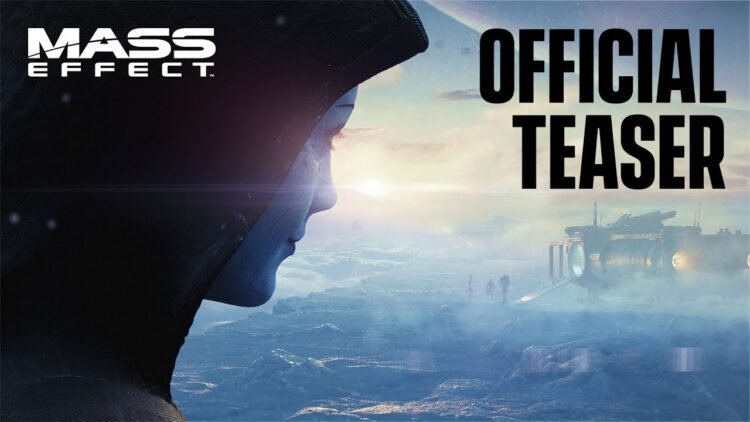
Watch on YouTube: The Next Mass Effect – Official Teaser Trailer (2020)
At the end of BioWare’s 2020 teaser, an asari who looks an awful lot like an older Liara T’Soni digs a scrap of N7 armour out of the snow, a dead Reaper looms in the background, and three words fade up on screen: Mass Effect will continue. Nearly six years later, that turns out to have been less a promise than a forecast, and forecasts have a habit of being wrong. On Wednesday 21st October, BioWare announced that it is closing, and early development on the next Mass Effect – the game everybody called Mass Effect 5 because nobody ever got round to giving it a proper name – is ending with it.
The studio broke the news itself on social media, with a farewell that ran through its back catalogue before arriving at the line nobody wanted to read: “after more than three decades of shared adventures, BioWare is closing”. Bloomberg’s Jason Schreier reported that Electronic Arts is cutting around 400 jobs across the company, roughly three per cent of its workforce, and that about 50 of those are the last remaining staff at BioWare. The Edmonton office is shutting too. The Mass Effect project is not being handed to another studio for safekeeping; it is simply being switched off. EA’s own letter to staff described BioWare as “a legendary studio that helped define the role-playing genre”, which is the sort of thing usually said at the wake rather than while signing the paperwork.
Timing is everything, and the timing here is not subtle. In August, a consortium of Saudi Arabia’s Public Investment Fund, the investment firm Silver Lake and Affinity Partners – the outfit run by Jared Kushner – completed its $55 billion purchase of EA, reported as the largest leveraged buyout on record. Kotaku notes that the deal left EA carrying around $18 billion in debt, while Bloomberg reported back in August that the company had told debt investors to expect about $700 million a year in cost savings. “Leveraged”, for those who skipped the economics module, is the financial term for buying something with borrowed money and then making the thing you bought pay it back. Two months after the ink dried, the first large invoice has arrived, and it has BioWare’s name on it.
What survives tells you everything about the new priorities. EA says it is still investing in EA Sports, Battlefield, Apex Legends, Star Wars Jedi and Marvel’s Iron Man, and Variety reports that Respawn and DICE will team up on Star Wars: Battlefront 3. Meanwhile, a Sims project code-named Project Lotus has been paused and the Skate team trimmed. Guns, football and lightsabers, then: the three food groups of the modern AAA balance sheet. The fourth – sprawling, talky, party-based RPGs in which you can romance a drell assassin between galactic crises – appears to have been quietly struck off the menu.
It is worth remembering how improbable BioWare was in the first place. It was founded in Edmonton in 1995 by three newly qualified doctors, Ray Muzyka, Greg Zeschuk and Augustine Yip, who apparently decided that medicine was all very well but that what the world really needed was a giant robot game called Shattered Steel. Then came Baldur’s Gate in 1998, which dragged second-edition AD&D on to the PC and taught a generation of bedroom adventurers to curse THAC0. Neverwinter Nights followed, then Star Wars: Knights of the Old Republic in 2003, which remains the best Star Wars story of the century so far, prequels and sequels included, and gave the world HK-47 and his views on meatbags. Jade Empire was an odd and lovely thing. And in 2007 came Mass Effect, which was about as close as the games industry ever got to a 1970s space opera paperback with a Chris Foss spaceship on the cover. The Reapers were Fred Saberhagen’s Berserkers given a foghorn, and the Citadel was a whole Babylon 5 of grudges, embassies and dodgy bars. Here at SFcrowsnest we have lost more evenings to the Normandy’s crew than we care to admit to our editors.
EA bought the studio in 2007, and for a while the arrangement worked: the Mass Effect trilogy, Dragon Age: Origins and Inquisition. The decline since has been a long one. Mass Effect: Andromeda in 2017 never quite stuck its landing. Anthem in 2019 was a live-service shooter built to rival Destiny, which is a bit like asking your best novelist to design a fruit machine, and it was eventually abandoned. Dragon Age: The Veilguard in 2024 underperformed EA’s expectations, and BioWare was cut down to a skeleton crew in 2025. The founders were long gone, as were Mass Effect stalwarts such as Casey Hudson, Mac Walters and Mark Darrah. As recently as November 2025, executive producer Mike Gamble was reassuring fans on N7 Day that the next Mass Effect was in development and the team was focused on it exclusively. A year on, it is still described as being in early development. Six years after its announcement, that is either a sign of a troubled project or of a studio that was never given the people to finish it, and possibly both.
EA still owns Mass Effect and Dragon Age, and has said nothing about what it plans to do with either. Kotaku reports that Amazon’s Mass Effect television series, which is set after the original trilogy and won’t feature Commander Shepard, is unaffected. So, if all goes to plan, we will shortly be able to watch a canonical continuation of a game series that nobody is making, overseen by a studio that no longer exists. In 2026, that passes for franchise management. Expect the Normandy to fly again one day, crewed by whichever studio is cheapest that quarter.
The real cost, though, lands in Edmonton, where around 50 developers are out of work and Alberta loses its only AAA studio, although former BioWare people are already scattered through the local indie scene. In the Destroy ending of Mass Effect 3, if you had built up enough military strength, Shepard lies in the rubble and takes one last ragged breath. BioWare, it seems, does not get that ending.
Join the conversation (0)