

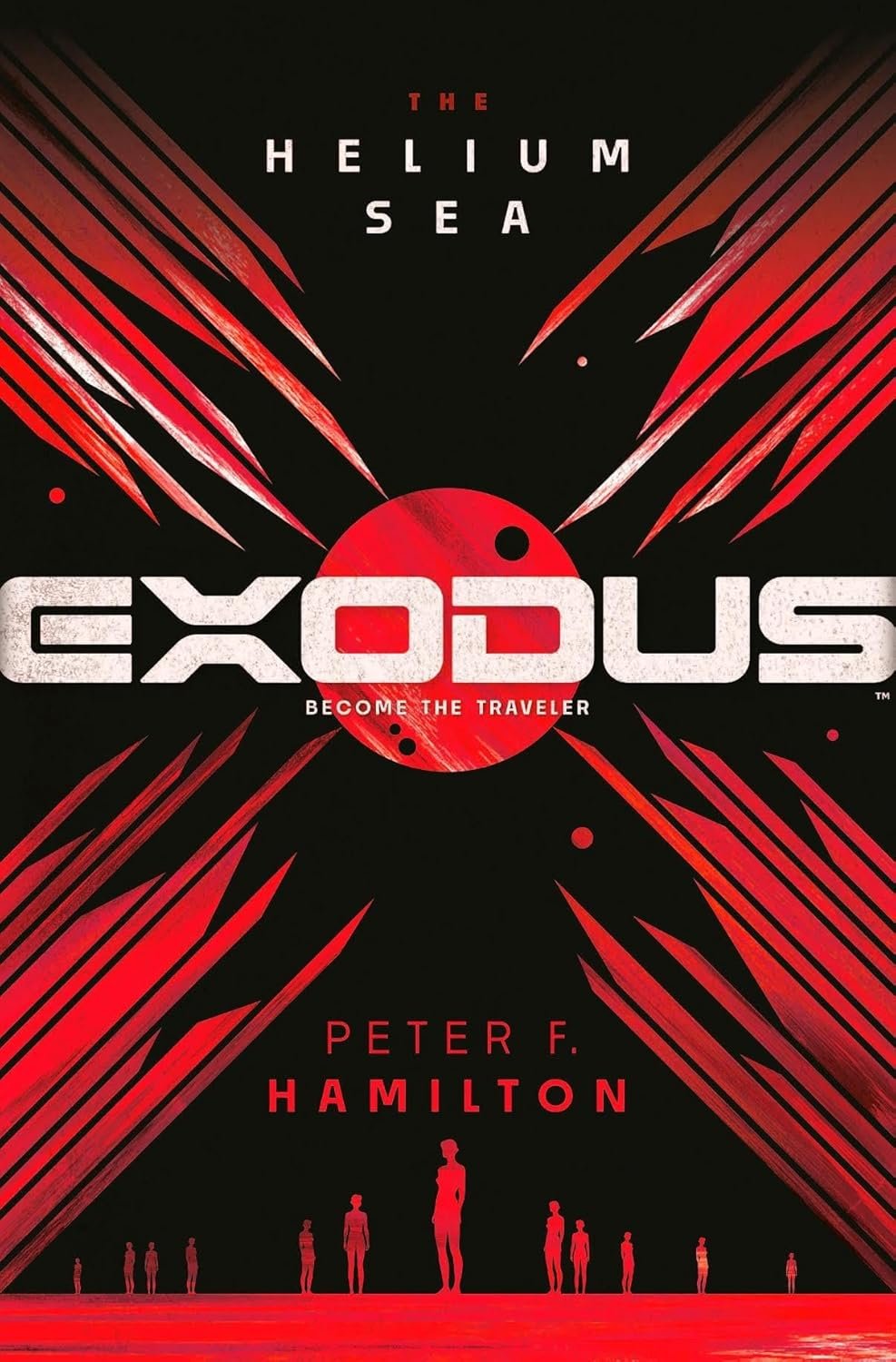
Exodus: The Helium Sea by Peter F. Hamilton (book review).
# Exodus: The Helium Sea review
Peter F. Hamilton is well known as a crafter of sprawling space opera, and he has produced quite a number of them. Probably his best-known works are the Night’s Dawn trilogy, averaging around 1,100 pages per volume, and anyone who has read them will know exactly what I mean.
In the previous and first volume, Exodus: Become The Traveller, Hamilton introduces us to the Centauri Cluster, some 16,000 light years from Earth and colonised around 18,000 AD. The earliest settlers found habitable worlds, established the Green Worlds signal to attract other arkships and began creating a new civilisation.
Various other arkships gradually arrived over the next 20,000 years. However, the earlier colonists used genetic engineering and advanced technology to diverge from baseline humanity, in some cases producing truly transcendent examples.
By 30,000 AD, a particularly advanced form of humanity called the Elohim had created technology capable of moving planets and establishing numerous habitable systems, as well as building a series of interstellar gates between them known as the Gates of Heaven.
At some point during the following 5,000 years, five powerful families of celestial humans set out to form their own advanced cultures under the guidance of five immortal queens.
By 42,350 AD, the arkship Diligent arrives carrying natural humans and their inspirational leader, Josias Matthew Aponi, the man who has walked on Old Earth. By the end of Become The Traveller, the humans have been conned into taking the blame for the villains’ plot. One queen, Thyra-Helena, has now taken control from the others and rules the whole Centauri Cluster.
At the start of the second book, Exodus: The Helium Sea, we have to pick up several strands from the first volume. Notably, there is Finbar Jalgori-Tobu, owner of the arkship Diligent, who is reeling from having been mentally compelled by one of the evil queen’s generals.
That general, Gyvoy, compelled Finbar to use an Archimedes engine to destroy the inhabited world of Kelowan. We also pick up the story of Terence Wilson-Fisher, a human detective who has the implanted personality of a major celestial in the back of his mind, giving him an astonishing level of knowledge and competence.
However, the book actually opens with a flashback to the downfall of the fantastically cruel Queen Zuberi-Dulcina on Kelowan some 7,000 years before the ‘present’. It seems Zuberi has decided to subjugate all the other queens using compulsion technology so she can ‘evolve’ humanity to the point where it can surpass the Elohim.
We meet Countess Liliana, Zuberi’s daughter and chief scientist for their mad genetic enhancements, and Dagon, Zuberi’s son, Liliana’s brother and their rather bloodthirsty general. This flashback reveals that, contrary to accepted belief, not all of Zuberi’s family perished when the other queens wiped out her line. Naturally, we can expect them to reappear later in the volume.
So, will the baseline humans be able to reveal the truth, clear their own reputation and foil the villains’ plans?
Although this book certainly has its labyrinthine plots, it is generally more straightforward than the first volume. Most of the time, the humans are on the run, trying to avoid battle fleets and technological spies for long enough to discover the truth. Along the way, they gradually work out the villains’ motivations and plans, often managing to beat them to the punch.
After a while, Thyra-Helena’s efforts to take over the entire cluster become fairly obvious to the remaining queens. They, in turn, begin to suspect that the baseline humans have been used as convenient scapegoats by the villains, and at this point the plot opens out a little.
Josias Aponi has a plan to negotiate with Thyra, having stolen the various weapons the villains were attempting to secure. Meanwhile, Terence Fisher starts to gain influence with the other queens. At this point, however, the resolution begins to become somewhat murkier.
This reviewer has never actually read a Hamilton novel he did not enjoy. That does not mean, however, that some are not better than others. Indeed, I know of no author who would not admit that some of their books are weaker than the rest.
As such, I do have one criticism of this book, and it is a slightly unusual one.
Hamilton has done a great job of making the villains truly detestable. Without giving away too much, the good guys eventually triumph, but only after a fair amount of anguish and hardship at the villains’ hands.
So when the villains finally meet their fate, why does it always seem to happen off-camera?
The good guys use a fair amount of ingenuity in engineering the villains’ downfall, but we don’t get to see the looks of disbelief on their faces or the moment when they realise that, after all this time, they have finally lost at the hands of mere humans.
I therefore found the climax of the book slightly, well, anti-climactic.
At the end of the day, do I recommend this book? The answer is a qualified yes. However, it will make far more sense if you start with the first volume. This is a direct sequel to Become The Traveller, and both books are complex, with large casts of characters.
It is also possible that some readers might not regard such an enormous book as a sensible undertaking. I suspect that if you are that kind of person, one glance at the physical dimensions will already tell you to steer clear.
Taken together, though, I am happy to report that Hamilton has delivered another solid and entertaining space opera. This is seriously good stuff: great characters, a terrific story, a future that feels ‘right’ and a talent for making technology easy to understand even when it is fantastical and essential to the plot.
Hamilton remains a mighty colossus standing astride literary SF.
Dave Corby
August 2026
(pub: Tor UK, 2026. 752-page hardback. Price: £25.00 (UK). ISBN: 978-1-52907-378-2)
Check out website: www.panmacmillan.com/authors/peter-f-hamilton/exodus-the-helium-sea/9781529073782


