Here is that old favourite M.R. James adapted into graphic novel form by writers Leah Moore and John Reppion and a variety of artists. ‘Ghost Stories Of An Antiquary: The Compendium’ combines two earlier volumes that were released in 2016 and 2017. Volume 1 has an introduction by very famous British horror writer Ramsey Campbell and Volume 2 has one by not-so-famous British horror writer Jason Arnopp, both of whom say nice things about the works herein.
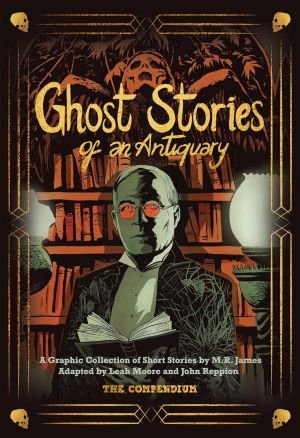
I have read some James and watched adaptations on the telly, usually over the Christmas season, so I’m vaguely familiar with his work. Plan A for this review was to read the relevant short story first and then look at the adaptation for comparison. I did this with ‘Canon Alberic’s Scrap-Book’ and found the graphic story faithful to the original, so I skipped to plan B: just read the stories here. I’m not sure that fans of M.R. James want or need a graphic novel version and the idea is, surely, to bring these classics to new readers.
In ‘Canon Alberic’s Scrap-Book’, illustrated by Aneke, an Englishman called Dennistoun goes to the cathedral at Saint-Bertrand de Comminges to study the church. The Sacristan shows him around and seems nervous and rather spooked by the place. Later, the fellow shows the Englishman a scrapbook that belonged to a former Canon of the cathedral and to say more would spoil the plot. As far as I can tell, the dialogue and captions are taken word for word from the original story, albeit cut to fit. The art and storytelling are clear enough, but they could have done more to show the beauty of the church interiors. Backgrounds are only vaguely rendered.
‘Lost Hearts’ is next. As with all the stories, the captions are in script and the word balloons are in block capitals. Mister Abney of Aswarby Hall, Lincolnshire, is such a nice old chap that he takes in his orphaned cousin, Stephen Elliott, aged eleven. Abney is very interested in his age. The housekeeper, Mrs Bunch, tells Stephen that Mister Abney has taken in waifs before, two of them, but the ingrates disappeared without a trace. The art by Kit Buss is stiff and cartoonish with large spaces between panels but the facial expressions convey emotions well.
Mr. Williams is working to enlarge a vast collection of English topographical drawings and engravings at Cambridge. A dealer sends him a mezzotint, 15 x 10 inches, of an unknown country house. The torn label only shows the ends of two words: ‘ngley Hall’ and ‘ssex’ which is presumably somewhere in Essex or Sussex. Working past midnight, Williams notices a strange figure has appeared on the drawing. It wasn’t there before! I like Fouad Mezher’s art in ‘The Mezzotint.’ It’s square and formal and tight, a bit like the ‘TinTin’ comics or ‘Blake And Mortimer’ and suits the stuffy college atmosphere of the story. Search ‘mezzotint’ to find out what it is. I had to.
Is it nominative determinism that ‘The Ash Tree’ has art by Alisdair Wood. This is a more conventional illustration style, almost Victorian, with fine, detailed ink lines. He draws trees beautifully. The setting is another country house, Castringham Hall in Suffolk. A great old ash tree near the house was already fully grown in 1690, when the district had several witch trials. Sir Matthew Fell, the occupant back then, gave evidence against a local ‘witch’ named Mrs Mothersole and, even though some local farmers attested to her good character, she was hanged. Not a good idea, as it turned out.
After Jason Arnopp’s introduction, Part Two features four more adapted supernatural stories, beginning with ‘Number 13’, illustrated by George Kambadais. His technique of brown colours and square panels resembles Fouad Mezher’s work on ‘The Mezzotint’ and again suits the material. A narrator tells of his cousin, Mr. Anderson, whose research into the church history of Denmark took him to the Golden Lion Hotel in Viborg, Jutland. He chose room 12 because it was spacious and noticed that although room 13 was not listed on the blackboard in reception, it was right there, next door to him. Except when it wasn’t. A low-key tale with no terrible ending.
Another narrator, for M.R. James liked a certain cool distance in his stories, tells how he constructed the tale of ‘Count Magnus’ from the papers of one Mr. Wraxall, who was making notes for a travel guide to Sweden in 1868. He investigates an ancient manor house in Vestergothland where Count Magnus once put down a peasant revolt with severe punishments. It’s best not to disturb the Count in his sarcophagus. Not the most gripping of James’ works but the loose and sketchy art style by Abigail Larson worked okay for it.
‘Oh, Whistle And I’ll Come To You, My Lad’ has art by Al Davison. Professor Parkins doesn’t believe in anything supernatural but odd things occur when he finds a whistle in the ruins of a Templar Preceptory at Burnstow, on the east coast of England. Good use of colour here to differentiate the spooky scenes from the everyday occurrences.
Meghan Hetrick also uses bright colours in ‘The Treasure Of Abbott Thomas’, apt for the stained glass window theme of the story. Mister Somerton decodes the hidden messages in three stained glass windows to find hidden treasure but the Abbott put something to guard it. Mister Gregory, a Rector, comes to his aid.
What splendid days they were, when every gentleman was known as Mister and only his closest friends used his first name! We should go back to that. In the meantime, both ladies and gentlemen might enjoy these digestible versions of classic English ghost stories.
Mr. Murphy
November 2026
(pub: SelfMadeHero, 2026. 144 page hardback. Price: £22.99 (UK). ISBN: 978-1-91422-441-6)
check out website: www.selfmadehero.com/books/ghost-stories-of-an-antiquary-the-compendium


Join the conversation (0)