

Journey to the Far Side of the Sun: classic scifi film (retrospective).
There are films that stride confidently into cinema history in polished boots, puffed up with their own importance, and then there are films like Journey To The Far Side Of The Sun, which sort of drift in sideways wearing a sharp suit, carrying a magnificent miniature spaceship, and looking faintly bewildered that nobody quite knew what to do with it.
Released in 1969 under the much moodier original title Doppelgänger, this was Gerry and Sylvia Anderson’s attempt to slip the puppet strings, leave Lady Penelope parked in the garage for a weekend, and prove that Century 21 could do serious, adult, live-action science fiction. Not just rockets and gadgets for the kiddies, mind you, but proper grown-up fare. Men smoking themselves into an early grave, marriages curdling quietly in expensive futuristic villas, espionage, adultery, infertility, and a sense of cosmic unease thick enough to spread on toast. In other words, the Andersons did not come to play. They came to announce that they, too, could be existential in tasteful modernist décor.
And the premise is still a cracker. A newly discovered planet is found on the far side of the Sun, tucked exactly opposite Earth in the same orbit, which is the sort of scientific notion that today would be laughed out of the room by anyone with a telescope and a basic grounding in celestial mechanics. Back then, though, it had just enough speculative swagger to get away with it. A joint European-NASA mission blasts off to investigate, only for disaster to follow and one of the astronauts to realise that the mysterious world is not merely Earth-like. It is Earth, but backwards. A mirrored Counter-Earth, with mirrored people, mirrored writing, mirrored bodies, mirrored technology, and presumably mirrored bureaucratic incompetence.
That idea remains wonderfully unnerving. There is something deeply creepy about discovering that the universe has copied your homework, but changed just enough details to make you feel seasick. Journey To The Far Side Of the Sun takes that shiver and wraps it in a very late-1960s package of sleek control rooms, elegant miniatures, and men in expensive suits explaining things to one another with immense seriousness.
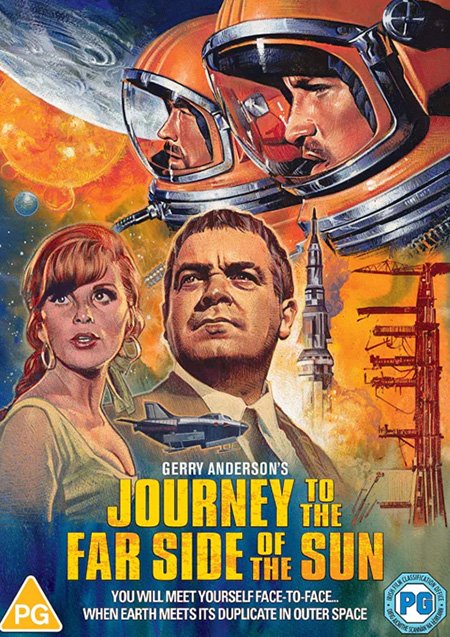
Roy Thinnes leads the film as Colonel Glenn Ross, the NASA astronaut who ends up stuck in this reflected reality, and he gives exactly the sort of performance the film needs. Clean-cut, capable, a bit brittle, a bit haunted, and smoking with the grim determination of a man who has personally vowed to keep the tobacco industry solvent. Opposite him, Ian Hendry plays Dr John Kane, the British scientist on the mission, bringing a gloriously frayed energy to proceedings. Patrick Wymark, meanwhile, stalks off with much of the film as EUROSEC chief Jason Webb, all barking authority and bruised ego, like a man who’s been informed the fate of humanity depends on a finance meeting.
And that, really, is one of the film’s secret charms. For all its cosmic strangeness, it remains deeply, almost aggressively British. Even the future is run through committees. Even the voyage to a duplicate Earth feels like it could still be derailed by paperwork, budget rows, and a man in a dark tie wondering whether the figures quite add up. There is something marvellously un-Hollywood about the whole enterprise. This is not a vision of the future where humanity has transcended petty bureaucracy. This is a vision in which humanity has taken petty bureaucracy into orbit and given it a nicer desk.
Visually, though, the film is often gorgeous. Derek Meddings’ effects work is the real star of the show, as it so often was with Anderson productions. The Phoenix spacecraft and its Dove lander are beautiful bits of design, practical and elegant and just stylised enough to feel futuristic without lapsing into total nonsense. The launch sequences still have an old-school grandeur to them, the sort of lovingly crafted miniature work that makes modern CGI sometimes look like a rushed office memo. There is weight here. There is texture. There is that delicious analogue tang of real models filmed by people who knew how to make impossible things feel solid.
Barry Gray’s score deserves a bow too. It is lush, eerie, stately and occasionally far more emotional than the dialogue around it. At points the music feels as though it has wandered in from a better, stranger, more haunting version of the film, one taking place just over the horizon from the one we are actually watching. It gives Journey To The Far Side Of The Sun much of its atmosphere, and atmosphere is something the film has in abundance. It drips with it. You could wring it out into a bucket.
What it does not always have is pace. Or, to be more charitable, it has the pace of a dignified man trying not to run for a bus. The film takes its time. Then it takes some more. Then it sits down for a cigarette and thinks about whether it ought to continue taking time. One of the great frustrations of Journey To The Far Side Of The Sun is that its central revelation is a corker, but it arrives after a long trudge through mission briefings, technical chat, and enough exposition to stun a horse. When Glenn Ross finally starts noticing that everything around him is backwards, the audience is liable to be a good twenty minutes ahead of him, drumming their fingers and muttering, “Yes, yes, the perfume bottle label is mirrored, do keep up.”
And yet even that ponderousness has become part of the film’s peculiar charm. This is not a modern science fiction thriller, darting about with caffeinated urgency and a soundtrack made of industrial banging. This is a film from an era when science fiction still believed it was doing important cultural work if it made people stare at control panels for a bit. It wants to be intelligent. It wants to be serious. It wants, rather desperately, to sit at the grown-ups’ table with 2001: A Space Odyssey. You can feel it straining towards profundity, sometimes so hard you fear it may pull a ligament.
The comparisons with Kubrick are inevitable, and not entirely flattering. 2001 had come out the year before and had already rearranged the furniture in everyone’s head. Against that, Journey To The Far Side Of The Sun can look a little like a talented cousin trying on the same suit and finding the sleeves too long. It has the cool design, the enigmatic imagery, the big abstract ideas, even the faintly cryptic ending. But where Kubrick had cosmic awe and terrifying evolutionary grandeur, the Andersons and Robert Parrish produced something more paper-thin and oddly melancholy. Not trivial, exactly, but smaller. Stranger. Less profound than it thinks it is, but perhaps more human for that.
The final act is especially bleak, and in a way that feels rather brave for what was, after all, made by the people best known for puppet rescues and dashing action. Ross’s attempt to return home ends in catastrophe, records are obliterated, and the truth is swallowed by wreckage and institutional collapse. Then, years later, we find Jason Webb reduced to an old man in a wheelchair, rolling towards a mirror in one last doomed gesture towards the impossible. It is the kind of ending that practically dares the audience to go home cheerful. One suspects Gerry Anderson, having been told for years that he made entertainment for children, was determined to leave nobody under the age of 40 in a remotely buoyant mood.
Behind the scenes, the production was nearly as dramatic as the film. The Andersons clashed with director Robert Parrish. There were arguments over tone, over shots, over nudity, over effects, over who had the right to decide what the film even was. John Read, the cinematographer and one of the key Anderson collaborators, resigned during the production after creative disputes that sound less like a professional disagreement and more like the sort of row that can only happen when several very stubborn people are trapped in a room with a futuristic shower scene. You can almost sense the tension in the finished picture. It is a handsome film made by people who, at times, seem to have wanted to throttle one another with lengths of 35mm stock.
And still, despite the awkward pacing, the occasionally clunking dialogue and the plot’s determination to take a fabulous idea and worry it like a dog with an old slipper, Journey To The Far Side Of The Sun endures. It has endured precisely because it is such a fascinating near-miss. It is not a polished classic in the sleek, unarguable sense. It is a cult item, a beautiful wobble, a film with enough style and weirdness to survive its own shortcomings. It doesn’t fully work, but it fails in such an interesting fashion that one forgives it a great deal.
It also matters because it was a prototype for what came next. Without this film’s experiment in adult live-action SF, you probably do not get UFO in the form we know it, and perhaps not Space: 1999 either. So much of the Anderson live-action house style is here in embryo: the sleek headquarters, the severe uniforms, the fetish for large organisations with alarming acronyms, the melancholic beauty of the machinery, the sense that the future will be both marvellous and weirdly depressing. Journey To The Far Side Of The Sun may have stumbled at the box office, but it planted flags all over the Anderson landscape that followed.
There is also something pleasingly old-fashioned about its version of speculative fiction. Modern sci-fi often likes its alternate realities flashy, its multiverses busy, its divergences loud. Journey To The Far Side Of The Sun offers a far more unsettling idea: what if the other world is nearly identical, and that sameness is exactly what makes it unbearable? No Nazi empire. No Roman super-state with laser chariots. Just your own world turned inside out by a mirror, a cosmic administrative error. It is drab in concept if you say it too quickly, but oddly potent once the film settles into it. The horror is not that the other Earth is wildly different. The horror is that it is almost insultingly familiar.
At its best, the film feels like a melancholy dream dreamt by someone who had spent too long in airport lounges and control rooms. Everyone is elegant, slightly weary, emotionally constipated, and permanently two minutes from receiving dreadful news. That may not sound like a recommendation, but it gives the film a peculiar flavour all its own. It’s less about adventure than dislocation. Less about triumph than unease. Less “to boldly go” than “to bleakly realise something has gone wrong with reality itself”.
So is Journey To The Far Side Of The Sun a masterpiece? Not unless you are feeling unusually generous after a second glass of something medicinal. But is it memorable, stylish, ambitious and gloriously peculiar? Absolutely. It is one of those films that lingers because it is forever caught between identities: part serious science fiction, part Anderson futurist showroom, part metaphysical thriller, part expensive stumble. It is too adult to be a children’s romp, too stiff to be a mainstream thriller, too peculiar to vanish. Which leaves it marooned in the most interesting category of all: the flawed cult object that still has enough strange electricity to crackle.
Here at SFcrowsnest, we have a definite soft spot for that kind of beast. Journey To The Far Side Of The Sun may not quite reach the stars, but it gets gloriously lost on the way, and sometimes that is the better trip.
