

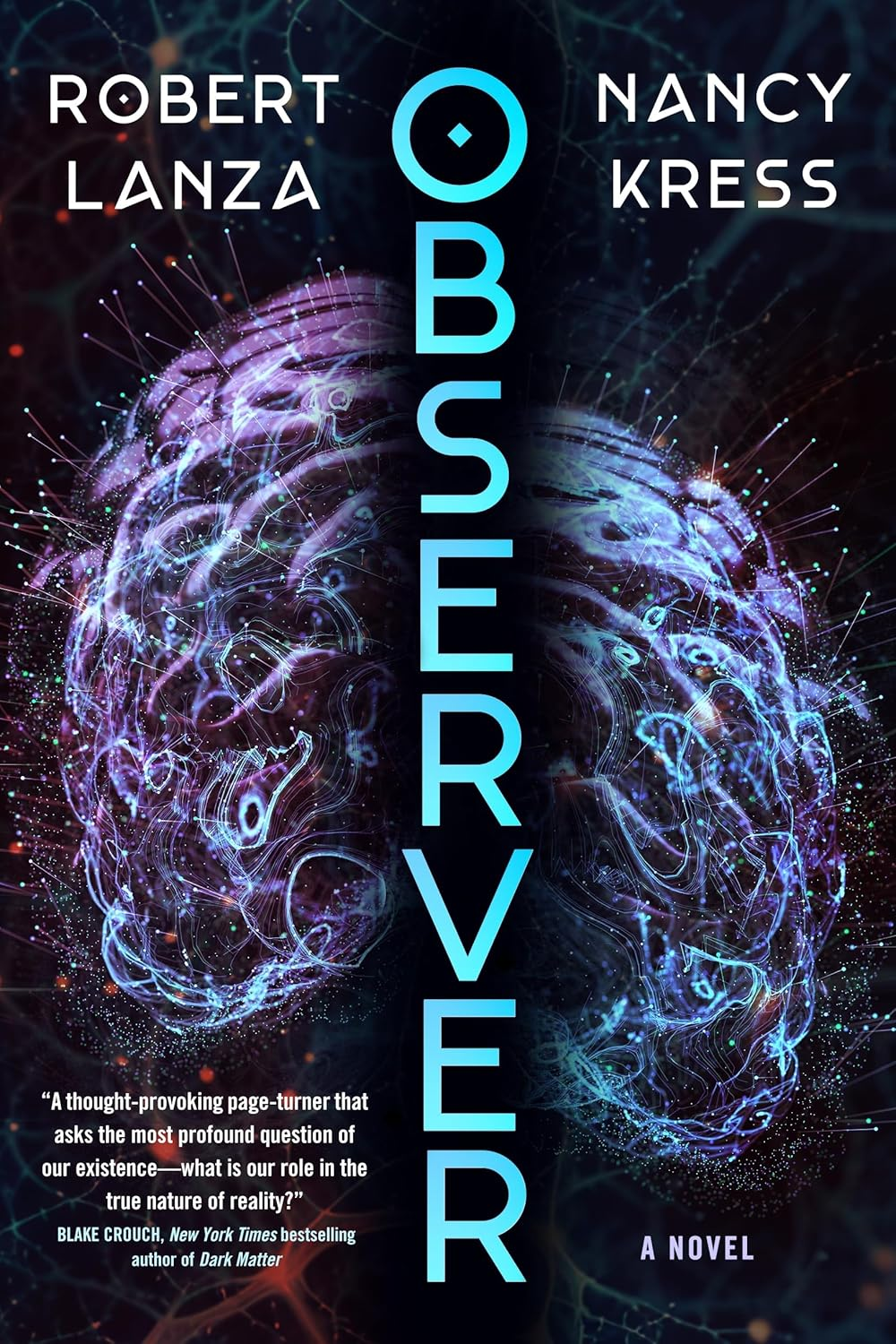
Observer: A Novel by Robert Lanza & Nancy Kress (book review).
There are various reasons why authors may wish to collaborate. Some fall into the partnership very easily, such as that between Iain Grant and Heide Goody (‘Clovenhoof’, etc.), and are very successful at it. Theirs is an equal partnership, and it is difficult to see the joins. The successful pairings play to the strengths of the individual writers.
In the case of Robert Lanza and Nancy Kress, their backgrounds are very different. Lanza is a respected scientist, best known for the ‘Biocentrism Trilogy’. Kress is an award-winning Science Fiction writer. The rationale behind this novel could be interpreted as an attempt to bring cutting-edge scientific ideas to a wider audience by burying them in fiction.
The near future setting is signalled by the fact that one of the main characters, Sam Watkins, is a Nobel Laureate credited with the development of a cure for the common cold. He is an important but background character, as the primary viewpoint character is Caro Soames-Watkins, his great-niece. Caro is a neurosurgeon. She accused a fellow surgeon of sexual harassment, but when the hospital board rejected her claims, she was nastily trolled on-line. This was a factor in deciding to take up a position at the research facility owned by her great-uncle.
The plot and the character development are clearly under the control of Nancy Kress. The science behind the research is the province of Robert Lanza. The research facility is on the isolated Caribbean island of Cayman Brac, a place I have visited, so I know that many of the features described are authentic. George Weigert has developed a theory that suggests that things only exist because they have been observed.
Using software developed by Julian Dey is a way to prove the theory correct. As a neurosurgeon, it will be Caro’s job to surgically implant a chip into the brain. When triggered, the chip will transport the volunteer’s consciousness into an alternative existence where everything they see only exists because they have created it by direct observation. The electronic set-up allows the observations on this other world to be viewed on a screen. They are able to see George’s reunion with his dead wife who still lives in his observed world.
The project and the characters are plagued with outside issues. Caro’s sister, Ellen, becomes distraught at the death of her handicapped daughter, and her other daughter is taken into care – issues Caro has to deal with remotely. One of the team absconds with sensitive information, and after his murder, the FBI gets involved, and the nature of the research leaks onto social media.
There is a lot to enjoy in the main narrative, but the science-based passages might put off readers without a science background. Although the basis is a different take on the idea of alternative worlds, the explanations slow down the narrative, and some readers might skip these parts. It is always useful to have a scientist on board when writing a science fiction novel, but the advice and/or narrative needs to slip in seamlessly. Unfortunately, this doesn’t.
Pauline Morgan
February 2026
(pub: TOR, 2025. 380 page enlarged paperback. Price: $19.99 (US), $27.99 (CAN), £10.99 (UK). ISBN: 978-1-250-3746-6).
check out website: https://torpublishinggroup.com/observer/?isbn=9781250376466&format=trade