
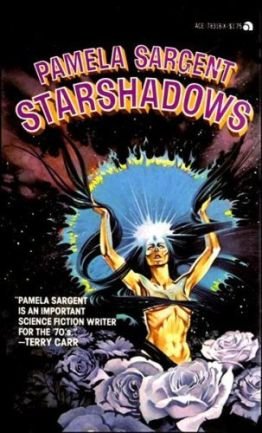
Starshadows by Pamela Sargent (book review).
In his introduction to Starshadows, editor Terry Carr describes his working relationship with author Pamela Sargent. He rejected her first four stories but wanted to see her sort out the problems he had identified. Carr admired Sargent’s ability to create realistic characters but felt she needed to work on her plots, and showed her what needed to be sorted out. Here, we have ten of her short stories.
I can see what he means with the opening story, ‘Shadows’. Earth has been invaded and lost. The remaining humans live in catacombs, with their captors, the Aada, living amongst them when a couple of the aliens are murdered. Oddly, the ending reverses things and the Aada are not quite what they appear to be.
‘Gather Blue Roses’ is told from the point of view of twins Esther and Simon Greenbaum, who can feel each other’s pain. However, the real focus of the story is their mother, a Holocaust survivor, and her need for solitude every so often. The way Sargent writes it, with all the detail, I thought she had to be Jewish herself, but a check reveals she’s an atheist. Even so, this is still more of a character-driven story than one relying on plot.
‘Oasis’ has an Arab-based character who has, shall we say, a homicidal bent. His tendencies are known about, but he carefully ensnares his prey through a little deception.
‘IMT’ of the title stands for Instantaneous Matter Transmitter. City Manager Lisa Fernandez decides not to implement it, even if the city is falling apart, simply because it would cause more problems than it solves. If anything, this feels like the antithesis of Larry Niven’s stepping discs in his Known Space stories, but explores different consequences from flash crowds. I doubt either author would have foreseen how it might look in the social media society we have today, although flash crowds would still happen.
‘Bond And Free’ starts in a hospital, where Alia discovers yet again that she can simply walk out if she wants to. She does so, taking some supplies and water, and keeps going. She encounters a barmaid who seems to think she’ll get her drinkers back, a crazy man who promises her a route through a mountain when it is actually easy to cross, and eventually a man who offers her a ride in a balloon. It’s when Alia takes the balloon for herself that you start to re-evaluate her.
‘If Ever I Should Leave You’ has to be Sargent’s best story here by far. A woman meets the ageing Yuri Malenkov and, through a Time Station, encounters him at different points in his life when he was much younger. As she ages, she needs to ensure their relationship will happen. This really is a nicely crafted story and ties up all the loose ends.
‘Cloned Sister’ read with some familiarity and is actually part of Sargent’s Cloned Lives, which I’ve reviewed here before.
In many respects, especially where Sargent’s short stories are concerned, she is an acquired taste, with more emphasis on character than plot. Nothing wrong with that. A lot depends on your own orientation. When she gets the balance right, her Science Fiction offers a different set of observations.
GF Willmetts
August 2026
(pub: Ace Books, 1977. 205-page paperback. Price: varies. ISBN: 78918-X)