

What Is Life? by Erwin Schrödinger (book review).
I came across this book, ‘What Is Life?’ by Erwin Schrödinger, last year. If the author sounds familiar, it should be. Schrödinger is the theoretical physicist with the hypothetical cat and its potential to be dead or alive in a box depending on whether a poison capsule could open. The thing is, that’s the most he’s associated with these days. He also wrote books, this being one of them. Actually, ‘What Is Life?’ is the first section; the rest is devoted to lectures he gave and a mini-autobiography.
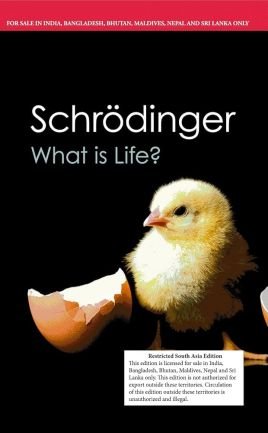
Schrödinger explores biology from a physicist’s point of view and evolution’s need for mutation for things to change. I like his comment on Brownian motion that with only one particle there is no motion. It only happens when there are several particles to bounce off each other. I wish he explored that more because the consequences of this are similar to his cat theory. The implication doesn’t explain what causes the motion unless it’s gravity.
For a physicist, Schrödinger had a good grasp of evolution when you consider history tends to remember only some aspects of their lives. If for no other reason, it’s worth reading books like this from the actual scientists to fill yourselves in on what else they did. I wasn’t even aware that there was a lecture circuit at the time that laypeople could attend.
In his lectures, it’s interesting that he goes into philosophically examining the senses and then into what consciousness is. Even seventy years later, they’re questions we still have today because we really don’t have answers today. I think he would love the Internet. He describes a white chemical that not everyone can taste but has forgotten the name of. I had to look up the spelling for phenylthiourea (PTC), and, I agree, it has a foul taste.
His mini-autobiography, written a year before his death at 73, tends to jump around a lot rather than follow a straight line through his history. I hadn’t realised how much time he had spent in England when young and his mother ensuring he learnt English at the age of 4. His latter years were spent at Dublin University.
The fact that this book has had 23 reprints should speak for itself and not a hypothetical cat in or out of sight. If anything, Schrödinger has all the pointers of an inquisitive geek, so he’s one of us.
GF Willmetts
February 2026
(pub: Cambridge University Press, 2018 – 23rd printing. 184 page small enlarged paperback. Price: varies. ISBN: 978-1-107-60466-7).
check out website: www.cambridge.org
