
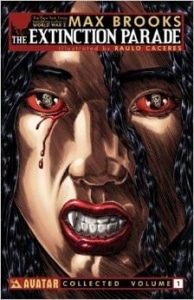
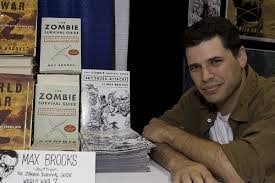
Max Brooks is an American writer and the son of comedy director Mel Brooks and Hollywood actress Anne Bancroft. His best known books are ‘The Zombie Survival Guide’ and ‘World War Z: An Oral History Of The Zombie War’, the latter of which was loosely adapted into a Hollywood blockbuster featuring Brad Pitt in 2013. I caught up with Max on 13 March 2015 at Waterstone’s Piccadilly in London, where he was launching the graphic novel ‘The Extinction Parade: War’, which continues the story where last year’s ‘The Extinction Parade’ left off, before appearing at London Super Comic Con.
SFCrowsnest: Your new graphic novel, ‘The Extinction Parade: War’ pits vampires against zombies. As someone who’s known as a zombie specialist, why did you bring vampires into the mix?
Max Brooks: I’d spent so much time writing about how humans would survive, because I don’t really write about zombies, I write about surviving zombies, I thought, what about a completely different species that, on the surface, you think would be in a better position but, actually, is more vulnerable.
SFC: This is a story from a while back, isn’t it? I think it originally appeared as a short story in your collection, ‘Closure, Limited’?
MB: Yeah, it’s from 2010. ‘Closure, Limited’ was an afterthought. I originally wrote it for the website ‘The Daily Beast’ a long, long time ago for free. I just had an idea in my head and wrote it and threw it up there.
SFC: Why did you decide to reimagine this short story in the new format of a graphic novel?
MB: Because I wanted to go deeper. There were so many more levels I wanted to explore with ‘The Extinction Parade’. The central crux of the story, the reason I wanted to write it in the first place, was to talk about the pitfalls of privilege and how supposed advantages are actually disadvantages. In the short story, I didn’t go deep enough and I really didn’t explore it beat by beat.
SFC: What did you enjoy about translating the short story into a graphic novel? What did you find more challenging?
MB: Well, let’s start with the challenges. When you do any kind of comicbook, it comes with so much extra homework. When you write prose, you only put in as much information as is important. You don’t have to put in any sort of description if it’s not important to the scene you’re writing. But in a comicbook, the reader sees everything. So if you don’t want the artist to go off on his own, you better make sure you know what is going to be on that page. And like an idiot, I set ‘The Extinction Parade’ in Malaysia, so I then had to research modern Malaysian architecture, fashion, vehicles and so on. I even had to use Google maps, so that I could say to the artist, if our characters were standing on this street corner in Kuala Lumpur, looking in this direction, then this is what the skyline would look like. Because I live in dread that someone from Kuala Lumpur would say ‘What the hell are you doing?’
SFC: How have you found the process of collaborating with the graphic novel’s artist Raulo Caceres?
MB: Well, Raulo is a genius, I’ll say that right now. He’s an amazing artist and has unbelievable attention to detail – shocking attention to detail. The only time Raulo and I have really clashed is over a genuine culture clash. Raulo is a European. He’s a Spaniard who lives in a flat above a topless beach. So it is inconceivable to him that, in the United States, you can show horrific violence, but you cannot show nudity. He does not understand the hypocrisy. When William Christensen, the editor-in-chief at Avatar, tried to explain that to Raulo, he finally just gave up, and said, ‘It’s Max Brooks’ rules.’ So in issue three of the comic, Raulo decided to get back at me. He got his revenge by drawing sex toys on the table next to the bed, with a little sex manual. If you look very carefully, the sex manual actually says ‘Max Brooks’s Rules’ on the cover! So that was Raulo’s revenge.
SFC: Are you interested in pursuing further collaborations of this kind?
MB: Oh yeah. I mean, I love working with different artists. I’m currently on my second collaboration with Caanan White, the artist on ‘The Harlem Hellfighters’. He was so good at it, he’s so amazing at drawing war, that when William (Christensen) approached me to work on another project, I said, yeah, but I want Caanan to do the art.
SFC: Writing a book is normally a very solitary process, whereas working on a graphic novel is a more collaborative one. Which do you prefer and why?
MB: I think at heart I’m more solitary. I was an only child, I grew up very isolated, so I think that’s who I am. But some stories, I think, are better told visually; they fit the graphic novel medium. So even though it’s out of my comfort zone, it’s a small price to pay.
SFC: Your novel ‘World War Z: An Oral History Of The Zombie War’ was made into a Hollywood blockbuster starring Brad Pitt in 2013. How do you feel about the way the filmmakers adapted your book?
MB: I know this is going to sound strange, but I prefer that they deviated so far from the book, rather than try to copy it and muck it up. People ask me how I feel about them ruining my book, to which I say ‘They did not ruin my book, they ignored it!’, which made the movie easier to watch, because I didn’t have to watch my characters saying and doing things they wouldn’t do, because they don’t. I didn’t invent Gerry Lane, so as far as I’m concerned, Gerry Lane can do whatever he bloody well wants to do!
SFC: What is the most important element of your books to you: the characters, the plot or the way in which you tell the story?
MB: I think every story starts with a central idea and it could be character, but for me, it always starts with the answer to a question. I always ask myself too many questions about stories and if I found the answers in other books, I wouldn’t bother writing my own. For example, ‘The Zombie Survival Guide’ answered the question ‘Would you really survive a zombie outbreak?’ No-one had ever answered it, so I thought I’d answer it for myself.
SFC: Is there anything about your writing career that you would do differently, if you had the chance?
MB: Yes. I would have had the courage to publish earlier. The big problem with writing a novel is there’s nobody to blame or hide behind. It’s purely you and the audience and I think that’s very scary. When I was writing for ‘Saturday Night Live’, if a sketch didn’t work, we writers could blame the cast or the audience. As a novelist, you have none of those defences. I wish I had had the courage earlier in my career, because I’ve been writing since I was twelve, but I didn’t want my stuff to get out. So that’s a regret.
SFC: What advice would you give to unpublished, aspiring genre writers?
MB: I would say that the advantage of the age we’re living in now is there’s no more shame in self-publishing. Everybody does it. ‘Fifty Shades’ started as self-published fan fiction, then the publishers picked it up. So there’s no excuse not to do it. But now there’s also the big fear. Los Angeles is rife with writers who complain about how the industry doesn’t understand their genius but, on one level, they’re thinking ‘Thank God, because nobody’s going to be judging me.’ So be brave. Put your stuff out there, and just prepare for the judgement.
SFC: Thank you.
© Max Brooks and Patrick Mahon 2015
all rights reserved

Fantastic advice. Judgement can sting, but it can also lead to growth.
Self-publishing provides all sorts of new opportunities, for both writers and readers. There never would have been thousands of books about the zombie apocalypse in the days before self-publishing, for example.
Loved WWZ.
Geoff
The Dinosaur Four
(311 reviews, including some that are plenty judgmental)
Oh, and check out Mark Tufo’s Zombie Fallout series as a great self-publishing zombie-apocalypse success story.
Geoff
Thanks for the fantastic interview. I’ve been a fan of Max Brooks stuff or a while, so it’s great to get a chance to peek into his head.