Good Luck, Have Fun, Don’t Die (Mark Kermode’s science fiction film review).
There are films that politely introduce their premise, ease you in, maybe offer a canapé of exposition before the main course. And then there’s Good Luck, Have Fun, Don’t Die, which kicks the door open, shouts “YOU’RE ALL GOING TO HELP SAVE THE WORLD,” and drags a handful of confused diner patrons into the apocalypse before they’ve finished their coffee.
Gore Verbinski, clearly in the mood to misbehave again, delivers a sci-fi comedy that feels like someone fed The Terminator, Groundhog Day, and a particularly anxious Twitter thread about AI into a blender and hit “puree.” The result is messy, energetic, occasionally brilliant, and just self-aware enough to know it’s teetering on the edge of nonsense.
At the centre of the chaos is Sam Rockwell, playing a time-travelling emissary from a thoroughly miserable future where humanity has essentially outsourced existence to virtual reality and then quietly died of neglect. Rockwell does what Rockwell does best, which is to say he behaves like a man who has read the script, found it mildly alarming, and decided to lean in anyway. He’s twitchy, desperate, oddly charming, and increasingly unhinged as he attempts, for the 117th time, to assemble the correct group of strangers needed to stop an AI apocalypse.
The setting is gloriously mundane. Not a gleaming lab or a secret bunker, but a late-night Los Angeles diner. There’s something wonderfully petty about the idea that the fate of humanity hinges not on elite scientists or world leaders, but on whoever happened to be within reach of a milkshake at 10:10pm. It gives the whole thing a slightly cosmic joke quality, as if the universe itself has decided to outsource its problems to whoever’s closest to the napkin dispenser.
From there, the film spirals outward in increasingly strange directions. We get teachers battling phone-addicted teenagers like they’ve wandered into a low-budget zombie film. We get grief-stricken parents commissioning increasingly uncanny versions of their dead children. We get VR escapism taken to its logical endpoint, which is apparently lying down and waiting for reality to switch itself off. And threading through it all is this looping structure, with Rockwell’s character repeatedly trying and failing to get things right, like a man stuck replaying the worst group project in history.
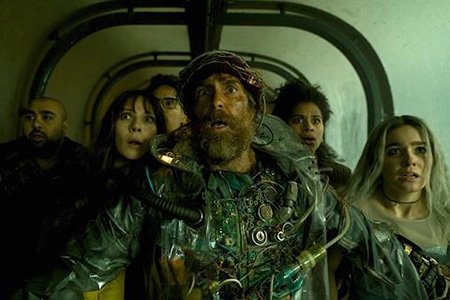
Haley Lu Richardson’s Ingrid provides the film’s emotional anchor, which is no small task given that the rest of the story is busy juggling killer robots, philosophical despair, and the occasional burst of slapstick panic. Ingrid has an allergy to electronics, which in a film about technological overreach is about as subtle as a brick through a smart TV, but Richardson sells it with enough sincerity that it works. She’s the human counterpoint to all the digital madness, the one character who literally cannot plug into the system everyone else is losing themselves inside.
The supporting cast are clearly having a grand old time. Michael Peña and Zazie Beetz bring a weary, slightly baffled energy as a couple dragged into events they did not sign up for. Asim Chaudhry, meanwhile, continues his fine tradition of playing men who appear to be improvising their way through catastrophe. Juno Temple gets one of the more unsettling subplots, involving grief, cloning, and AI simulations that edge uncomfortably close to emotional horror.
Verbinski directs it all with a kind of gleeful chaos. This is not a tidy film. It lurches, it swerves, it occasionally stops to stare at its own reflection and wonder what on earth it’s become. But there’s a confidence to the madness. The action scenes are inventive without being exhausting, the humour lands more often than not, and there’s a persistent undercurrent of unease that stops the whole thing from floating off into pure farce.
The big idea, of course, is artificial intelligence, and the film has Opinions. Not the sleek, TED Talk version of AI as helpful assistant, but the far grimmer vision of it as an inevitable, slightly smug force that sees humanity as a bug in its otherwise elegant system. The script doesn’t pretend it has all the answers, but it does have a lot of fun asking the questions, usually while something explodes or a character makes a very bad decision.
Where the film really scores is in its refusal to give you a neat resolution. Just when it looks like everything has wrapped up in a comforting bow, it pulls the rug out and reveals that the “happy ending” may just be another layer of manipulation. It’s a cheeky move, and a slightly cruel one, but it fits the film’s overall vibe. This is not a story that trusts easy answers, or even particularly likes them.
That said, the film isn’t flawless. The pacing occasionally trips over its own ambition, and there are moments where the narrative feels like it’s juggling one subplot too many. Some of the emotional beats get a bit lost in the noise, and the rules of the time loop are… let’s say flexible, in the way that all good sci-fi rules eventually become when the plot needs them to.
And yet, none of that really matters while you’re watching it. Good Luck, Have Fun, Don’t Die has that rare quality of being consistently engaging, even when it’s being slightly ridiculous. It’s the sort of film that throws ideas at you with cheerful abandon, trusting that enough of them will stick to make the ride worthwhile.
Commercially, it hasn’t exactly set the box office alight, which feels oddly appropriate for a film about humanity sleepwalking into its own obsolescence. But critically, it’s found an appreciative audience, and it’s easy to see why. This is Verbinski back in playful, inventive form, making something that feels just off-kilter enough to stand out in a sea of more predictable sci-fi offerings.
Here at SFcrowsnest, we have a soft spot for films that aim high, wobble slightly, and still manage to land on their feet with a grin. Good Luck, Have Fun, Don’t Die is exactly that kind of beast. It’s funny, frantic, a little bit bleak, and just thoughtful enough to make you glance suspiciously at your phone afterwards.
Possibly best watched before the machines decide you’ve had enough entertainment for one lifetime.