

Arthur C. Clarke said that sufficiently advanced technology is indistinguishable from magic. The point of this article is to question him. Within our own lifetimes, we’ve watched inventions that once belonged to science fiction become ordinary. We’ve adapted quickly, sometimes through necessity and sometimes because everyone else was doing it. Stage magic relies on distraction and deception, but I think Clarke meant something more arcane: an encounter with technology so far beyond our understanding that we cannot work out what we’re seeing.
Much has changed in the 18 years since Clarke died. We’ve known what a computer is for long enough that a modern one would probably inspire curiosity rather than cries of witchcraft. The surprise would be how so much computing power could fit inside a mobile phone. Where are the flashing lights that showed a computer was working in early SF films and television programmes? Where’s the keyboard? We had already become familiar with the idea of a handheld communicator through Star Trek, though, so the mobile phone’s arrival hardly came out of nowhere.
Film and television computers needed visible activity to tell the audience something was happening. Lights blinked and tape reels turned. Viewers didn’t necessarily believe real computers worked that way; they accepted it as part of the fiction.
For years, we were told computers would remain enormous machines. Miniaturised processors changed that. A box on a desk with a screen and keyboard might be useful, but it hardly looked dramatic. Hardware developers brought computing into other technologies and, eventually, into ordinary household items. Now many of us carry a computer in our pockets and take it for granted. The screen and means of entering information are among the practical limits on making a phone smaller. Audio isn’t always perfect, either.
Even if we could project a holographic screen, I doubt it would catch on if everyone nearby could read it. Glasses that let only the wearer see the display might solve the privacy problem, provided the wearer noticed the pedestrian or car coming towards them. Oddly, science fiction does not always keep up with the devices we already use, let alone imagine how they might look in the future. They needn’t be central to a story, but they could at least be part of its background.
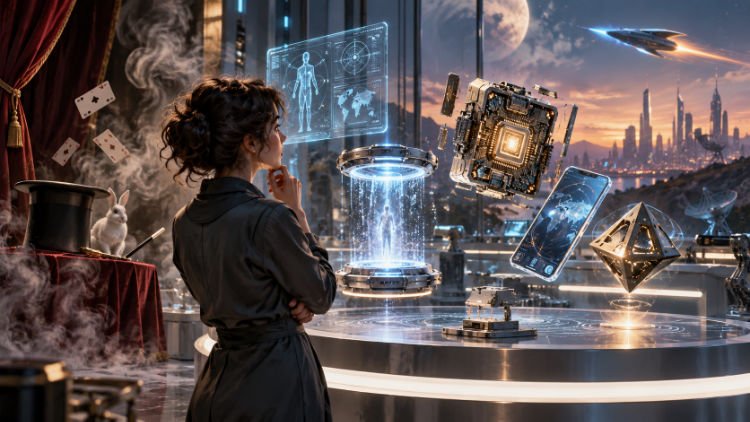
Once we know what a computer does, it is fairly easy to recognise one, even if we cannot see its circuitry working or read its programming language. Give it a particular problem and, with the right software, we expect a useful answer. Current AI systems complicate that expectation by producing answers that can sound equally confident even when they disagree. It feels like a bit of a regression. Show one to somebody from the turn of the twentieth century and they might well call it magic.
We have examples from our own lifetimes of inventions changing drastically while their functions remain recognisable. We adapt to them; we don’t confuse them with magic. Even the Large Hadron Collider has a purpose we can explain, although the particles it studies are too small for us to see.
A device with several functions might puzzle us at first, but observation would soon help. We can recognise a weapon by what it does: it can stun, injure or kill. The result tells us something about its purpose. I can often get a firm grasp of unfamiliar equipment by scanning its manual, looking especially for what differs from similar devices I already know.
Much technological development involves combining existing ideas or refining a design. A Taser, for example, is intended to incapacitate rather than kill, although its use can still carry serious risks. That does not stop us recognising it as a weapon.
Consider the main uses of technology: transport, communication, weaponry, agriculture, medicine, education, information storage and calculation. Add housing, with its power, plumbing and insulation. It would take something extraordinary for us to see it and have no idea what anyone might want it for. Development often means making something faster, smaller or more efficient. Cleaning devices can now do much of the work without us. These are extensions of things people have tried to improve for years.
Perhaps the biggest change nobody anticipated was how thoroughly computing would enter everyday life. That was difficult to picture when a computer seemed destined to occupy a large room. Steampunk has explored primitive computers, but flexible programming would present a different challenge. Smaller calculators, processors and the silicon chip changed what was possible. Looking back, we can see how we got here. Looking forward is harder.
Growing up alongside new technology makes adapting to it easier, although that is a generalisation. Some people will never want to use a particular device, however useful others find it.
I spent some time trying to think of an exotic invention whose purpose we would fail to recognise. If I knew what it was, of course, I would already have defeated the exercise. So I took a different tack: something we might recognise by its effect without understanding how it worked. Teleportation would qualify, though science fiction got there first. Would we mistake it for faster-than-light travel if something simply vanished faster than our eyes could follow?
Travel at extraordinary speeds would bring its own problems. Accelerating a craft within an atmosphere might release dangerous amounts of energy. You would not want to try it close to Earth without knowing the consequences. Invisibility offers another puzzle. If light passed through your eyes without interacting with them, how would you see? Making a person invisible would not make them absent, either.
A larger problem may be the way films portray technology we already have. A lift does not necessarily have a convenient ceiling hatch for an escape. Not every skyscraper window will shatter when somebody is thrown against it. Nobody writes a complicated, flawless computer program in a couple of minutes. Films cheat. In science fiction, though, it helps to know what is possible before deciding how the story’s technology gets around the limits.
Nature imposes some of those limits. Light travels through a vacuum at 299,792,458 metres per second. A photon has no rest mass; a starship does, which makes accelerating one to the speed of light a very different proposition.
Scientific laws come from observing nature and describing the relationships we find. The units we use to measure those relationships are our own inventions. Time itself is not man-made, but our hours and minutes owe much to systems developed long ago, including the Babylonian use of base 60. It remains handy for dividing an hour even though we use decimal numbers for so much else.
If we meet an alien species, its system of numbers may be quite different. It might count in base ten, but I wouldn’t rely on it having ten digits on its hands, assuming it has hands. We would need shared physical measurements to establish conversions. We already know how costly a mismatch of units can be: one Mars spacecraft was lost because different parts of its mission used incompatible systems. Imagine working that out across two civilisations.
Another species might agree that nature does not copy all our inventions. There are no wheeled animals that I know of, for example. Different civilisations could apply the same scientific principles in different ways and arrive at similar results. In comparing ourselves with another intelligent species, we would look for what we share as well as what differs. How much of its technology comes from learning to cope with the same physical limits we face?
Then there are reports of UAPs apparently moving in ways our aircraft cannot. We do not know enough about them to say what, if anything, produces those observations. If an unfamiliar form of technology were involved, we would still ask what principles allowed it to work. The same applies to nuclear fusion as a practical source of power: we understand the principle, but making it work reliably and economically at scale remains the difficult part. Neither question requires magic as an answer.
Was Clarke right? I think it is more debatable than his famous line suggests. Our scientific knowledge has grown, and we are inclined to investigate an unfamiliar effect rather than accept that it lies beyond explanation. That does not mean every technically possible invention is practical. A flying car, for example, raises awkward questions about traffic, mechanical failures and what happens to the people beneath it when something goes wrong. Automation would not make those questions disappear.
Science fiction, in all its forms, has accustomed us to futuristic inventions and even to the possibility of alien technology. Its guesses will not always be right, but it may leave us less inclined to mistake the unfamiliar for magic. We are more likely to ask: ‘How did they learn to do that?’
© GF Willmetts 2026
All rights reserved.
Ask before borrowing.
Join the conversation (0)