
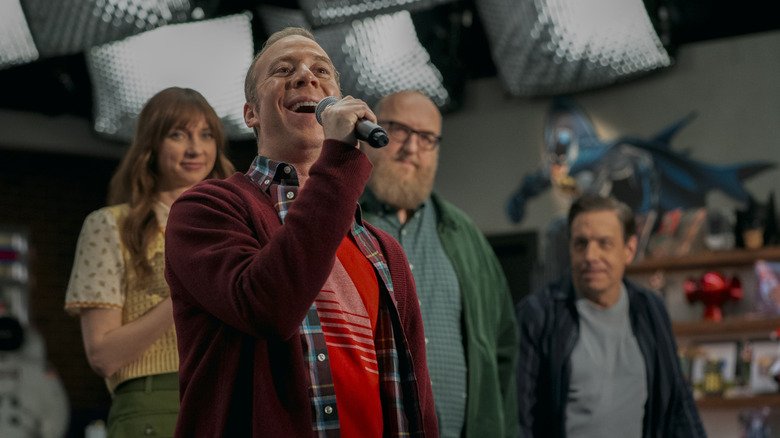
Giving Stuart Bloom responsibility for the continued existence of reality is rather like asking the bloke who cannot work the office laminator to land a passenger jet. You can see why everyone is nervous. You can also see why you might want to watch. With its first season now complete, Stuart Fails to Save the Universe has found a surprisingly fertile use for one of The Big Bang Theory’s perennial supporting players: send him into actual science fiction and discover whether all those years behind a comic-shop counter count as emergency training.
Season-one spoilers follow, including the finale. Please secure your quantum equipment and leave any emotional attachment to the fourth wall at reception.
The series, created by Chuck Lorre, Bill Prady and Zak Penn, promotes Kevin Sussman’s Stuart alongside Lauren Lapkus’s Denise, Brian Posehn’s Bert Kibbler and John Ross Bowie’s Barry Kripke. This is an agreeably dubious rescue party. Science fiction usually assembles its finest minds and bravest hearts when reality starts coming apart. Here, it appears to have rung whoever was still available after the main cast’s agents stopped answering.
There is a proper comic idea beneath that casting. Stuart has spent years surrounded by stories about people who matter enormously. Now he matters enormously, which is inconvenient, because being overlooked was one of his few reliable survival strategies. A man equipped to explain a continuity error must suddenly cope with living inside one. His specialist knowledge acquires practical value without requiring him to turn into Captain Competence overnight.
The Big Bang Theory made much of the distance between its characters’ intellectual confidence and their ability to negotiate ordinary life. This spin-off closes the gap in the worst possible way: ordinary life has been abolished. Breaking a device built by Sheldon, Leonard and Howard has precipitated a multiversal catastrophe, and Stuart’s party must try to put things right. Somewhere, presumably, there is a warranty card with an extremely awkward box to tick.
The shift is more substantial than simply spending extra money on monsters. A familiar sitcom setting lets viewers anticipate the sorts of trouble its inhabitants will encounter. Here, the setting itself keeps changing the terms of the argument. A new universe can turn yesterday’s sensible assumption into today’s digestive emergency. The comedy has room to behave like a succession of sketches, with the travellers providing continuity while the scenery suffers a nervous breakdown.
That freedom has a cost. When anything can happen, an audience can start wondering whether anything matters. Stuart and Denise’s relationship supplies a useful answer. Keeping someone you love beside you is a comprehensible ambition even when the local laws of biology have been rewritten. Their partnership gives the wandering a human scale. Without it, the programme could become a succession of effects shots waiting for someone to make a remark.
The cow-derived universe captures the attraction of the whole enterprise. Pasadena can look reassuringly familiar while its residents possess four stomachs. This is the sort of speculative adjustment that a solemn drama might spend eight episodes connecting to humanity’s essential nature. Here it can become an argument about whether this is, on balance, a reasonable place to settle down. Given the current housing market, additional stomachs would barely trouble an estate agent’s particulars.
There is a family resemblance to Douglas Adams in that collision between cosmic possibilities and modest personal requirements. The willingness to let a ridiculous premise take over the programme also recalls The Goodies. Those are comparisons, rather than a claim that Lorre has been secretly studying a British comedy correspondence course. The shared pleasure lies in following nonsense far enough to discover that it has developed its own perfectly serviceable logic.
The closing stretch pushes that idea into comic-book territory. Having spent years selling adventures, Stuart ends up trapped in one. Jay Garrick, the Golden Age Flash, and his Cosmic Treadmill offer a route out. At last, a piece of exercise equipment with a benefit sufficiently substantial to justify getting on it. Stuart’s comic knowledge becomes a survival skill, which should provide considerable comfort to anyone who has ever described an expensive collection as an investment.
There is another pleasing joke in visiting a superhero universe and discovering that it still contains mundane inconvenience. We tend to imagine life between comic panels as a continuous festival of dramatic silhouettes. Someone, however, has to wait at the airport. Saving the world loses a little glamour when your onward connection has been delayed and the only available sandwich costs more than your secret headquarters.
The finale then finds something stranger than a superhero’s domestic arrangements: a television sitcom. The travellers encounter a production of their own lives, complete with performers who look like them. The fourth wall has not merely been broken; somebody has discovered it was a removable studio flat all along. For characters spun off from a hugely successful sitcom, discovering the machinery of that format is a particularly well-aimed indignity.
It also makes the season’s wandering feel more purposeful. They have been passing through worlds governed by different rules, and television turns out to have rules as arbitrary as any of them. Imagine discovering that the peculiar rhythm of your conversations has an audience. Worse, imagine discovering that your distress is somebody else’s light entertainment. Stuart might reasonably want to speak to management, although management is probably already discussing international sales.
Their departure from the studio lot leaves a more interesting question than which spectacular location comes next. What do they now believe about themselves? The missing quantum device also looks, from a storytelling perspective, like a useful inconvenience. A machine that can transport everybody out of trouble risks becoming the writers’ emergency exit. Taking it away may force more inventive escapes. That is an interpretation of the ending, however, rather than a confirmed instruction sheet for season two.
The adversary remains unfinished business, and the series will eventually need to make its accumulating mysteries pay off. Cheerful improvisation can carry a comedy a long way; it cannot indefinitely substitute for consequences. The trick will be to preserve the unpredictable journeys while ensuring that Stuart’s choices do more than determine which set gets used next.
HBO Max renewed the series in August, well before the finale. In a subsequent TVLine interview, Lorre said the team was planning ten more episodes, with production tentatively beginning in January or February and hopes of returning around the same time in 2027. That is an ambition, not a confirmed autumn premiere date. Even a multiverse deserves an accurately labelled calendar.
Here at SFcrowsnest, we have a soft spot for science fiction that remembers the universe might be ridiculous. Stuart Fails to Save the Universe has found a promising comic engine in allowing a minor character to stumble out of the margins and discover that the main plot is badly supervised. Stuart may still be struggling to save existence, but escaping the fate of simply being another familiar face on another familiar sofa is a respectable first-season achievement. He has earned a second attempt. Someone else should probably carry the equipment.
Sources: renewal and series details; episode-nine cast and creators’ interview; finale and season-two interview.

Join the conversation (0)