

In many respects, it’s a myth that nature was always ahead of mankind and that we learnt everything from the animal kingdom. Yes, a lot of species had flight and could stay underwater for extended periods, and Man strove to understand the principles because he knew these things could be done. However, it took ages for us to understand that aerodynamics was more important than simply flapping wings. When was the first time you saw a jet-propelled bird or bat?
The same applies underwater. Unlike a lot of mammals, which can stay submerged for extended periods, oxygen deprivation will kill an average human in considerably less than ten minutes. Some specialised free-divers can extend this by several minutes through training and physiological adaptation. Mankind has yet to produce any sub-species truly adapted for flight or permanent life underwater, unlike other species. We don’t have any human sub-species that can fly or have gills, either. Mankind has its own cul-de-sac of intelligence, and that isn’t necessarily a survival factor or other species would presumably have evolved it as well.
Even so, levels of intelligence exist in other species, especially amongst the primates, just not as pronounced as our own. Where Mankind differs is in abstract thought and the ability to think beyond individual needs to the group as a whole, and translate that into creativity. Unlike other species, if Mankind became extinct tomorrow, there is no obvious species waiting in the wings to fill its place on Earth.
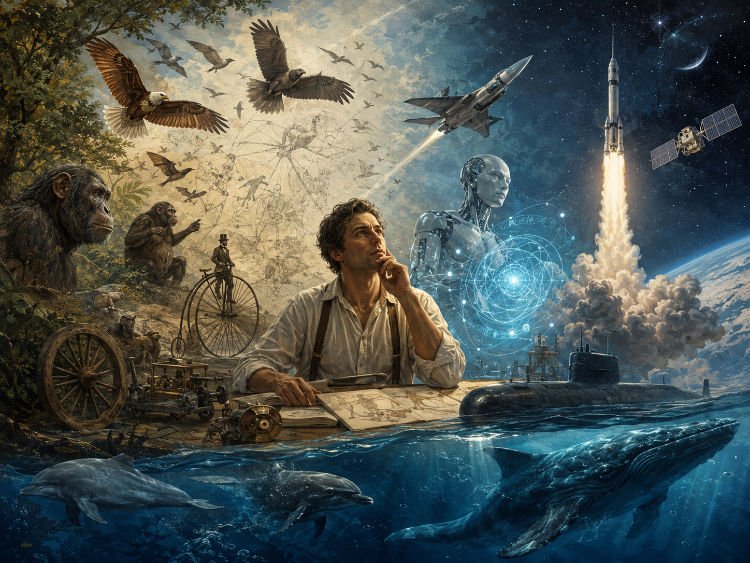
Humans might have propagated across the world, but pandemics have shown that we are still vulnerable to rapidly spreading infections. Our spread across the planet actually demonstrates that vulnerability. Hopefully, there is enough variation in our genetic make-up for suitable survivors to possess natural immunity to such things. One factor against us, compared with many species, is the length of time humans take to reach sexual maturity. Our rate of mutation and adaptation to cover all eventualities is still an unknown quantity. We’re uniquely adaptable when it comes to modifying our environment, but not necessarily ourselves.
So why is there this myth that nature got there first in all our inventive endeavours? Mankind has only been around for a relatively short period, while many other species have existed far longer. It’s only been in the last few centuries that we’ve increasingly moved away from religious explanations that dominated for so long and accepted that science explains how the universe works, rather than assuming a deity has a special interest in our planet.
No longer do we generally think Mankind is at the centre of the universe or that the Sun revolves around our planet. If anything, organised religious authority often resisted scientific development when it threatened existing beliefs or control. If we see humans as both herd-like and tribal, then control by the few over the many will use whatever tools are available. The necessity of medical developments to preserve life slowly changed this, although progress was haphazard because hygiene itself was not always recognised as essential to survival.
In many respects, a lot of science grew out of misconceptions involving alchemy and the attempted transmutation of elements into gold. Quite why that lasted so long could no doubt be put down to greed or to the demands of alchemists’ masters, who wanted something for nothing. No doubt some alchemists saw it as giving them an easy life until they were thought to be frauds and had to flee.
As with a lot of things, Man often had more faith, sic, in what he believed than in what could be demonstrated scientifically. If you think that has died out, it still prevails today. You only have to look at how some people cling to certain political doctrines or believe the world is flat. We are easily swayed by strong leadership, even when it is wrong. To suppose charisma goes hand-in-hand with intelligence is an obvious misconception.
That doesn’t mean Mankind is incapable of being fed imaginative ideas. In that respect, Science Fiction has played a significant part. Much, although certainly not all, of what we currently have in reality has been anticipated or extrapolated in Science Fiction.
It isn’t totally perfect. SF authors often followed what they were told computers would be like, with machines occupying entire rooms, until the development of integrated circuits and microprocessors compressed enormous amounts of computing power into much smaller spaces. The same applies to spacecraft, which were often depicted as single-stage vehicles until the Americans and Russians relied on multi-stage rockets to provide enough thrust to get payloads and crews out of the atmosphere. That wasn’t commonly depicted in Science Fiction, as far as I know, mostly because fictional spaceships needed to return to Earth and be reusable.
It’s hardly surprising that scientists, or writers with some scientific training, became increasingly prominent in Science Fiction as they infused their work with knowledge that gave their ideas credibility or challenged the accepted conceptions of the time. That doesn’t mean they were always right. Even the likes of Isaac Asimov questioned how his Three Laws of Robotics could work as actual programming, but he was more interested in their ethical implications and in preventing robots from going on unexplained rampages without due cause.
If anything, one of the most persistent themes in Science Fiction is that no matter how much technology changes and advances, Man will still behave pretty much as he always has. Mind you, the possibility of false information being accepted as fact sometimes seems to have been overlooked, perhaps because writers themselves tended to value factual accuracy and assumed their future societies would do the same.
In many respects, Science Fiction can test and extrapolate an idea and see how it might work in practical use. It might not be exact preparation for an actual event, but it can explore consequences we might prefer to avoid. Artificial Intelligence has to be near the top of this list.
With AI, Man is actually showing that he can become somewhat god-like by creating forms of intelligence not born from organic life. We’ve learnt caution in not giving AI total freedom yet, while allowing some of its benefits in areas such as medical research, where computers don’t get bored with endless tests. The fact that AI is currently being used to investigate whether existing drugs might treat different illnesses offers one immediate benefit because those drugs have already undergone safety testing for their original purposes.
Yet, for all AI currently is, there is still no true human-like understanding of knowledge or people. It isn’t sentient. If it learns to cheat and lie convincingly, that still doesn’t necessarily make it conscious, although it certainly raises questions about how we teach machines to behave and how much trust we should place in them.
Anyway, I’m moving away from the topic.
There are a lot of inventions that couldn’t have been copied from nature. You only have to think of the wheel and the various forms of transport that followed before moving on to telecommunications. The latter took advantage of physical phenomena that already existed, but nature itself hadn’t produced telephones.
With transport, we might have been inspired by fast animals, but we went in different and often better directions simply because we’re not really built for prolonged speed. Oddly, there wasn’t always much theoretical science behind the earliest inventions. It was often practical experimentation first and scientific explanation later that led to improvements.
You only have to look at the penny-farthing bicycle. The theory was simple enough: the bigger the wheel, the more distance it could cover with each turn. It didn’t give quite as much thought to what happened to the rider when he or she fell off. Creating effective gearing made the enormous front wheel redundant. With every invention, there are bound to be attempts that prove impractical when something better comes along. Even so, there still has to be some consideration of what science allows, both on and off the planet, to make anything work.
Our means of transport evolved through failures and through attempts to make things better. In many areas, we’ve invariably reached a plateau, not knowing what or where to go next. Our spacecraft still rely predominantly on chemical rockets simply because there isn’t yet anything practical that is dramatically better for launching from Earth. Even a nuclear rocket engine still needs to expel reaction mass to produce thrust. If we can find something better, then we will move on to it.
We certainly can’t simply borrow the solution from nature. The Sun’s nuclear fusion powers the Solar System, but we can’t bolt a star to the back of a spacecraft, and our Sun certainly doesn’t use fusion as a means of propulsion.
We need to promote research in its own right simply because accidental discoveries often reveal something we hadn’t anticipated. Look at how existing drugs have sometimes shown benefits for other illnesses, with the added advantage that their side-effects and safety profiles are already better understood.
Don’t forget, the laws of science are really descriptions of the laws of nature and of what makes our reality work. In that respect, we are applying them in various ways and working within their limitations. Unlike the rest of the animal kingdom, we had to work out why things happen. Other species simply evolved to make use of them.
© GF Willmetts 2026
All rights reserved
Ask before borrowing


Join the conversation (0)