

There is a lot of responsibility in being the only apparent sentient, adaptable biped species, often called humans, in our local space. Although the number of stars in the Milky Way, let alone the number of other galaxies in the universe, means there has to be other sentient life somewhere, the prohibitive distances involved reduce the likelihood of meeting any of them in the same time frame as our own civilisation. Of course, if there is some unknown science we have yet to discover that can reduce the time needed to travel across space, it still wouldn’t change one thing: the odds of extra-terrestrial species having the same genetic make-up as our own are still pretty remote.
Recognisable human recorded history only stretches back a few thousand years, give or take a few centuries. If we don’t sort out global warming, our tendency to attack each other or our ability to commit nuclear holocaust, mankind isn’t likely to last very long. In a couple of centuries, and certainly in geological terms, little might remain to say that the Earth ever had a sentient species. As I’ve pointed out before, in terms of nature, intelligence is not a requirement. Humans are really a cul-de-sac species, as we are not physically evolving to fill every niche in our environment. Any way we do so is purely by our own means. Even so, we should recognise that existing on only one planet is limiting our chances of survival.
The choice of going to the Moon and Mars, both really inhospitable places, seems an unusual option. These are being considered primarily because they are the nearest possibilities and, considering how dangerous Venus is by comparison, our only practical nearby choices. The discovery of water on both the Moon and Mars at least shows the possibility of self-sustaining small colonies. Transporting materials to either location is likely to be very expensive. I should point out that either of Mars’ twin moons, Deimos or Phobos, might be used as advance bases rather than Mars itself, at least to begin with.
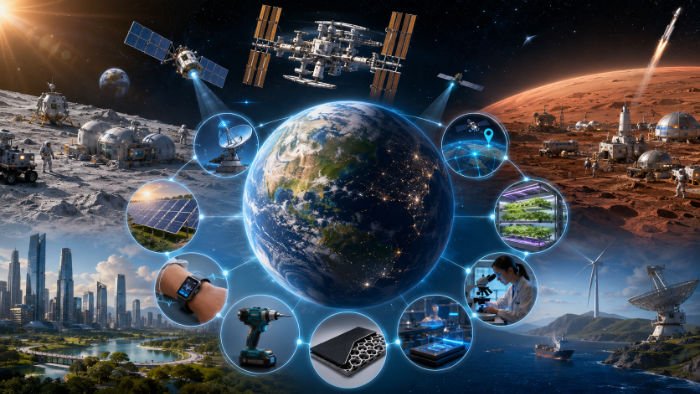
I’ve been asked what the benefits are to our own planet from such expense, and hence this article.
When you look back at the Apollo programme and the space stations since, our advances in technology came largely from particular needs, especially in miniaturisation. The development and use of integrated circuits helped reduce the size of computers, leading to technology that most people across the globe now rely on in one form or another. Although there are undoubtedly too many satellites in orbit around our planet, they also provide navigational aids and fast transmission of audio and visual signals. There are new fabrics to keep people warm, such as the silver thermal blankets we see at the end of marathons or used in rescues. Solar panels feeding the Sun’s energy to space stations are now a technology used across Earth and are continually developing to improve efficiency. Battery-powered tools were a surprise, although they might have happened anyway. Memory foam is now common in mattresses and chairs. Fly-by-wire systems are also used in aircraft. Liquid-cooled and flame-retardant fabrics came out of similar needs as well. The list grows ever longer, and you can look at NASA’s own examples here: https://spinoff.nasa.gov/
The companies that developed such things for the space programme and then used them elsewhere allowed themselves to continue growing. I can hear some of you saying that some of these advances would have happened anyway, but incentive and necessity got them made quickly.
For continuing colonies off-planet that have to be self-sustaining, there must be progress in areas that will benefit other parts of our planet. Hydroponics, which removes the need for soil to grow plants, has to be high on the list, probably with a lot more food choices as well. The need for natural sunlight substitutes and ever-improving nutrients to feed such plants can expand here on Earth. Unusually, it will be improvements made here that will benefit these colonies rather than the other way around. Much of what these colonies need will already have been tested on crewed space stations, although it will have to go much further for full self-sustainability, especially with Mars, where there can be no immediate rescue if anything goes wrong. In that respect, a colony on the Moon will be the test ground before going further. Survival in unusual environments is bound to have some effect on how such knowledge can be applied both on Earth and off-planet.
If we go back to the Apollo missions, it was the American public’s lack of interest in continuing missions that put paid to them and moved the focus towards building a crewed satellite, which was cheaper, even if it became an international project. Investment went into the space shuttle programme rather than further rocket development. A lot of experiments are carried out in orbit, although they rarely enter the media. One of the most important things is testing the various crews for their health in low gravity. There is invariably movement of the internal organs and loss of calcium from the bones, which still has to be remedied. A short flight to the Moon wouldn’t be quite as bad as going to Mars.
If anything, having a centrifuge like the USS Discovery in 2001: A Space Odyssey, or rotating sections of a spacecraft like the CCCP Leonov in 2010: The Year We Make Contact, would help with that aspect. Don’t under-estimate the research into calcium retention. A number of people are born with fragile bones and would certainly benefit from any remedy.
As both films are being mentioned here, author Arthur C. Clarke thought that by 1999-2001 we would have various Moonbases and an active culture on our nearest satellite. As such, various progressions would have happened and we would have moved ahead with our missions in space. A mission to Jupiter wouldn’t have seemed a big deal to organise within a couple of years.
The biggest stumbling block is inflation. A Google search reveals that it has gone up enormously since the Apollo missions. If we hadn’t gone to the Moon in the 1960s and 1970s, I doubt whether we would have had any sort of crewed space flight by now because it would have been seen as prohibitively expensive. If we consider this for alien species, you would have to ask how many of them might never have developed beyond their own planets.
Oddly, using the American federal annual budget, only a tiny percentage is used on the NASA space programme. It might be measured in billions of dollars, but everyone has felt some benefit, and our current reality certainly reflects the various space missions in it. We might not have gone far enough in sorting out global warming or being less wasteful with our mineral resources, but it is a human failing to put off long-term projects when we think a future generation can handle them.
Interest is going up now because outside investment is entering space projects. There is also the fact that other nations, including China and India, have their own space programmes and crewed flight ambitions, with the aim of having colonies on the Moon. It’s getting competitive again. Although there are laws forbidding war in space, no country involved in the various crewed space programmes wants to be left out. Compared to when it was just the USA and the USSR, it is now becoming more of a free-for-all, especially with commercial companies launching their own rockets without some of the restrictions placed on NASA.
One thing I have given thought to about the UAPs and UFOs recorded roaming our planet is whether they are here to watch us develop. The so-called foo fighters that watched over aircraft during World War Two would certainly suggest that possibility. As the only thing we really know about whoever controls these vessels is that they are extremely fast in flight and can stop on a sixpence, other currency is available, even our current aircraft make us beginners by comparison. If they are waiting for us to have comparable technology, then they still have a long wait ahead of them.
If we are going to match their technology before they reveal themselves, then we need to keep evolving our knowledge of the sciences and advancing our flying capacity off-planet. All the signs that they are aware of cultural shock, and that we are still primitive apes in comparison, mean we still have to develop. The ability to prove we can live off-planet must surely be considered a contributing factor in that development.
© GF Willmetts 2026
All rights reserved
Ask before borrowing



Join the conversation (0)