

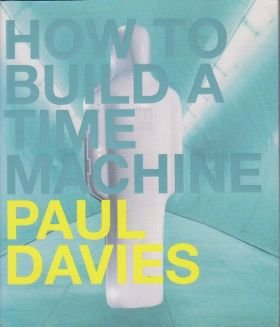
How To Build A Time Machine by Paul Davies (book review).
I had heard of Paul Davies’ How To Build A Time Machine years ago, but Mark Brake’s The Science Of Science Fiction drew it back to my attention, and I found it relatively (sic) easy to lay my hands on a copy. You do have to wonder who his intended audience is. The illustrations are literally illustrations, of the kind that would probably appeal to a younger audience, unless he or his publishers simply wanted to keep the price down. In his introduction, he cites a couple of examples, including Doctor Who, Back To The Future and Michael Crichton’s film Timeline rather than the book version. I’ve seen neither version of the last one. Carl Sagan’s Contact, both book and film, is also mentioned, mostly for its use of wormholes to travel across space. I suspect these examples were included to appease our kind of people because they are only mentioned briefly.
The real focus of this book is on actual time travel. There is a real difference between people’s passage through time in the air or in space, but it is measured in microseconds. You have to get very close to the speed of light to produce a noticeable difference, and then only by slowing your personal time down relative to the rest of the universe, so you effectively travel into the future. The biggest lesson is to remember that time is not static, only relative. Davies lays down the scientific laws that take account of this.
Putting on my science fiction hat, I ended up wondering if there is some hitherto unknown law we haven’t come across yet. Even so, it still comes back to this: if there were time-travelling tourists, wouldn’t we have some relics left behind by now? Then again, considering how we are still digging up fossils from our own past, perhaps, if they have been here, they obeyed their instructions, were litter-conscious and avoided violating anything significant.
For the second chapter, there is more emphasis on singularities and wormholes. I’m a bit concerned about the notion of no subjective time within them. Clocks, assuming they could survive there, could still tick on. If they froze, then anything within them would as well. A reduction in entropy or matter deterioration might be better descriptive terms, except everything would be drawn out thinner than spaghetti, so nothing would be working anyway. Extremes of gravity might allow violations of certain scientific laws, or at least make them behave differently, but would that allow time travel? From my perspective, faster-than-light travel and time travel would need some kind of scientific laws we haven’t spotted yet, or else we have made some basic assumptions that might not be right.
The third chapter deals with the principles of using a generated wormhole to travel through time. The one failing with that is that we don’t have the technology or energy supply, something the size of Jupiter, to start with, and you would also need a time machine in order to go back to where you wanted to go. The thing is, when you consider the distance between star systems, if other species out there were going to travel across those distances, they would have to be applying some form of time travel or they would never reach any existing civilisations when they first detected them. If that were true, then surely there would be some evidence, such as energy signatures, of such activity going on out there.
The fourth and last chapter focuses more on the science fiction dilemmas and paradoxes that we are familiar with. I tend to believe that, assuming there is only one reality, time will act to prevent change, or else any change has already been incorporated into the timeline and allows events to happen the way they should. Watch a film like The Final Countdown and consider the understory we don’t see: what happened in the years left behind by the USS Nimitz that needed a man like Tideman to create advanced aircraft carriers?
This is really a short book, although it deserves some heavy thinking. If you’re considering writing a time travel story, then this book should be included on your reading list as you consider the problems.
GF Willmetts
June 2026
(pub: Allen Lane/Penguin, 2001. 148-page illustrated indexed small hardback. Price: varies. ISBN: 978-0-71399-583-1)