

Ludwig season 2 trailer: David Mitchell returns to solve crimes by looking mildly appalled (trailer).
The first trailer for Ludwig season 2 has arrived, and the good news is that John “Ludwig” Taylor is no longer pretending to be his missing detective twin brother James. The bad news, at least for John, is that he is now openly consulting for the police, which is rather like escaping a bear pit only to be handed a folding chair and asked to judge the bears.
David Mitchell returns as the reclusive puzzle-setter who accidentally became Cambridge’s most useful crime-solving appliance. In season one, John found himself impersonating his identical twin, DCI James Taylor, after James vanished into the kind of conspiracy-shaped cupboard that television detectives are always being shoved into. By the end, the impersonation had unravelled, the police had somehow avoided admitting that several murder cases had been solved by a man whose main qualification was being professionally good at crosswords, and John had been re-engaged as a paid consultant.
Season 2, then, gives the series its neatest possible upgrade. John no longer has to pretend to be a confident copper. He can instead be openly, beautifully, catastrophically himself: a man whose brain is a Swiss watch wrapped in beige anxiety. The trailer suggests more locked rooms, more strange clue patterns, more Cambridge respectability curdling gently at the edges, and more of David Mitchell giving the impression that the entire criminal justice system has been assembled incorrectly from flat-pack furniture.
This is where Ludwig has its odd little magic. It is a detective show, yes, but it is also a comedy about procedure being attacked by logic. Most TV detectives stride into a room and absorb the emotional weather. Ludwig enters a room and appears personally offended by the carpet, the corpse, the witness statements and the fact that someone has used a semicolon badly. He does not solve crimes through machismo, intuition, or a tragic backstory involving rain. He solves them because the universe has made a small mistake and he cannot rest until it has been corrected.
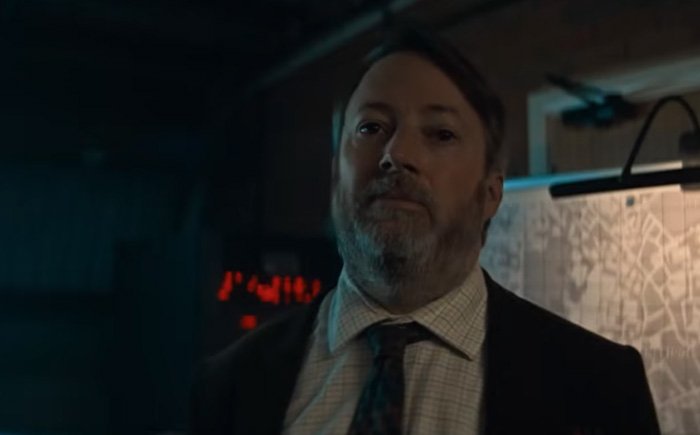
Season 2 being more official should also make the police station funnier. In the first run, half the tension came from John trying not to be discovered. Now the question is not, “Will they realise he isn’t James?” but “How long can an institution tolerate a civilian consultant who is right in the most socially exhausting way possible?” That is a much richer comic seam. The police can no longer simply be fooled by him. They must endure him. This is progress, of a sort. Possibly sideways progress, wearing sensible shoes.
Anna Maxwell Martin is back as Lucy Betts-Taylor, which is essential, because Lucy is the show’s emotional anchor and, more importantly, the person most likely to stop John folding himself into a filing cabinet at the first sign of interpersonal conflict. The missing James mystery is still hanging over the show like a damp overcoat in a hallway. John may now be consulting on weekly cases, but he is also still hunting for his brother, and the first series left enough unfinished business to keep the conspiracy cupboard well stocked.
The trailer’s promise of new faces also hints that the second series may widen the web beyond the police station. Mark Bonnar joins as newspaper editor Gareth Fisher, which feels immediately dangerous. A newspaper editor in a cosy detective mystery is rarely there to improve literacy standards. He will either know too much, print too much, or have the sort of office where incriminating files go to breed. Sian Clifford also joins as local MP Joanne Kemper, and local politicians in crime dramas generally arrive with smiles polished to a parliamentary sheen and basements full of plot.
If season one was about John discovering that murder could be approached as a puzzle, season two may be about what happens when the puzzle starts noticing him back. The “impossible crimes” setup gives the show room to become even more deliciously contrived. Locked rooms. Vanishing witnesses. Bodies discovered in places where bodies really ought to phone ahead. Perhaps a murder at a crossword convention, which feels so inevitable that someone at the BBC may already have laminated the clue cards.
There is also the question of James. Is he victim, conspirator, coward, double-bluffer, or merely the sort of man who causes administrative chaos by being mysteriously unavailable? The first series made it clear that his disappearance was not just a family drama with a detective hat on. There were hidden files, the Sinclair case, and enough institutional fog to make Cambridge look less like a university city and more like a very polite swamp. Season 2 will need to start paying that off, even while leaving enough thread for further unravelling. Nobody wants the entire jumper pulled apart by episode two. We paid for six episodes of wool.
The clever move would be to let John become more competent without becoming comfortable. He should learn how to stand in a crime scene without looking as if he has been delivered there by mistake, but he should never become a slick detective. The joy of Ludwig lies in the gap between his brilliance and his inability to inhabit normal human chaos. Give him a cipher, a timeline, or a murder disguised as a chess problem, and he is unstoppable. Ask him to make small talk with a superior officer, and the entire Cambridge Police Authority may need a structural survey.
Here at SFcrowsnest magazine, we have a soft spot for crime dramas that remember murder can be puzzling without requiring every detective to be a haunted leather jacket. Ludwig is not gritty in the usual bruised knuckle sense. It is cosy, yes, but not sleepy. It is sharp, strange, and faintly anxious, with a hero who treats crime as if it were a misprinted logic grid sent to torment him personally.
Season 2 looks set to give John Taylor the one thing he least wants: professional recognition. The poor man is now officially useful. There can be no greater punishment for a recluse. Bring on the impossible murders, the Cambridge conspiracies, the suspiciously helpful politicians, the newspaper editor with far too much curiosity, and the slow, glorious spectacle of David Mitchell solving homicide while looking as if he would much rather be alphabetising a shed.