
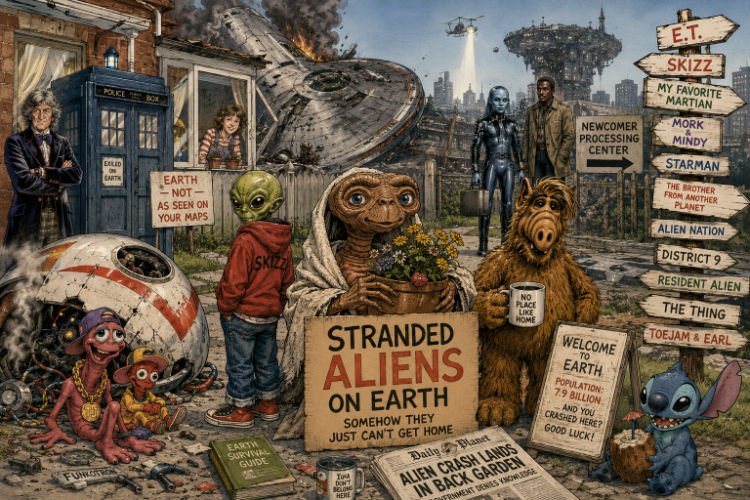
Earth: the Galaxy’s worst breakdown lane? (article).
There is a worrying amount of evidence in science fiction that Earth sits beside some sort of badly maintained interstellar roundabout. Aliens keep crashing here. Not invading, which would at least suggest planning. These are aliens who were travelling somewhere else, popped out for a perfectly ordinary hyperspace jaunt and found themselves embedded in a Californian swimming pool, hiding behind a council estate in Birmingham, or trying to repair a fusion drive using components available from Radio Shack.
Humanity spends an enormous amount of money worrying about hostile extraterrestrials arriving with kilometre-long battleships. Judging by science fiction, we would be better advised to erect a large AA sign on the Moon: BREAKDOWN? EARTH 384,400 KM. TEA AVAILABLE.
The stranded alien is one of science fiction’s oldest and most durable story ideas, Robinson Crusoe turned inside out. Instead of a human being marooned among the strange inhabitants of some distant land, the strange inhabitant is marooned among us. Which, from the alien’s point of view, may be worse.
Daniel Defoe’s Crusoe at least had coconuts. E.T. had American suburbia. The classic version runs on a simple mechanism. Alien arrives. Alien loses access to spaceship. Alien cannot telephone home, except perhaps after dismantling several household appliances. Alien encounters one or more humans. Government departments eventually arrive carrying nets.
This basic machine has powered novels, films, television series, comics, cartoons and video games for decades. Sometimes the alien wants desperately to go home. Sometimes there is no home left to go to. Some visitors decide Earth is preferable. And occasionally one concludes that eating the locals is the quickest solution.
That last branch of the family tree contains The Thing, and we’ll come back to it.
Hal Clement got there early. His 1950 novel Needle crash-lands both an alien policeman and the criminal he is pursuing. Neither resembles a little green man. They are intelligent symbiotic organisms capable of inhabiting other creatures, which turns the stranded-alien story into a detective novel where neither detective nor murderer can stroll into Scotland Yard and explain matters. The hunter is cut off from home and has to find his quarry without harming the humans around him. Science fiction was working this seam long before Elliott discovered someone rummaging around behind the garden shed.
Television soon realised that stranding an alien on Earth had one enormous practical advantage. Once you had paid for the crash in episode one, the rest of the series could be filmed in somebody’s kitchen.
My Favorite Martian turned this into a sitcom in 1963. Reporter Tim O’Hara discovers a Martian whose spacecraft has crashed, whereupon the unfortunate extraterrestrial takes up residence as “Uncle Martin” while attempting to repair his ship. Which establishes another fundamental law of stranded-alien fiction. Whenever an extraterrestrial is forced to live secretly with humans, nobody ever claims they are the plumber. They become an uncle.
Interstellar customs officials are presumably suspicious of plumbers. The later film version kept the whole arrangement intact: broken spacecraft, human helper, alien passing as Uncle Martin, and a long attempt to get back to Mars.
Walter Tevis gave the idea a much sadder spin in the same year. In his 1963 novel The Man Who Fell to Earth, Thomas Jerome Newton comes here deliberately, seeking a solution to the catastrophe consuming his own world. He is not a crash survivor in the E.T. sense, but Earth closes around him anyway. By the time Nicolas Roeg made the film with David Bowie in 1976, the stranded alien had become a metaphor for loneliness, addiction and the sensation that everyone else was issued a copy of the human instruction manual except you.
Alexander Key offered another variation in 1965. In The Forgotten Door, a young visitor from another civilisation falls through a dimensional doorway that closes behind him. Key returned to extraterrestrial children in Escape to Witch Mountain, where Tony and Tia discover that their mysterious origins lie a good deal farther away than the nearest orphanage.
Then Disney produced one of the great pre-Spielberg examples of them all: The Cat from Outer Space, in 1978, which may be the purest proof that nearly any story improves once the stranded astronaut is a cat.
The extraterrestrial, nicknamed Jake, arrives in a disabled spacecraft and possesses advanced technology, telepathy and all the usual advantages of an interstellar civilisation, but is still fundamentally a feline. Somewhere out among the stars there is apparently a civilisation capable of faster-than-light travel whose senior engineering officers occasionally stop halfway through a hyperspace calculation because somebody has opened a tin of tuna.
In 1982, Steven Spielberg detonated the trope culturally with E.T. the Extra-Terrestrial. Note that E.T. does not crash. He is left behind when his companions make a hurried departure, which is worse. A crashed spaceship can be blamed on mechanical failure. E.T. has been forgotten at a motorway service station.
The genius of E.T. is that the alien Robinson Crusoe is also a lost child. Earth is not merely unfamiliar to him. It is frightening. Elliott becomes Friday, except Friday owns a bicycle, Reese’s Pieces and a bedroom full of things that can be converted into telecommunications equipment. Hollywood noticed that audiences had cried approximately enough tears to fill Lake Erie and concluded that more stranded aliens were required immediately.
Britain, meanwhile, looked at E.T., considered the possibilities and asked an important question. What if the alien landed in Birmingham? Thus, in 1983, 2000 AD gave us Skizz, written by Alan Moore and drawn by Jim Baikie. Interpreter Zhcchz of the Tau-Ceti Imperium crashes on Earth, loses his ship and becomes known as Skizz after befriending Roxy, a teenage girl in Birmingham. The strip ran from Prog 308 and turned what might have been straightforward Spielbergian territory into something far more recognisably British.
Skizz is sometimes described as the British E.T., which undersells what Moore and Baikie did with it. E.T. lands in comfortable American suburbia. Skizz arrives in the Britain of unemployment, institutional suspicion and Thatcher-era social tension. One story gives you moonlight bicycle rides over California. The other strongly suggests the extraterrestrial might shortly have to sign on.
Here at SFcrowsnest, we have to admire a country capable of seeing an adorable story about a stranded visitor from the stars and thinking: yes, but what does he make of the Department of Employment?
The emotional mechanism is identical, though. The alien is vulnerable precisely because it is alien. The humans who should possess all the power become frightening, while the ordinary person who offers friendship becomes heroic.
In 1984, Starman inverted things again. John Carpenter’s visitor arrives after being shot down, takes the form of a dead man and travels across America with the dead man’s widow towards a rendezvous where he can finally leave Earth. It is part science fiction, part road movie and part extremely unusual bereavement counselling.
The same year brought John Sayles’ wonderful The Brother from Another Planet, in which a mute extraterrestrial fugitive arrives in New York and tries to survive while bounty hunters pursue him. Here the alien castaway becomes an immigrant story with almost none of the usual science-fiction furniture. The stranger’s experience of America is shaped by race, poverty, work and community rather than ray guns.
A stranded alien is almost automatically an immigrant. They have arrived somewhere they did not grow up. They may not speak the language. Their customs are wrong. Their paperwork is certainly inadequate. They might desperately want to go home, while the locals cannot decide whether to welcome them, exploit them, study them or put them in a detention centre. Science fiction did not have to work very hard to turn that into social commentary.
It did, however, work extremely hard to turn it into ALF. In 1986, Gordon Shumway from the planet Melmac crashes into the life of the Tanner family. Since Melmac has been destroyed, ALF’s situation is a good deal bleaker than the studio-audience laughter suggests. E.T. needs to build a telephone. ALF has nobody left to ring.
That is another important branch of alien Crusoe fiction: the castaway whose island is permanent. Superman is the enormous superhero version of the same idea. Krypton is gone. Earth is not where he intended to grow up, but there is no return ticket. Supergirl shares the fundamental displacement. Martian Manhunter has often embodied it even more directly, an adult alien carrying memories of another world while making a life among humans.
Even Doctor Who spent several years playing this game. At the end of the Second Doctor’s era, the Time Lords sentence him to exile on Earth and block his ability to operate the TARDIS properly. Jon Pertwee’s Third Doctor therefore spends much of his early tenure marooned here, working with UNIT and behaving like Robinson Crusoe if Crusoe had owned a velvet smoking jacket, a vintage roadster and sufficient Venusian aikido to knock Friday unconscious. The Time Lords restored his freedom in the end.
Mork & Mindy belongs somewhere nearby, although Mork is not really stranded in the strict sense. He has been sent to Earth to observe humanity and reports back to Orson. The series lives on exactly the same comic fuel: a civilisation examines Earth and discovers that its dominant intelligent species invented both nuclear weapons and daytime television.
The joke in almost every stranded-alien sitcom is secretly the same one. The alien is not weird. We are. Drop someone from another planet into a suburban family and suddenly all the things humans regard as normal need explaining. Dating. Money. Offices. Christmas. Television advertising. Why people spend five days doing something they dislike in exchange for money and then use part of the money to purchase alcohol that makes them temporarily forget about the five days.
The alien is anthropology with antennae. My Parents Are Aliens later worked the same seam for British children’s television, while 3rd Rock from the Sun removed the stranded element but kept the extraterrestrial study of human absurdity. Resident Alien, first in Peter Hogan and Steve Parkhouse’s comic and then on television, takes the idea somewhere darker and stranger: an alien stuck on Earth assumes the identity of Dr Harry Vanderspeigle and slowly becomes entangled with the species around him.
If E.T. learns that humans can love, Harry initially has to learn why killing them all might be considered poor bedside manner.
Not all stranded aliens are individuals. In 1988, Alien Nation scaled the premise up until Robinson Crusoe became Robinson Crusoe Housing Estate. Hundreds of thousands of extraterrestrial Newcomers arrive aboard a spacecraft and become part of human society, complete with prejudice, segregated neighbourhoods, employment and crime. The film spawned television and further stories built around first contact becoming permanent immigration rather than a weekend visit from Klaatu.
This reaches its brutal logical conclusion in District 9. An enormous alien ship appears over Johannesburg, but instead of an invasion force humanity finds more than a million malnourished extraterrestrials aboard. They are brought down to Earth and placed in what becomes a sprawling refugee settlement. The stranded visitor has ceased to be cute. There are too many of them. They are poor. They need feeding. Their technology is valuable. Suddenly humanity’s welcome mat starts developing barbed wire.
District 9 works because it understands how radically numbers alter sympathy. One E.T. hiding in your cupboard is enchanting. A million E.T.s requiring housing might produce a rather different newspaper headline. The individual alien asks whether we can love someone different. The alien refugee population asks whether we still feel the same way when somebody needs a school place.
Other stories have played variations on the refugee version. Defiance gives Earth whole populations of displaced extraterrestrials. Roswell builds teenage identity stories on descendants and survivors of an extraterrestrial crash. Zenna Henderson’s The People stories imagine alien survivors quietly living among humanity long before many of the more famous screen versions arrived.
Sometimes the stranded visitor just gets unlucky with the date. Michael Flynn’s Eifelheim is the loveliest example. An alien vessel comes to grief in fourteenth-century Germany, which creates a serious technical problem. If your antimatter regulator fails in Los Angeles, there is at least a theoretical possibility that somebody at Caltech might understand the diagram. If it fails in medieval Germany, the local repair facilities consist largely of a blacksmith and a monk.
Flynn’s stranded aliens arrive just as plague approaches, which lets the novel explore religion, science, mortality and genuine attempts at communication between minds separated not only by species but by radically different understandings of the universe. The Krenken are castaways in a society that could not possibly build them a way home.
Parke Godwin went considerably further in Waiting for the Galactic Bus. Two alien brothers end up stuck on prehistoric Earth after missing their opportunity to leave, interfere with developing humanity and then hang around long enough to become entangled with the origins of human religion.
This is what happens when Robinson Crusoe is marooned for several million years and gets bored. Douglas Adams found an equally elegant comic version in Ford Prefect. Ford arrives on Earth to update The Hitchhiker’s Guide to the Galaxy, expects a brief research trip and ends up stuck here for fifteen years because he cannot obtain a lift off the planet. He therefore spends years on Earth knowing two things humanity does not. First, Earth is nowhere near as important as everyone thinks. Second, the pubs close absurdly early.
When rescue finally comes, it arrives in the form of the Vogon demolition fleet. There is a lesson here for all stranded extraterrestrials: when waiting for the bus, check the destination board carefully. Video games discovered that the stranded-alien premise offered something even better than comedy or social commentary. It provided an objective. ToeJam & Earl may therefore be the most mechanically perfect Robinson-Crusoe-alien story ever created. ToeJam and Earl, aliens from Funkotron, crash their spaceship on Earth. The ship breaks into pieces. You explore Earth, recover those pieces and rebuild the ship so they can leave.
That is it. No prophecy. No ancient evil awakening beneath a mountain. No forty-seven-minute cinematic explaining the metaphysics of the Omega Crystal. You crashed the car. Find the bits.
Earth itself becomes a surreal collection of floating levels filled with bizarre humans, which means the game understands the old stranded-alien joke perfectly. Viewed from Funkotron, human beings are the monsters.
Alien Hominid turns the same situation into frenetic violence after its extraterrestrial hero is shot down by the FBI. Stupid Invaders, derived from the animated series Space Goofs, gives us an entire household of incompetent extraterrestrials marooned here. Pikmin provides a beautifully sideways version, with Captain Olimar crash-landing on a mysterious planet strongly implied to be Earth and gathering pieces of his spacecraft before his life support expires.
The human race is absent from Olimar’s immediate predicament, which may explain why his survival prospects are relatively good. Then there is The Thing.
John W. Campbell’s Who Goes There? and its film descendants give us the dark mirror of E.T. An extraterrestrial is stranded on Earth. It encounters humans. It needs to survive. So far, exactly the same story. The disagreement concerns methodology. E.T. befriends Elliott. The Thing befriends Elliott, absorbs Elliott, perfectly imitates Elliott and waits patiently for Elliott’s mother to come downstairs. Robinson Crusoe has eaten Friday.
The idea has survived this long because it is not really a plot at all. It is a perspective machine. Put an alien on Earth without easy access to home and you can tell almost any kind of story you like.
Hand the premise to children’s fiction and the alien becomes the ultimate lonely outsider in need of friendship: E.T., Earth to Echo, Lilo & Stitch, Farmageddon. Comedy turns the same alien into the observer who exposes the lunacy of ordinary human behaviour, which covers My Favorite Martian, ALF, Mork & Mindy and Solar Opposites. Social science fiction makes them an immigrant or a refugee, and you get The Brother from Another Planet, Alien Nation and District 9. Horror gets an outsider with no reason whatsoever to respect the sanctity of your internal organs. Games get ten missing spaceship components scattered over twenty-five levels.
The premise also does something most science fiction cannot. Most science fiction sends humans elsewhere so that writers can invent alien societies. The stranded alien reverses the traffic and makes Earth the alien society. Supermarkets become bizarre. Dogs are alarming. Religion requires explanation. Cars make no sense. Humans possess thousands of nuclear weapons but cannot agree on which side of the pavement to walk down. We send spacecraft beyond the Solar System while people become furious because somebody put pineapple on a pizza.
The visitor gives science fiction permission to look at us from the outside. Which is why the best examples stop being about whether the spaceship can be repaired. E.T. wants to leave, but the film is really about childhood and loss. Skizz is about an alien in Birmingham and also about the people Thatcher’s Britain was leaving behind. The Man Who Fell to Earth is a tragedy about alienation in every sense of the word. District 9 barely needs extraterrestrials at all to make its point about refugees, segregation and bureaucracy. Resident Alien asks what happens when an outsider spends so long pretending to be human that humanity starts getting into him.
Being stranded changes the castaway. Sometimes they find a way home. Sometimes they choose not to go. Sometimes home has disappeared. And sometimes, after several seasons and a respectable syndication deal, going home would put the entire supporting cast out of work.
That is probably the real appeal. We have all been the alien at some point. The new child at school. The new employee who does not know where anything is. The tourist staring at a ticket machine while a queue forms behind them. The guest at somebody else’s family Christmas wondering whether what just happened is a cherished local tradition or the opening move in a murder.
Science fiction makes the metaphor literal. Some poor traveller has fallen out of the sky, their phone has no signal, their vehicle is written off and the indigenous population keeps asking whether they come in peace.
Usually they do. Although if it has been lying frozen beneath Antarctica for a hundred thousand years, perhaps leave it there. So: should a flying saucer ever crash in your back garden, do not telephone the military. Take the occupant inside. Offer tea. Find out whether it breathes oxygen. Keep it away from the cat unless it actually is the cat.
Then ask the most important question in interstellar diplomacy. “Have you tried turning the spaceship off and on again?”
