

Ghibli Park is growing a Toxic Jungle, and we demand a full-size Pirate Airship (news).
Studio Ghibli has apparently looked at its enormous park in Aichi, looked at the millions of people already wandering around it pretending not to cry in front of Totoro, and concluded that what the place really needs is a Toxic Jungle. Excellent.
Aichi Prefecture has officially unveiled plans for the third phase of Ghibli Park, with a substantial new indoor attraction based on Nausicaä of the Valley of the Wind. It is planned for the West Entrance Plaza of the Expo 2005 Aichi Commemorative Park, better known these days as Moricoro Park, which contains Ghibli Park’s existing five areas. The new building would sit around Koi-no-Ike pond, across from the general vicinity of Ghibli’s Grand Warehouse. No opening date has yet been given.
Before anyone starts booking flights for next Easter, the project is still at the stage where Japanese officials are sharpening their pencils and discovering precisely how expensive pencils can become when attached to a major public construction project. Aichi plans to put around ¥387 million into the supplementary budget for the basic concept, geological surveys and design work. That is emphatically not the cost of constructing Nausicaäland. It is the money required to work out what Nausicaäland ought to be, whether the ground will hold it up, and approximately how many additional zeros will subsequently be required. Japanese construction media reports that the aim is to complete the basic concept and design during the 2026 financial year.
The choice of Nausicaä is rather wonderful. Although the 1984 film predates Studio Ghibli itself, it is the great proto-Ghibli ancestor from which much of Miyazaki’s later ecological, technological and anti-war obsessions scuttled forth. Aichi says Studio Ghibli itself suggested using Nausicaä because the new development required something with enough pulling power to persuade people to stay longer and return to the park.
There is also an unexpectedly practical reason for putting it indoors. Japan in summer can make standing outside feel like participating in an experimental cooking technique. Aichi studied visitor movements and found that people spend particularly long periods in Ghibli’s Grand Warehouse and the Valley of Witches, but long stays in the largely outdoor Valley of Witches decline during summer. The authorities concluded that a large, air-conditioned indoor attraction on one of the park’s busiest walking routes would simultaneously give visitors more to do and reduce the chances of them becoming Studio Ghibli-branded raisins.
The study is surprisingly interesting because it also reveals how people actually use Ghibli Park. Visitor movement forms roughly a figure-eight around the Grand Warehouse, West Entrance, Dondoko Forest and the other attractions. Rather than simply asking where there was an empty field and parking Miyazaki’s imagination on it, Aichi compared possible sites and selected the West Entrance because it sits beside this main flow of visitors, can apparently accommodate development without major new earthworks, and can coexist with the existing public park.
Which brings us to the important question: what should they actually put inside?
Here at SFcrowsnest magazine, we are prepared to perform this vital consultancy work for considerably less than ¥387 million. Indeed, we’ll settle for flights, a nice Nagoya hotel and one of those little black soot-sprite things.
The obvious centrepiece is an Ohmu.
Not a tasteful model behind glass. Nobody flew halfway around the planet for Tasteful Model Behind Glass Land. We require a vast, full-scale animatronic Ohmu emerging from the darkness of the Sea of Corruption, with hundreds of eyes switching from calm blue to incandescent red when some tourist ignores the signs and tries to climb on it. Ideally it should move. Slowly. Very slowly. Just sufficiently slowly that your rational brain knows you are safe while the primitive portion at the back starts composing its will.
The indoor setting positively begs for a recreation of the Toxic Jungle itself. Towering fungal columns, luminous spores, strange insects disappearing overhead and a subterranean chamber where visitors descend beneath the poisonous forest to discover the purified world below. Ghibli Park works best when it allows you to inhabit environments rather than merely queue for a machine, and Nausicaä contains perhaps the richest environment Miyazaki ever created.
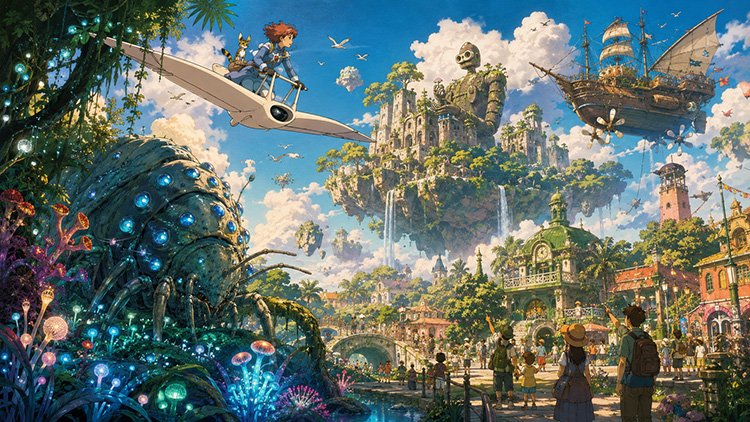
There also has to be a Mehve.
Ghibli Park has so far resisted becoming Japanese Disneyland, and that is part of its charm. It is largely about walking into places which previously existed only in paint and pencil. So a screaming Mehve rollercoaster called NAUSICAAAAA: EXTREME ECO-WARRIOR would probably result in Hayao Miyazaki personally arriving with an axe.
But a suspended flying experience could be glorious. Put visitors aboard a Mehve-style glider, move it gently through a huge projection-and-miniature landscape and let them skim above the Valley of the Wind, the jungle and the advancing Ohmu herd. Think less rollercoaster and more moving Studio Ghibli painting. If they can arrange for your hair to blow heroically rather than reveal the precise location of your bald patch, all the better.
A life-sized Valley of the Wind settlement would make sense too, with Nausicaä’s workshop, her collection of purified plants, the windmills and one of the film’s wonderfully improbable aircraft sitting in a hangar. Given the purpose of the building is partly to keep visitors lingering indoors, cafés and shops are virtually inevitable. Someone is therefore surely already calculating how much Western tourists will pay for blue Ohmu-eye pudding.
There is plenty of theoretical room for Ghibli Park to continue expanding. The entire Expo memorial park covers about 194 hectares, while the five dedicated Ghibli areas constructed so far occupy only roughly seven hectares between them. That headline number is deceptive, however. Moricoro Park remains a proper public park containing woodland, gardens, lawns, an ice rink, sports and cultural facilities, roads and existing visitor infrastructure. Ghibli cannot simply annex 187 hectares and build Miyazaki World until Nagakute disappears beneath animatronics.
Indeed, Aichi’s own work on the Nausicaä project shows that future expansion will probably be surgical rather than imperial. The authorities looked at places including the Great Lawn, Aichi Art Square and West Entrance Plaza before deciding the West Entrance gave them the best combination of space, visitor flow and compatibility with what was already there. That suggests further developments could appear as new nodes dotted around the greater park rather than a single contiguous Ghibli kingdom surrounded by a moat and guarded by lawyers.
And if anyone from Studio Ghibli is reading, we have suggestions.
First, Castle in the Sky. Obviously.
There are already tantalising scraps of Laputa throughout Ghibli Park. The Grand Warehouse contains the ruined Garden in the Sky with its Robot Soldier and a giant flying ship overhead. The Valley of Witches has a children’s Flying Machine attraction explicitly inspired by Castle in the Sky, with Laputa and the Tiger Moth incorporated into it. These are splendid appetisers. We would now like dinner.
Give us an actual Laputa area.
Imagine entering through Pazu’s mining town, climbing towards a stone tower while distant machinery clanks beneath you. You board an elevator or funicular and emerge onto the floating ruins of Laputa, surrounded by vines, water and shattered stonework. There, standing among the flowers, is a genuinely full-size Robot Soldier.
And not another static one.
We want the enormous fellow to move.
Not quickly, because several thousand adults simultaneously fleeing an eight-metre robot would create paperwork. Let him rise slowly, turn his head, extend an enormous hand, tend the flowers and interact with the little fox-squirrels. Modern animatronics can produce creatures astonishingly close to film characters. If Disney can make a Na’vi blink convincingly, Studio Ghibli can surely build a melancholy gardening robot capable of reducing half the audience to tears before lunch.
Then build the Tiger Moth.
Full size.
Dola’s pirate airship is practically an attraction waiting for someone to notice. Construct it as a walk-through vessel with cabins, engine rooms, observation bubbles and Dola’s bridge, suspended partly above the landscape so visitors genuinely feel as though they have boarded an enormous flying machine. The park already understands that Ghibli technology should look oily, riveted, slightly dangerous and apparently repaired by somebody’s uncle in a shed. A proper Tiger Moth would be engineering pornography for anyone who has ever stared lovingly at one of Miyazaki’s aircraft.
And while we’re committing imaginary billions, Spirited Away remains the elephant-sized No-Face in the room. A full-scale Aburaya bathhouse would immediately become one of Japan’s most photographed buildings. Build the bridge, boiler room, kitchens and several floors of increasingly peculiar bathing chambers. At night the lanterns come on and No-Face starts wandering about. Ideally he does not accept credit cards.
Better still, connect parts of the enormous park with Chihiro’s train.
This one almost makes practical sense. Ghibli Park is spread out. The official walking distances from the station reach around 1.3 kilometres to Dondoko Forest, and even the Grand Warehouse to Dondoko Forest walk can approach 850 metres depending on route. Instead of another ordinary shuttle bus, construct a slow electric railway inspired by the spectral train travelling across the flooded landscape in Spirited Away. Suddenly transport itself becomes an attraction, which is exactly the sort of quiet, slightly strange solution Ghibli Park does well.
Porco Rosso deserves a Mediterranean corner as well. A lagoon, Hotel Adriano, Porco’s red Savoia S.21, Piccolo’s aircraft workshop and perhaps a gentle flying-boat attraction would suit the park beautifully. There is already a Savoia S-21 display elsewhere at Moricoro Park, so clearly somebody in management has excellent taste.
Then there is The Boy and the Heron, which practically comes supplied with its own theme-park architecture. Build the mysterious tower in the woods and let visitors pass through its increasingly impossible rooms into the other world. No ride necessary. Doors, staircases, pelicans, parakeets and architecture behaving badly would do nicely.
And perhaps that is the trick Ghibli Park should continue to understand. Its greatest advantage over Disney and Universal is that it does not need to compete with them. Nobody particularly requires Totoro: The Ride, in which the Catbus accelerates from zero to 70mph before throwing you through a loop while someone screams “MEIIII!” over a loudspeaker.
Ghibli’s films are places before they are franchises. We want to walk into the Valley of the Wind. We want to open Howl’s bathroom door. We want to stand beneath Laputa’s trees and hear the Robot Soldier approaching through the ruins.
And, yes, we absolutely want to climb aboard Dola’s pirate airship.
For Western visitors contemplating the pilgrimage already, there is one peculiarity worth knowing: Ghibli Park tickets are not normally something you book six or twelve months ahead. The overseas system currently releases tickets two months in advance, on the 10th of each month at 2pm Japan time. At the time of writing, October 2026 tickets have just gone on sale. Overseas buyers can purchase through Lawson Ticket or Klook from the official Ghibli Park ticket page, while accommodation packages are also offered through JTB-linked travel companies. Reservations are date-specific, the Grand Warehouse has a timed entry, and once purchased the tickets generally cannot be changed or cancelled. In other words, plan carefully, because Calcifer is not running customer services.
The current Premium O-Sanpo Day Pass, which covers all five areas and the designated buildings including Howl’s Castle and Satsuki and Mei’s House, costs ¥7,300 on weekdays and ¥7,800 at weekends and holidays. At exchange rates around 11 August 2026, that is roughly £34-£36 or $46-$49 for an adult, plus ticket service charges. The cheaper Standard pass costs ¥3,300-¥3,800, roughly £15-£18 or $21-$24, although it excludes Hill of Youth, Dondoko Forest and access inside several premium buildings.
Considering what major Western theme parks now charge merely for the privilege of entering the gift-shop blast radius, Ghibli Park remains strikingly inexpensive. Your airfare to Japan will cost rather more, although at least nobody has yet introduced a £30 Lightning Lane allowing you to overtake an elderly Japanese grandmother on the path to Totoro.
So Phase Three looks promising. A giant indoor Nausicaä world is exactly the sort of expansion that could give Ghibli Park another major attraction without destroying the leisurely, exploratory character which makes it unusual.
But after that, gentlemen, we need to discuss Laputa.
We have waited since 1986.
Build the robot.
Build the Tiger Moth.
We will come.
