
Ann Droid: Diane Morgan Puts the Artificial into Social Care (TV trailer).
The BBC has released Ann Droid, a new science-fiction comedy in which Diane Morgan plays a second-hand robot employed to care for an elderly widow. This is clearly speculative fiction, because the machine arrives, attempts to do the job and does not immediately demand that Sue complete a forty-page online eligibility assessment.
Written by Morgan and Sarah Kendall, the six-part series introduces Linda, an AnnDroid Z58/100 Basic Eldercare Robot. The “Basic” is important. Linda is not one of those sleek, sinister machines found wandering around billionaire-funded laboratories while reassuring reporters that humanity has nothing to fear. She has a severe red wig, the social grace of a parking meter and the unsettling attentiveness of someone who has just discovered your browser history.
Linda has been purchased second-hand by Michael, played by Paul Ready, for his widowed mother Sue, played by Sue Johnston. Michael is moving out of Sue’s house to repair his marriage, an undertaking he has apparently attempted before with all the dependable precision of a Windows update. To make himself feel better about leaving, he supplies his mother with a robot capable of monitoring her health, keeping her company and taking pressure off the NHS.
Presumably it also allows the NHS to concentrate on its traditional duties of sending appointment letters after the appointment has taken place.
Sue is not delighted. Linda is overly helpful, painfully literal and incapable of recognising the subtle British distinction between “That would be nice” and “I would rather crawl into the sea”. She is technically advanced but socially several firmware updates behind the average Labrador.
Fortunately, Sue soon discovers that possessing a humanoid robot has advantages. Linda can tackle chores, pursue grievances and deal with the sort of unfinished business that adult sons have been promising to sort out “next weekend” since the invention of the loose cupboard hinge. What begins as an unwanted care arrangement develops into an odd-couple friendship between two beings society has begun treating as obsolete.
That is where Ann Droid finds something meatier beneath the mechanical slapstick. Artificial intelligence is usually presented on television as either humanity’s magnificent new servant or the thing that will turn our skeletons into decorative furniture. Here, the technology is less concerned with conquering civilisation than remembering Sue’s medication and stopping her from falling over.
This is arguably the more plausible robotic future. Skynet requires an enormous military infrastructure. A machine that asks whether you have taken your blood-pressure tablets can be built by a start-up in Reading and sold to a local authority before lunch.
The central question is not whether Linda possesses a soul, although science fiction has been rummaging enthusiastically through that particular drawer since Karel Čapek gave us the word “robot”. It is whether care can be reduced to a set of functions. A machine may monitor a heartbeat, detect a fall and remind someone to drink water, but companionship is not merely the absence of a medical emergency.
There is also something quietly pointed about Michael outsourcing responsibility for his mother to a machine because he is busy repairing the rest of his life. Linda may be socially inept, but at least she turns up. As artificial intelligence becomes more sophisticated, humanity may discover that the alarming thing is not how closely robots resemble us, but how readily they expose our own malfunctioning.
Morgan is particularly well suited to playing Linda. Her comedy has always thrived on characters who appear to have received incomplete instructions about how ordinary human behaviour works. Philomena Cunk approached civilisation as though it were a misunderstanding nobody had bothered to correct. Mandy charged through life with the survival instincts of a shopping trolley released onto a motorway. Linda belongs to the same broad family, although this time her bafflement has been installed at the factory.
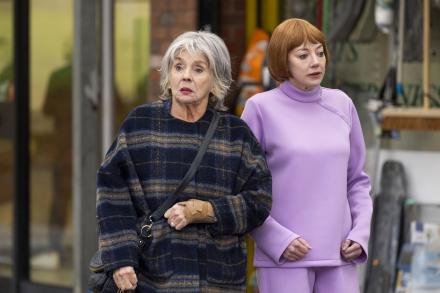
Sue Johnston supplies the necessary human ballast. Sue is grieving for her husband David, irritated by her son and understandably hostile to being treated as a maintenance problem. The programme’s emotional machinery depends upon her being more than a standard sitcom pensioner who swears, drinks gin and shocks younger relatives by knowing what sex is.
The pairing gives Ann Droid the shape of a traditional buddy comedy, except one buddy is processing bereavement while the other probably requires a proprietary charging cable that was discontinued in 2027.
Here at SFcrowsnest, we have long suspected that the first domestic robots will not resemble the polished synths of Humans or the elegant hosts of Westworld. They will be bought refurbished, arrive without the manual and insist on announcing private medical information while the window cleaner is outside.
Ann Droid therefore looks less like a grand prophecy of the machine age and more like Britain’s likely version of it: underfunded, faintly embarrassing and held together by two women trying to make the best of somebody else’s bright idea.
All six episodes of Ann Droid are available on BBC iPlayer, with the series also airing on BBC One.

My girlfriend wanted to watch Ann Droid as a thing about carers and I didn’t really think of it as SF, though it clearly is, but as a BBC situation comedy. It is very funny in places. Worth watching.