

When I started reading this book, The Loafers Of Refuge, I was going to make the point that just because you might not recognise an author’s name is no reason not to try their books. Joseph L. Green died in February this year at the age of 86 and wrote five SF novels and many short stories. I’ve included his initial because there is more than one author with that name since this book, The Loafers Of Refuge, came out. The book was originally released in 1965 by Gollancz, combining short stories from New Worlds Science Fiction from 1962-63, with this reprint published in 1967 by Pan Books.
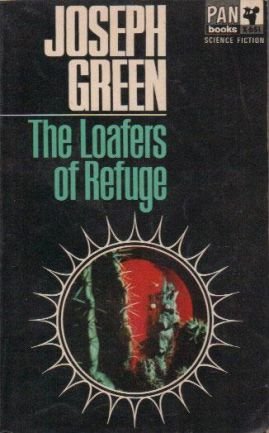
Refuge is a colony planet for humans and the local inhabitants, the Loafers. They get the name for apparently being idle, at least by human standards. These hairy individuals have their own lives and initiations and are essentially telepaths in tune with their habitat. Carey Sheldon has reached his 18th birthday and, eager despite his mother’s protests, wants to take part in their Controller’s initiative and gain their telepathic ability. I wouldn’t recommend trying Sheldon’s technique for enlightenment. Eating snow, no matter its fluffiness, is not good for the stomach. From a new-century perspective, think of it as humans having to go through a purging to gain telepathic ability.
It became pretty obvious as I read his first adventure as a Controller, with Timmy his Loafer buddy, that I think I might have read it before. With anthologies, I’m bound to have come across all sorts of authors. If anything, it demonstrates how colonisers have to get on with the local natives and how compromises have to be reached. In some respects, this would also be a problem in general fiction.
Certainly, Doreen Sheldon’s experiment with Phazz, a young breshwahr telepathic tree, and the teleportation to Earth is something I remember. The teleportation would not allow the transportation of live species, but Phazz was able to show how to do it, although it could only be limited to sentient species.
The last story follows Timmy on his great havasid, or journey, to see the other tribes. What he sees distresses him, as his society is absorbing human habits. None of this is helped by the fact that humans and Loafers can’t produce offspring, and even he was formerly engaged to Doreen. This revelation changes Timmy significantly and encourages him to keep his tribe separate.
In many respects, Science Fiction has often explored how humans aren’t superior to a native species that looks unsophisticated but is really more advanced. Green’s Loafers didn’t so much hide their psionic talents as become more at one with nature. Even so, you would have to ask yourself why they would want mass colonisation from Earth, which could still damage their environment through expansion.
Although I doubt the overall theme evolved deliberately over Green’s stories, in general terms this is a common theme in SF: understanding the repercussions of different societies getting along with each other and how far they should change. We see that a lot in our own societies, especially with equality. Any political or religious system that controls by force is ultimately going to fail, as new generations will have their own revolutions. Lest we forget, the suffragette movement in the UK was a struggle for equality. It wasn’t an easy change. Think of what will happen when we meet our first extra-terrestrial species. I doubt we’d be superior, and there is bound to be social upheaval. Maybe the pilots of the UAPs know this and keep away for that reason. Books like this one are worth picking up for a read and a think.
GF Willmetts
June 2026
(pub: Pan Books, 1967. 175-page paperback. Price: varies. ISBN: X651)




Join the conversation (0)