

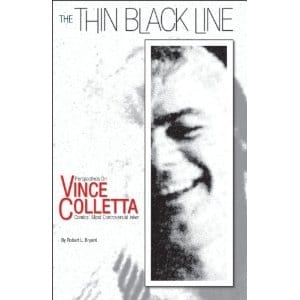
The Thin Black Line: Perspectives On Vince Colletta by Robert L. Bryant, Jr. (book review).
‘The Mystery of Vince Colletta! Hero or Villain? You decide!’ So says a dramatic, comic-style black box at the start of ‘Chapter 1: The Controversy.’ Other chapters are titled ‘Inking Asgard’, ‘Rivets And Trees’, ‘The Fourth World’ and ‘The Guy On The Assembly Line’. There’s an introduction with quotes from various debaters in an on-line chat about Vince Colletta which was curtailed when his grand-daughter posted to say he was a very good family man and it wasn’t nice to say bad things about him.
Which is true, so I won’t. But as a dedicated Jack Kirby fan, I can see why the really, really dedicated Kirby fans are bitter and twisted. Colletta treated all pencil artists the same way. He inked the pages as fast as he could and sometimes rubbed out stuff that would have taken too long. For most artists this was annoying and for fans of Kirby, who discovered the sins years later by virtue of ‘The Jack Kirby Collector’, it was blasphemy. For to some of them, it seems, Kirby is a god.
The funny thing is, Jack understood Colletta’s motivation better than they did. When Kirby was asked about inkers, he usually said that they were all men trying to earn a buck to feed their families and that was fair enough. Kirby and Colletta grew up in 1930s depression era America and knew about poverty. Neither had any notion that the comicbooks they were turning out would one day be regarded as ‘art’ and both worked hard to do as many pages per day as possible, because they were paid by the page.
That said, there is the integrity of the craftsman. Kirby and many other pencillers genuinely tried to do the best work possible in the circumstances and, sometimes, to stretch the medium a little. Colletta was really only in it for the money. He had bought a large house in New Jersey in 1960 and had to cover the costs of paying for it and keeping a wife and children. To that end, he worked. Usually, like Kirby actually, he worked late at night. Sometimes he would work for days at a time, catnapping next to his drawing board then starting again. Unlike Kirby, he liked a bit of socialising in the day. He was fond of hinting at Mafia connections and liked to hang around in bars, gamble on horses and so forth. Through his photography, he knew many models and actors. He was apparently very affable and got on well with nearly everyone.
He was also a godsend to editors who were up against a deadline. If a comic was late to the publishers there were heavy penalties and if one month’s issue didn’t make the stands it would mean a severe decline in sales. Colletta was the go-to guy in a crisis as he could turn out pages faster than anyone else. They might not have been the best pages but they were delivered on time. Alas, Kirby was never, ever late with his pages but Colletta would have other stuff to do at the same time, so Jack’s work got skimped, too. A great shame, as the chapter ‘Inking Asgard’ shows.
In assessing Colletta, it’s important to understand Italians or Sicilians in his case. Family is everything. A father’s job is to provide for his wife and kids. Nothing is more important than that. If being a good provider meant rubbing out a few excess Asgardians in a panel or making a detailed figure into a silhouette, so be it. They were, after all, ten cent comic books, not the Sistine Chapel. Oddly enough, Colletta could do excellent work and sometimes did. His style didn’t suit Kirby particularly well but he did a pretty good job on a lot of stuff. There’s a panel on page 88 here, from ‘In The Days Of The Mob’, that shows his talent. On other artists, he often did even better. I was reading Essential Daredevil # 5 recently and was very impressed with his inks on Bob Brown in the Deathstalker story.
Hero or villain? Far too dramatic a choice. Dedicated artist or dedicated family man? That’s more realistic and he was indubitably the latter. I imagine he is resting in peace. This book is a fair assessment of Vince Colletta with many interesting anecdotes from his colleagues and it’s nicely illustrated too. Worth a look.
Eamonn Murphy
March 2013
(pub: TwoMorrows Publishing. 128 page illustrated small softcover. Price: $14.95 (US). ISBN: 978-1-60549-028-1)
check out website: www.TwoMorrows.com