
A Sense Of Wonder by John Wyndham, Murray Leinster and Jack Williamson (book review).
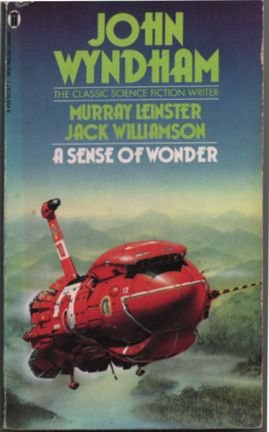
When you look at the cover of this fifth reprint of the book, the title, A Sense Of Wonder, is almost lost beneath the far more prominent names of the three authors: John Wyndham, Murray Leinster and Jack Williamson. Its 1982 title was actually Three Stories, which is hardly the sort of thing to send readers stampeding to the bookshop.
The introduction by Sam Moskowitz explains that these three stories from the 1930s had never been reprinted before, but what made them stand out was how they helped raise the bar for science fiction at the time. In this century, that kind of leap forward feels increasingly rare, so there are still lessons to be learned from these older tales.
John Wyndham’s story, ‘Exiles On Asperus’ from 1933, has various species marooned together and explores how they cope on a habitable asteroid. We initially follow a prison spaceship when an object crashes into it, killing the guards. The Martian political prisoners seize control and dump the remaining seven crew members onto the Asperus asteroid, unaware that one of the crew has drained their fuel supply, forcing the Martians to return later. The mysterious object contains a message from another spaceship already stranded on the asteroid. The abandoned crew seek them out and discover various marooned species adapting to their situation before the Martians return. Change is very much in the air, and the rest is spoiler territory. It can occasionally become confusing as to who was enslaved by whom, and you may need a checklist to keep track of the shifting loyalties, but Wyndham already shows the knack for writing stories that pull readers in.
Murray Leinster’s story, ‘The Mole Pirate’ from 1934, has one major flaw, although it was a common scientific assumption of the period: atoms were believed to resemble miniature star systems. That notion lingered well into the 1960s if you remember your Fantastic Four and Incredible Hulk comic books. Leinster’s inventor, Jack Hill, applies the logic of magnetic alignment and a thorium-based paint to create a mole-like vehicle capable of becoming intangible. Unfortunately, scientific mastermind and wanted criminal James Durran steals it and embarks on a spectacular crime spree, eventually working out how to construct an airlock so his gang can emerge safely during their robberies. What is especially interesting is that Hill openly explains his plans to stop Durran using a second mole machine, with the details appearing in the press. Durran reads the story and promptly destroys Hill’s factory. I think this is the first time I’ve encountered an SF story using the media in this way as part of the plot, and the fact that the tale is now ninety-two years old makes it even more remarkable. It is always enjoyable to read science fiction genuinely ahead of its time, and Leinster’s story certainly qualifies.
Oddly, Jack Williamson’s story, ‘The Moon Era’ from 1931, leans far more towards science fantasy than hard science fiction. It begins strongly, with millionaire Enfield Conway offering his nephew, Stephen, both his fortune and an annual stipend if he agrees to use a revolutionary new technology to travel to the Moon. Although the device is described as cancelling gravity, it feels more like an inertialess drive. Stephen is not expected to leave the craft upon arrival, merely to make observations and return safely to Earth. The journey itself is described in considerable detail and even hints at some form of time dilation. However, Stephen soon discovers that the Moon he reaches, despite its one-sixth gravity, resembles a jungle world. Naturally, he climbs out to explore. The rest is spoiler territory. The story is largely saved by Williamson being an engaging writer, although it does feel like the odd one out in the collection until you remember that, back in 1931, nobody really knew what the Moon looked like and many people still believed Venus might be habitable.
Although A Sense Of Wonder is very much a mixed bag, the number of reprints suggests readers over the decades have clearly seen something worthwhile in it. It is certainly worth a look, especially if you can track down the edition with the Chris Foss cover.
GF Willmetts
May 2026
(pub: New English Library, 1982; first published in 1967. 175-page paperback. Price: varies. ISBN: 0-4510-02247-1)