

Stupefying Stories # 22 (emag review)
There seem to be quite a lot of small press fantasy/Science Fiction/Horror (FSFH) magazines on the market these days. I should know, I co-edit one. I have to confess that I wasn’t aware of the existence of this particular example until author Ian Whates informed me that he had a story in the latest issue which featured the same protagonist as the novella of his, ‘The Smallest Of Things’, that I’d recently read and reviewed. On learning this, I immediately tracked the issue down on Amazon, bought the Kindle version and placed it towards the top of my to-be-reviewed list. Unusually, the contents pages include a fairly detailed description of each story. I think I would have preferred a simple linked list with author and title.
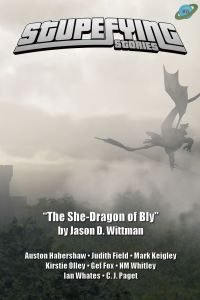
‘Groundskeeper’ by Kirstie Olley opens the book. Shena, the main protagonist is the labyrinth keeper for Lord Rangatt, the local evil wizard, having inherited the position from her late father. She’s by no means a bad person, any more than many people who work in nightclubs owned by criminals are. It’s just what she does for a living. It almost goes without saying that Lord Rangatt keeps a princess captive in the tower that is guarded by the labyrinth. Every so often a handsome prince will turn up, seeking to claim the princess for his bride, but they inevitably end up feeding the labyrinth beasts. This time it’s different, though. This time Shena finds herself falling for the handsome prince and decides to help him, despite the inevitable heartbreak. It’s really not my sort of thing, if I’m honest, but it’s written so well that I still found it quite an enjoyable read.
‘Rain Charmer’ by Gef Fox is set in a town in the grip of a drought so bad that they resorted to hiring one Johnny Eagle Wing to perform a rain dance, despite the fact that Mr. Eagle Wing didn’t look remotely Native American. Hutch took his grandson, Sheldon, along to watch, but made his opinion of the whole sorry spectacle pretty clear. Sheldon eventually drags the story out of his grandfather about how he’d been taught the correct method by Red Cloud, an old Indian rain-charmer, but it hadn’t gone well. Shame he didn’t manage to convince Sheldon not to make another try. It’s a nice, creepy little story.
NM Whitley’s ‘Ohotsuku-Kai’ is the story of Moe, a not very bright and most definitely exploited worker in some sort of energy plant in a post-apocalyptic near future. All of the satellites were brought crashing to Earth by the massive solar flare which caused the disaster. One of these satellites contains an experimental energy source, which has survived the crash intact and now lies beneath the sea. The American government are not the only people on the Earth to covet this potentially game-changing power source. Whitley cleverly gives us a conflict in which we may find ourselves rooting for the other side, but what if neither have the moral high-ground? What if there’s another viewpoint to be considered? This was my favourite story so far.
But not for long as Auston Habershaw soon usurped that position with ‘Upon The Blood-Dark Sea’. It’s a sword and sorcery story involving a powerful witch running away from her masters by taking control of a pirate ship. I say ‘witch’ as a sort of shorthand, but that’s not really accurate. While the editor’s descriptive passage in the contents does use the term, ‘dark magic’, magic is never actually referred to in the story. Katatha is a dream-walker of sorts, able to enter and influence the dreams of others. She also wields a powerful weapon which manifests through a tattoo on her wrist. Certainly paranormal, possibly magical. It depends on which term you prefer, I suppose. She is pursued by agents of the Oneirarch of Nyxos, who enslaves people like her to use their powers to his own ends. Never having encountered any of Habershaw’s work before, I was inspired to look him up on Amazon to see what else was available. While I didn’t find anything obviously set in the world of ‘Upon The Blood-Dark Sea’, I’m certainly hoping this isn’t the last we see of Katatha.
I loved ‘The Fisherwoman’ by C.J. Paget. Skilfully told in the present tense, it concerns three young kids. Roland, an asthmatic city boy on holiday in the country and Silvie and Suzanne, twin girls. Roland has become close friends with Suzanne, but Silvie is jealous and wants him gone. To this end, Silvie has made plans involving a fake treasure map. While there’s no truth in her tale of Red Gustave’s treasure, there’s also a local ghost story about the Fisherman’s Wife. There’s a delightful twist at the end, which made me smile. Having said that, it’s not perfect. Silvie’s actions are truly appalling and the consequences are never fully addressed.
Up next was ‘The Yin Yang Crescent’ by Ian Whates, which is the story that inspired me to buy this magazine in the first place. I wasn’t disappointed. Chris, the dimensional traveller I’d already encountered in Whates’ PS Publishing novella, ‘The Smallest of Things,’ is called in by his friend from another London, Jad, to recover part of an extremely dangerous device. In this endeavour, he is aided, much against his wishes by Cena, who wants his help as little as he wants hers. As with the novella, this story owes as much, if not more, to the occult detective sub-genre as it does to Science Fiction. I will definitely be looking to find the rest of the adventures of Chris (I do wish Whates would give him a surname. One can’t really run a search on ‘Chris’) wherever they may have appeared.
In Mark Keigley’s ‘With Possum You Get Free Were-Fi’, the Earth is in an unholy mess. 10,000 human disembodied brains have been sent on a spaceship, headed for Proxima Centauri. Their bodies have been dispensed with when awake from their stasis, they remotely inhabit the bodies of genetically altered possums. Earth had neither the time nor the technology to adequately screen the candidates, whether they were of the great scientific minds deemed most worth preserving or the hoi-poloi who made up the rest of the mission to save humanity. Aiden and Ming-huá are latent telepaths known as ‘mem-sensers’, whose job it is to assess the human brains on the ship, but they are having second thoughts about the ethics of their job. The work Keigley has put into making this scenario work on a scientific level is seriously impressive.
As it turns out the final story, ‘Glamour For Two’, by Judith Field was my least favourite in this collection by a fair margin. It involves a couple who teach magic skills, who take on their niece as a potential student. Janie, the aforementioned niece, saves a water elementals life on the first day and they fall in love with disastrous results. It’s by no means terrible. It made me smile a few times with some witty lines, but other than that it simply did nothing for me. Editor/publisher Bruce Bethke makes a point in bigging up Field’s work at the end of the book and recommending her collection, also published by Rampant Loon Press, so it may well speak to my personal taste more than Field’s writing ability.
This is perhaps not a publication for those whose tastes fall within narrow boundaries, as the stories can fall pretty much anywhere within the broad scope of speculative fiction. It’s fairly obvious that Bruce Bethke’s only criteria for the magazine is that the work should be of a uniformly high standard. The Kindle edition I read was not totally error-free, but they were few and far between and the general quality of the editing is rather higher than many magazines can boast.
Dave Brzeski
January 2019
(pub: Rampant Loon Press. Kindle edition. Price $ 3.00 (US). ISBN: 978-1-938834-63-9. 166 page paperback. Price: $ 5.99 (US). ISBN: 978-1-938834-64-6)
check out websites: http://rampantloonmedia.com/ and http://www.stupefyingstories.com