
Metro 2034 (book 2 of 3) by Dimitri Glukhovsky (book review).
How do you stop the spread of an incurable disease in a closed underground world that may contain the last survivors of the human race? Kill everyone infected, or find another way? That’s the central problem at the heart of Metro 2034, and the central character is Hunter, a tough, ruthless, traumatised soldier who makes Rambo look like a wimp. Hunter is in no doubt as to the solution. The only people who might stop him are a would-be novelist, a brave teenage girl and a dishonest itinerant musician.
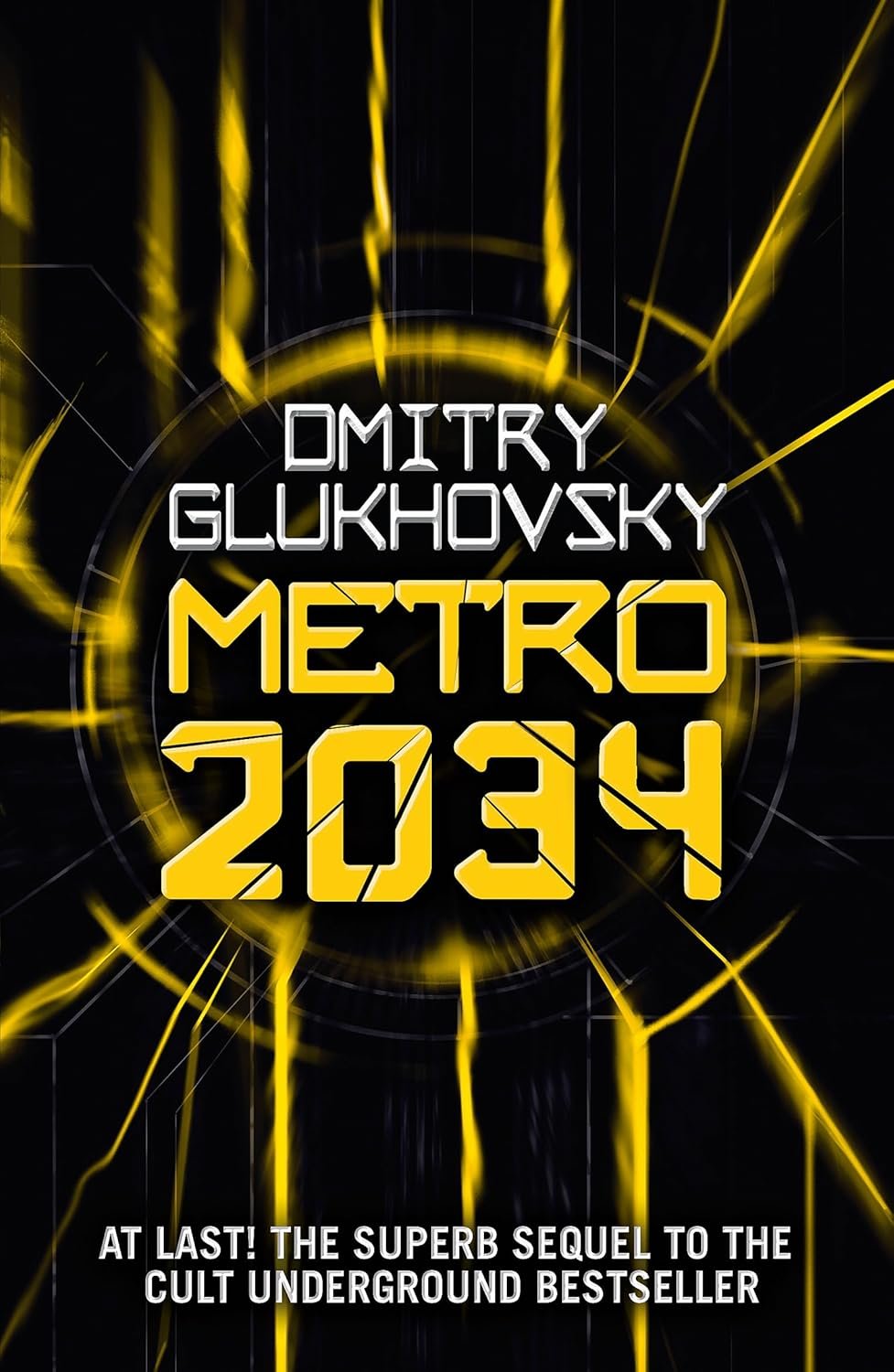
Metro 2034 by Dmitry Glukhovsky is the sequel to Metro 2033 and has the same setting: the Moscow Metro system, 20 years after a nuclear war has destroyed and irradiated much of the Earth’s surface. Thousands of survivors eke out a living in the underground stations and tunnels, growing mushrooms, farming pigs and chickens, and scavenging what they can in dangerous raids up to the ruins of Moscow. They are divided into various political bodies, some of which are hostile to one another.
Metro 2033 followed the adventures of a young man named Artyom as he fought to alert the Metro to a menace he had unwittingly let in from the irradiated surface world. His mentor early in the book was Hunter, a soldier in the Order, a paramilitary group dedicated to keeping the Metro safe. Hunter vanished while investigating the threat Artyom had unleashed. Now he’s back, working as a border guard at Sevastopol Station in the south of the Metro.
Sevastopol is an outpost and relies on supplies and ammunition from the central stations, but these have stopped arriving. Scouting parties sent to investigate do not return. Hunter leads another expedition, accompanied only by an old guard nicknamed Homer, a former Metro worker who collects documents to preserve its history and wants to write a great novel about it. He sees Hunter as the main character in his epic.
They set off for Tulskaya Station, but the guards won’t let them in. Homer finds a diary indicating that the place is infected with a deadly plague. They detour around it and rescue Sasha, the daughter of a former stationmaster who was exiled to the surface. She seems to see Hunter as a great, traumatised hero who needs her help to become human again. Later, they encounter Leonid, a musician with an interesting background that doesn’t become clear until near the end. The story is told from Homer and Sasha’s points of view, and they are interesting characters in their own right, but Hunter is at the heart of it.
Reading this book took me a while because real life got in the way. I was bogged down in the story now and then and lost the plot somewhat, unable to see the wood for the trees. The trees were great, because Glukhovsky really gets inside his characters’ heads and lets you share their profound thoughts and emotions, including their ponderings on the arts and the meaning of it all for us poor humans. However, you can lose track of what’s actually happening. Or maybe it’s just me.
I can’t help wondering if a commercial editor would have cut out a lot of the philosophising to up the pace to that of a more traditional thriller. Perhaps because the Metro books are published online for free first, the publisher felt obliged to go with the text as it was. Or perhaps Russian books have a different style, which is fine. It’s all good stuff, and it becomes clear in the end, but I got a bit lost in the middle. The fault may have been with a rusty old brain taking it in piecemeal rather than with the book itself.
It all came together nicely in the end, and I enjoyed it just as much as Metro 2033: an entertaining immersion into a world that makes you glad to live in this one, at least until the madmen in charge start having fun with nukes. Watch the skies!
Eamonn Murphy
June 2026
Pub: Gollancz, 2014. 320-page paperback. Price: £10.99 (UK). ISBN: 978-1-47320-430-0.
Check out the website: https://store.gollancz.co.uk/products/metro-2034