
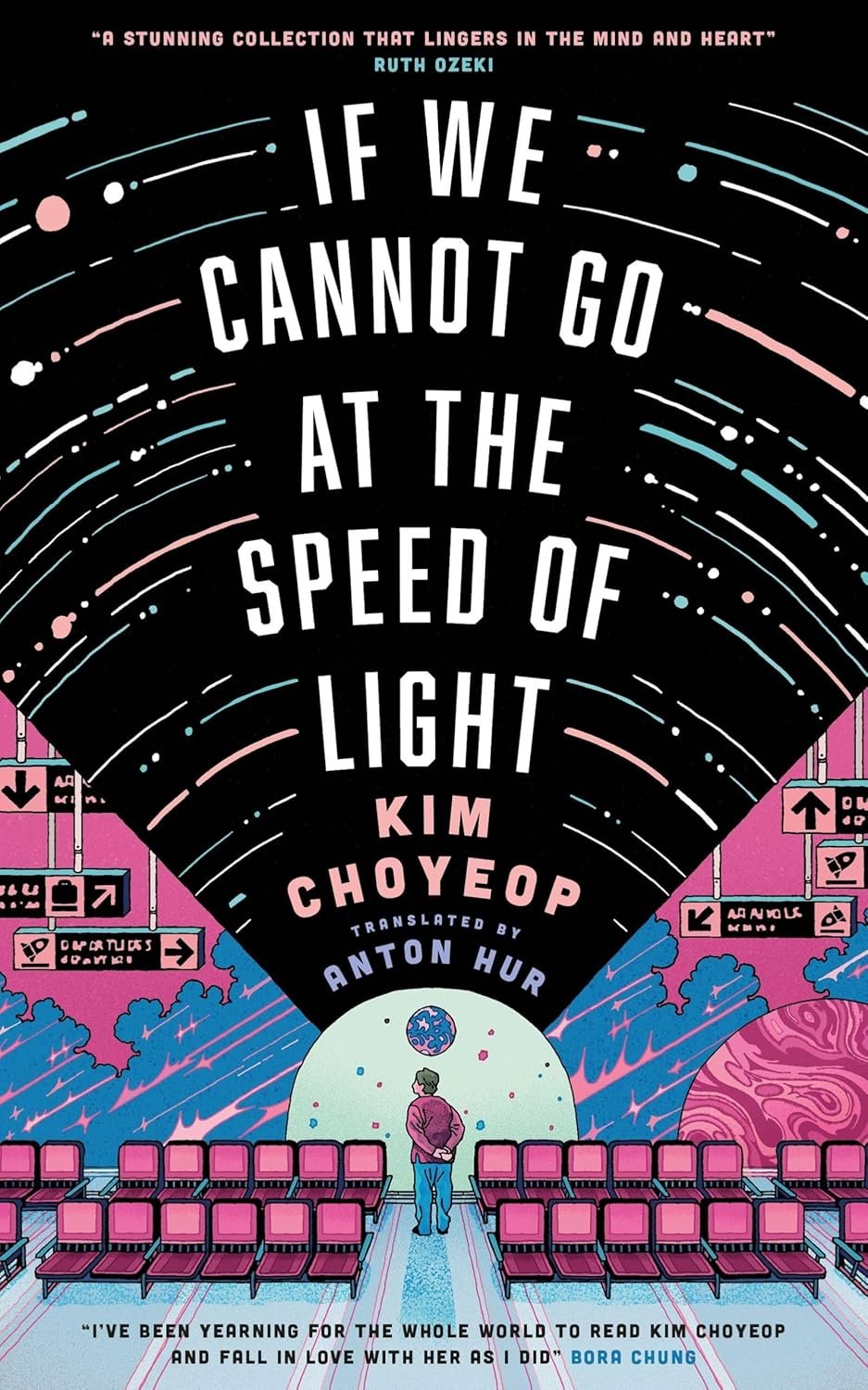
If We Cannot Go At The Speed Of Light by Kim Choyeop, translated from Korean by Anton Hur (book review).
If We Cannot Go At The Speed Of Light by Kim Choyeop, translated from Korean by Anton Hur, is an anthology of seven literary science fiction stories.
Some science fiction writers start with an idea and build the characters around it. Other speculative fiction authors begin with a storyline and surround it with a world that emphasises the characterisation. These stories come close to being a balance between the two, which is very unusual and therefore makes for a refreshing read.
All the tales are good and have something deep to say about the human condition. All of them contain some sadness or loss. Inevitably, some will resonate with the reader more than others.
For me, ‘Archival Loss’ reminded me very much of the frustrations I experienced when dealing with computers in their earlier days of development. Jimin has found herself pregnant and wants to tell her mother, Eunha. However, her mother’s mind remains in a computer archive, having been digitally uploaded immediately after her death three years earlier. The archive librarian cannot locate her. Her mind is definitely somewhere on the computer because it has never been checked out, but it has been severed from the search index. A possible way to access Eunha is suggested, involving the use of objects that had special meaning to her. This starts Jimin on a personal journey of discovery about herself and her true relationship with her mother.
‘Symbiosis Theory’ tends to reflect my relationship with science fiction. Ludmilla is an artist. She draws pictures from memory of a planet she has never visited, does not know actually exists and yet can portray in great alien-like detail. This series makes her artwork popular. She has another series, less well-known, called ‘Never Leave Me’. She dies, leaving anyone free to use her artwork. Then they discover the real planet in space, exactly as Ludmilla had painted it. Even stranger is the discovery that the planet has already been extinguished in a solar flare event. Nobody thinks the paintings and the planet are a coincidence, but no explanation comes to mind. Then somebody notices some strange results at the Neurointerpretation Institute about what babies are saying in their cries. An investigation follows, with inevitable conclusions that are out of this world.
Perhaps the most traditional of the stories is ‘If We Cannot Go At The Speed Of Light’. Anna has been on the space station for a very long time, waiting for a spaceship to take her to the Slenfonia system to join her family. She missed the last warp-ship by minutes. The discovery of numerous wormholes put warp-ships out of business. It also cut off several colonies that were not close enough to a wormhole exit, including Slenfonia. So Anna uses bouts of cryogenic sleep to wait for the next warp-ship. She has also grown old while waiting. The space station has become disused and now needs to be removed from orbit to make way for new space stations. A man is sent up to persuade her to return to Earth. He has the power to arrest her if need be, but he does not want to do that if he can help it. They talk, with him trying to persuade her to leave the space station and her trying to organise a ship, any vessel, to Slenfonia. It becomes a ping-pong match of stubbornness until a compromise is reached.
All the stories are thought-provoking in their own ways but, for me, they are surreal. Some of the technologies used seem unrealistic to me. One example is wormholes, which are theoretically possible, but we have seen no evidence of wormhole exits. Another example is the archived mind copied close to death. Surely the mind would have been damaged by illness and would not really represent the true person? Yet these flawed, popular science fiction tropes are what make the stories in If We Cannot Go At The Speed Of Light work.
Putting it another way, Kim Choyeop has taken various storylines and built worlds around them for emphasis. This makes them literary science fiction, but the flaws in the standard tropes also turn them into surreal science fiction. Nevertheless, the anthology is thought-provoking and full of ideas, which makes it a worthwhile read.
Rosie Oliver
June 2026
Pub: MacLehose Press/Quercus Books, 2026. 181-page small-format paperback. Price: £14.99 (UK). ISBN: 978-1-52944-761-3.
Check out the website: https://www.maclehosepress.co.uk/titles/kim-choyeop/if-we-cannot-go-at-the-speed-of-light/9781529447613/