
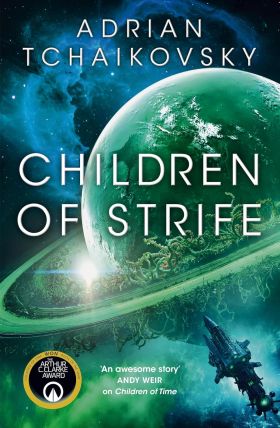
Children Of Strife by Adrian Tchaikovsky is the fourth book in the Children Of Time series of novels. The author won the Arthur C. Clarke Award for the first book in the series, so I had high expectations for this book. First impressions were positive, as the cover is quite striking, with a spaceship approaching an alien world with Saturn-like rings and, well, something else. It’s also a thick book, with XVIII (18) pages of preamble to explain what has gone before and list the main characters. This is followed by 678 pages of story.
When I say 678 pages of story, I need to be more specific, as there are three stories contained in this one volume. The three tales are related but spread over a huge timespan. Each tale covers a specific time period, or age, as the author likes to call them. The first age is known as the Age of Terraformers, with the second age called the Age of the Ark Ships. Completing the trio is the third age, known as the Age of Exploration. The preamble does a good job of explaining what has gone before, which is presumably covered in the first three volumes of the Children Of Time series.
In the beginning, there is a human civilisation that has reached the stars and started to terraform planets to make them habitable for human life. Unfortunately, the civilisation collapses and plunges humanity back into the dark ages, while also bringing the Earth close to becoming uninhabitable. It takes a long time, but the human survivors eventually rediscover space travel and build ark ships to transport as many people as possible to the terraformed worlds created by their ancestors.
One of the earlier terraformers accidentally creates several sentient species, which continue to evolve. These eventually join with the terraformers’ descendants to establish another space-faring civilisation, but this one is a multi-species affair. It promises to have a better chance than the previous one.
Now that I have set the scene, I’m going to try to give a synopsis of the book without including any spoilers. The first age within this book describes the efforts of five notable individuals, led by Gerey Hartmand, who have set out from Earth to terraform a planet and make it habitable for humans. They have arrived at the target planet but are discovering that terraforming is a lot harder than they expected. Things are not made any easier by the frequent personality clashes within the team.
The second age tells the story of an ark ship carrying thousands of humans in hibernation towards the world being terraformed by the dysfunctional team in the first age. Some things go well and some things do not. The reason the people are in hibernation is that the voyage to the new world will take a very, very long time. Far longer than a person’s natural lifespan.
The third age is concerned with the beings who originated from other terraformed planets. They include sentient spiders and stomatopods, which are evolved mantis shrimp, along with a human and a microbial life form that takes on a human shape. These terraformed planets were successfully engineered by one Doctor Avrana Kern during the first age. This is important, as Gerey Hartmand’s chief nemesis during that period was Doctor Avrana Kern. The antagonism between the two echoes through the ages.
The characters from the third age, including a human, a spider and a stomatopod, inadvertently arrive at the planet terraformed by Hartmand’s team. It is currently populated by humans who are the descendants of those from the ark ship in the second age. Since their arrival, the ark ship descendants have come to believe that the planet is malevolent, forcing them to live in fortified compounds. It doesn’t help that there’s an eclectic collection of weird wildlife, most of which is dangerous.
For reasons I can’t mention, the characters from the third age make landfall, which results in a bit of unpleasantness with the human natives and the local wildlife. The scene is set for an ending that draws everything together, though not to everyone’s benefit.
As I mentioned earlier, the three ages cover different time periods, although the events depicted in the first and second ages have a direct consequence on what happens in the third age. It’s only fitting, then, that part one starts with the first age. Yes, the book is divided into parts, nineteen to be exact. Each part contains chapters related to a specific age. You do get thrown from one age to another and back again as you read through the novel, so it keeps you on your toes.
Perhaps now is a good time to mention that I haven’t read any of the preceding novels. So, it has been a bit of an experiment to see if I could read this book with very little prior knowledge of the Children Of Time universe. In that regard, it was a success, as this works as a standalone novel, although I don’t doubt that reading the prior books would have added more detail to my understanding of what was going on and why.
There were a couple of problems I had when reading the book. The first is to do with the First Age and Gerey Hartmand’s team. They are a truly horrible collection of individuals, to put it bluntly. This made it hard to engage with this section of the story. I understood what they were trying to do, but the mutual hostility towards each other made it a hard read.
There are some radical concepts in this novel, some of which are hard to accept. A good example is a computer made up of ants. I accept that the ants might evolve into something far different from what we know today, but it’s hard to see how they could process information and react fast enough to run a program that provides responses in real time.
The First and Second Ages are essentially explanations for how the peculiar situation towards the end of the book came about. Loose threads are tied while leaving just enough that one or more characters could feature in another story from the Children Of Time series.
To wrap up, I thought Children Of Strife wasn’t a bad read, but there was a lot of superfluous detail that added to the page count without adding any real value to the story.
Andy Whitaker
June 2026
(pub: TOR, 2026. 678-page hardback. Price: $30.00 (US), £15.99 (UK). ISBN: 978-1-03505-778-8).
check out website: www.tor.com

Join the conversation (0)