
The start of this edition of Comic Book Creator is an interview from long ago by Les Daniels with comic-book writer Alan Moore. Editor Jon B. Cooke recently acquired Daniels’ notebooks, in which he transcribed all his interviews before using them in his books on Marvel and DC Comics. In some respects, Daniels was cautious in how he approached particular subjects, such as John Constantine, Watchmen and From Hell, but Moore quickly opened up.
I think the best reveal, for me, was Moore explaining that Tales Of The Black Freighter was really a metaphor for Adrian Veidt in Watchmen. Likewise, it wasn’t until he reached issue #3 that the plots started to come together, and he had to reinvent himself with other storytelling techniques after it was completed.
There are a lot of smaller articles and features here, so I’ll pick out a few. Steve Thompson examines his childhood and how he did the rounds looking for current and old comics. Even in the UK, we can probably all tell similar stories of doing that and trying to make sense of why some newsagents had different issues.
There is a one-page interview by Darick Patrick with Darick Robertson about The Boys. Have I missed it, or hasn’t there been a proper article on the subject?
There’s also a look at the Eastern Color Printing Company by writer Shaun Clancy, and how the company worked gives further insight into the printing end of production.
The second part of editor Jon B. Cooke’s interview with cartoonist Shary Flenniken covers her career, mostly at National Lampoon and elsewhere. There are a lot more samples of her work here, too. I loved her ballet gag.
Writer Steven Fears’ interview with comic-book artist Ric Estrada (1928-2009) gives a fascinating insight into the Cuban artist, from his leaving his country to beginning his career in the USA. Multi-talented, with a desire for travel and able to contribute to every medium, I agree with the final assessment that Estrada was a renaissance man. This interview, made a few years before his death, gives more about his life than just his work in comic books.
Jon B. Cooke also looks over Bill Mantlo’s life. In 1992, Mantlo was hit by a car, leaving him bed-ridden with brain damage and paralysis. He’s still alive and is currently living off film money from creating Rocket Raccoon and Cloak & Dagger. He was also a trained lawyer who stood up for the oppressed. It’s nice to be reminded that he’s still out there, although sad to be reminded of his injury.
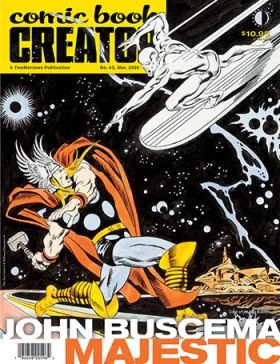
Now for the bigger feature: John Buscema (1927-2002) and four interviews given over the decades. He loved to draw and was a good draughtsman, but he had no love for superheroes, despite the fact that he drew some of the best. I think my first introduction to his work that stuck in my head was The Avengers #66’s story, ‘Like A Death Ray In The Sky’, a title I remembered more than the issue it was printed in, where his opening double-pager rains destruction down on Earth. Buscema was a strong advocate for the Marvel “method”, leaving the artist to draw the story rather than relying on the dictates of the writer.
Much of the time, he laid out the pages for other artists to ink, largely for economic reasons. He could turn out six pages a day compared to two-and-a-half pages of full pencils, so he made more money doing the former. His favoured character was Conan, and he spent a great part of his career illustrating the barbarian’s adventures without having to worry about modern-day buildings.
I’m looking at these interviews as a collective. Buscema admits he was a 9-to-5 artist with no interest in the medium and rarely looked at his own comics when they were completed, let alone those by other artists. In many respects, I think his interviewers got sidetracked on what they could ask him, as he rarely went to the Marvel offices. His memories of the 1950s, when he worked there, do provide some insights. Working in comics allowed him to freelance from home and saved him a six-hour commute. A strong presence in comic books, despite himself.
Don’t forget to buy. There’s quite a lot of material here.
GF Willmetts
June 2026
(pub: TwoMorrows Publishing. 82-page illustrated magazine. Price: $10.95 (US). ISSN: 401-783-1689. Direct from them, you can get it for $10.95 (US).)
Check out websites: www.TwoMorrows.com and TwoMorrows product page.

Join the conversation (0)