
Mark Kermode is here for Steven Spielberg’s Disclosure Day, which arrives in cinemas with the subtlety of a flying saucer landing on the White House lawn and asking whether the gift shop is still open. This is Spielberg returning to alien contact territory, but not quite the soft-focus, mashed potato mountain of Close Encounters Of The Third Kind. This time, the little visitors have brought whistleblowers, psychic trauma, black-budget corporate villainy, viral television clips, and the sort of secret government department that probably has its own very discreet HR problem.
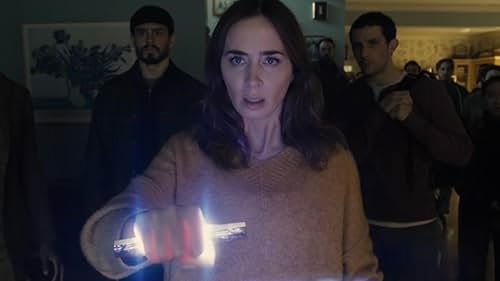
Emily Blunt plays Margaret Fairchild, a Kansas City television meteorologist whose morning takes a sharp left turn when a cardinal flies into her home, gives her the sort of meaningful stare usually reserved for haunted dolls, and then leaves. Shortly afterwards, Margaret starts developing psychic abilities and speaking in an extraterrestrial language during a live weather broadcast. This is awkward for everyone, especially viewers who were only trying to find out whether they needed an umbrella.
Meanwhile, Josh O’Connor’s Daniel Kellner, a cybersecurity specialist, has stolen evidence of decades of alien contact from Wardex, a secretive government-linked corporation run by Colin Firth’s Noah Scanlon. Firth plays Scanlon as the kind of man who could weaponise a tea break. Wardex has allegedly been experimenting on alien captives and reverse-engineering their technology, which means the usual human response to discovering life beyond Earth has apparently been: “Lovely, can we patent it?”
From there, Disclosure Day becomes part chase thriller, part UFO conspiracy epic, part psychic mystery, and part sentimental Spielberg sermon about empathy being the only force in the universe more powerful than human stupidity. Naturally, this being Spielberg, the sermon comes with immaculate camera movement, a John Williams score glowing quietly under the floorboards, and several moments designed to make grown adults feel eleven again.
Blunt is the film’s great stabilising force. Margaret could have become ridiculous in the wrong hands, a cosmic weather girl accidentally tuned into Radio Zeta Reticuli, but Blunt makes her frightened, curious, funny, and increasingly determined. She sells the impossible without winking at it, which is harder than it looks when the plot involves alien languages, repressed abduction memories, psychic influence, and mysterious animals that may not be animals at all.
O’Connor is good as Daniel, though his character sometimes feels less like a person and more like a human USB stick containing the plot. Colman Domingo brings warmth and gravitas as Hugo Wakefield, a Wardex insider turned advocate for disclosure, while Eve Hewson’s Jane Blankenship gets dragged into the chaos as Daniel’s girlfriend and former novitiate. Nothing says “relationship test” quite like hiding from federal agents in a convent while your boyfriend explains that Roswell was only the starter course.
The film is at its best when Spielberg lets atmosphere do the heavy lifting. A strange bird in a room. A silent alien presence. A childhood memory that may have been buried rather than forgotten. These are the moments where Disclosure Day feels properly alive, full of that Spielbergian hum between dread and wonder. When it works, it really works.
There are problems, mind you. The plot occasionally develops the density of a conspiracy corkboard assembled by someone who has had too much coffee and access to red string. Wardex, the black sites, the alien devices, the psychic bonds, the childhood experiments, the global war crisis, the viral broadcast, and the grand final transmission all jostle for position like commuters trying to board the last Tube from Leicester Square. Some viewers may find the whole thing overstuffed. Others may simply accept that if Spielberg wants to throw half a century of UFO folklore into one very polished blender, one should probably stand back and admire the expensive mess.
The finale is pure Spielberg optimism, in which revelation becomes salvation and humanity’s better angels are summoned by extraterrestrial PowerPoint. It is earnest, bold, occasionally daft, and oddly moving. Cynics may roll their eyes hard enough to detect planets. Believers may come out ready to scan the skies. The rest of us will wonder why aliens always choose Americans with complicated childhoods rather than, say, a retired bus driver from Doncaster.
John Williams, returning once more to the Spielberg mothership, wisely avoids trying to outdo his own Close Encounters legacy. His music here is gentler, stranger, more insinuating than triumphant, giving the film emotional lift without parking a brass section directly on the audience’s lap.
Disclosure Day is not Spielberg at his cleanest or most disciplined, but it is Spielberg with his sleeves rolled up, rummaging once more through the great cosmic toybox. It has wonder, wobble, heart, and spectacle. It is sometimes profound, sometimes preposterous, and occasionally both before breakfast.
Here at SFcrowsnest magazine, we have always suspected that when disclosure finally comes, it will not arrive via majestic alien ambassador, but through a badly compressed video, three contradictory government statements, and a bloke on X insisting he knew all along. Still, if the truth is out there, Spielberg has at least given it a decent lighting rig.
Disclosure Day: Spielberg


Join the conversation (0)