

The Science Of Science Fiction by Mark Brake (book review).
The Science Of Science Fiction by Mark Brake has the sub-title The Influence Of Film And Fiction On The Science And Culture Of Our Times. A bit of a mouthful, but you do have to wonder which, or what, was originally the main title. Whatever the case, it was enough to pique my interest in looking at this 2018 book. Even so, Brake doesn’t always appear to keep to that remit throughout.
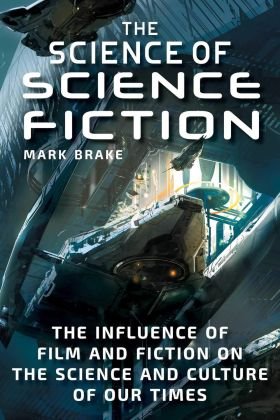
The book is divided into four sections, Space, Time, Machine and Monster, with mini-chapters on various subjects within them. These sub-titles are a bit of a misnomer because it’s rare that they dominate the chapters, serving more as a starting point for each subject. Brake draws on several quotes from various sources, both non-fiction and fiction, before launching into a particular topic.
In his introduction, Brake reveals himself to be both a science fiction fan and a scientist, so this book blends both interests. He has certainly done enough research, especially judging by the opening two parts. You’ll need to keep a notebook handy to jot down any books that pique your fancy for later reading. He’s certainly well-researched, and I’m not spotting any obvious flaws at this stage. He even points out that the American population listening to Orson Welles’ War Of The Worlds radio broadcast wasn’t as large as publicised and has been exaggerated over the years. Why should we be surprised at media exaggeration?
I like his examination of space battles, going beyond there being no noise in space and looking at the problems of firing missiles in space. I did have a serious think about that. A missile is far smaller than any spacecraft firing it, so a reaction in the opposite direction by the larger-massed spacecraft isn’t quite on the cards. A tickle at most, especially if the missile’s full motor isn’t turned on until it is ejected. The same applies to forward momentum. Provided the missile is going faster than the spacecraft, the relative distance between the two would remain. Both of these points contradict his comments. Hopefully, this would never have to be proven for real. Don’t be complacent when you read. Think about what Brake says rather than simply accepting it as correct.
With his Time section, I did wonder if he was running out of things to say about it, or rather if he was relying on repetitions without going into too much detail about how it could be done. Basically, going forward is easy because of relativity, but going back would surely have left proof. He ignored something basic from Doctor Who in that people have selective memories and remember what they want to remember. I mean, look at how people commemorate the end of the two world wars every year to ensure they are not forgotten by new generations. Wars earlier than that aren’t so easily remembered. However, there is a list of books here that I want to look at, although some of them are prohibitively expensive. Anyone got any uranium-235 for my time machine? It doesn’t have to be weapons-grade. What is puzzling is why there is no bibliography or index to make it a proper reference book.
As with all books about science fiction, somewhere into the book I did start to think about how well-read or well-viewed the author is compared to the impression given in his introduction. These days, a lot of research can be done online without necessarily seeing the completed works, although that can have an effect on which examples are used. I can console myself with this: I’m widely read in SF, but there’s too much out there now for anyone to be called a complete expert any more. Giveaway points tend to be things overlooked. The opening sections have a lot of examples, but the Machines section has somewhat fewer, considering how much importance Brake places on this subject. He points to fictional examples of flying cars and mentions Thunderbirds, more the later CGI version than the 1966 original, but neglects Supercar and Joe 90, which have better examples. Mac McClaine’s Jet Air Car is probably the way to go. A low-level flying car makes a lot more sense than cars flying at the same height as aircraft, and at least it avoids potholes. Look at the problems we currently have with drones.
The Monster section deals with more of the same, dividing itself between creatures and humanity evolving through mutations. My impression of the last two sections was that they felt sparser than they should have been. Brake cites Charles Xavier as an example of telepathy but doesn’t mention Henry Kuttner and C.L. Moore’s Baldies stories, which were an obvious source. I know there is a likelihood of using examples people would recognise, but SF is loaded with super-humans and evolved beings, yet there are few examples here. The same applies to cyborgs. He acknowledges Martin Caidin’s book but, really, there are so many others.
This book is worth a look, if only to test your own SF knowledge. How much science fiction has really influenced our world could have been covered better. SF has had as many failures as influences on our society. Other than space battles, Star Trek is barely mentioned, although it had a major influence on mobile phone design. The same applies to computers, although that came much later. No SF author anticipated the silicon CPU that would help reduce the size of computers. I could go on. What Brake does cover will give you some food for thought, but don’t treat this as a definitive volume.
GF Willmetts
June 2026
(pub: Skyhorse Publishing, Inc, 2018. 216-page enlarged paperback. Price: varies. ISBN: 978-1-5107-3936-9)
