
For a literary prize named after the man who gave us geostationary satellites and a rather alarming number of giant space monoliths, the Arthur C. Clarke Award has always had a habit of rewarding science fiction that cheerfully ignores the boundaries of what science fiction is supposed to be.
Now celebrating its 40th anniversary, the UK’s most prestigious SF novel prize has unveiled a shortlist that ranges from dungeon-crawling chaos and memory-devouring conspiracies to ecological futures, AI anxieties and hotels that would make even TripAdvisor reviewers nervous.
The six contenders battling for the famous engraved bookend and a prize purse of £2,026 are Dungeon Crawler Carl by Matt Dinniman, The Dream Hotel by Laila Lalami, Luminous by Silvia Park, There Is No Antimemetics Division by qntm, When There Are Wolves Again by E.J. Swift, and The Salt Oracle by Lorraine Wilson.
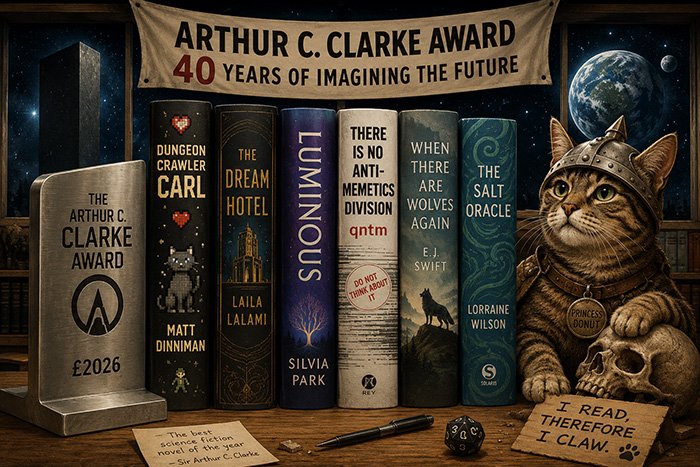
That list alone tells you everything about the state of modern science fiction. Once upon a time, Clarke shortlists were packed with spaceships, alien empires and earnest scientists peering at pulsating phenomena through very large windows. These days, one of the favourites began life as a LitRPG sensation featuring a man, his cat and a reality-TV death game watched by the galaxy.
Matt Dinniman’s Dungeon Crawler Carl arrives as perhaps the most unusual nominee in the award’s history. Originally a self-publishing phenomenon, the novel became a global bestseller through word-of-mouth, audiobooks and sheer internet enthusiasm. The fact that a LitRPG title now stands shoulder-to-shoulder with literary SF heavyweights says much about how the genre landscape has evolved.
Meanwhile, qntm’s There Is No Antimemetics Division represents another internet-era success story. Expanding ideas first developed through the SCP Foundation collaborative fiction project, the novel explores entities that erase themselves from memory. It’s the sort of premise that sounds impossible to explain at parties but has generated a devoted following among readers who enjoy their cosmic horror served with a side order of existential confusion.
Laila Lalami’s The Dream Hotel brings a more near-future speculative edge, examining surveillance, identity and predictive technologies. Silvia Park’s Luminous explores memory, humanity and artificial intelligence, themes that seem particularly timely as AI continues its relentless march from science fiction into daily life. E.J. Swift’s When There Are Wolves Again and Lorraine Wilson’s The Salt Oracle meanwhile demonstrate the continued strength of environmentally focused speculative fiction, where the future is often shaped as much by ecosystems as technology.
The judges had plenty to choose from. A record-breaking 132 eligible novels were submitted this year from 52 publishers and independent authors, suggesting that science fiction publishing remains in remarkably healthy shape despite periodic predictions that readers have abandoned books in favour of staring blankly at social media feeds.
Chair of Judges Dr Andrew M. Butler noted a recurring theme of memory running through this year’s finalists. Given that one shortlisted novel literally revolves around things that cannot be remembered, another explores AI consciousness, and several others examine personal and collective histories, it is difficult to argue with the observation.
Award Director Tom Hunter also used the announcement to reflect on the prize’s own history. Following Sir Arthur C. Clarke’s death, there were genuine concerns that the award might not survive beyond its 25th year. Instead, it has reached its fourth decade and is already looking ahead to celebrations for its 50th anniversary in 2036.
The winner will be announced on 12th August 2026. Until then, expect the usual spirited debates among science fiction fans. Some will champion literary experimentation. Others will argue for big ideas. Quite a few will be quietly rooting for Carl and Princess Donut to bring a little dungeon-crawling anarchy to one of the genre’s most respected awards.
Here at SFcrowsnest, we’re just delighted that forty years after its creation, the Clarke Award can still produce a shortlist capable of surprising almost everyone.

Join the conversation (0)