
It goes without saying that Alfred Hitchcock is still famous today as one of the masters of cinema. Films such as Vertigo, North By Northwest, Psycho, The Birds and Rear Window are widely regarded as stone-cold classics, mixing masterful cinematography with psychological weight. His legacy is immense and frequently alluded to by the generations of filmmakers who followed him.
At the same time, though, Hitchcock’s reputation as a person has taken some knocks. His relationships with women, in particular, have been subject to intense scrutiny and considerable criticism. Much of this is based on a biography of Hitchcock written by Donald Spoto, in which actress Tippi Hedren described Hitchcock’s obsessive and possessive behaviour towards her. While other actresses who worked with him have defended Hitchcock, the fact remains that, in the #MeToo era, it can be hard to approach Hitchcock films with an open mind.
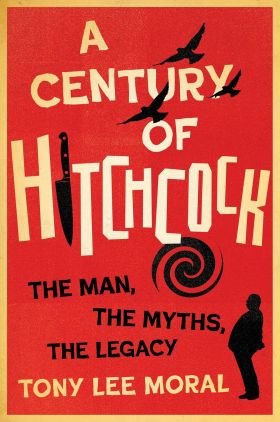
Tony Lee Moral’s book, A Century Of Hitchcock: The Man, The Myths, The Legacy, is divided into three parts. The first covers Hitchcock’s rise through the 1920s to the peak of his career with films like Vertigo (1958) and Psycho (1960). The second section is focused very much on the two films he made with Hedren, The Birds (1963) and Marnie (1964). Finally, the third part looks at how Hitchcock’s legacy and reputation have been viewed following his death in 1980.
To some extent, the biographies written during the 1970s and 80s tended to look for the flaws in their subjects. Albert Goldman’s 1988 biography of John Lennon was memorably dismissed by U2 in one of their songs with the line, ‘…his type like a curse.’ It’s virtually impossible today to separate the real Joan Crawford from the one described in Mommie Dearest, published by her daughter, Christina Crawford, in 1978.
Moral’s thesis, then, is that we have to be very careful about basing our entire view of Hitchcock on a biography written very much in the style of the time. Spoto is portrayed as a biographer who asks leading questions and twists stories out of context. But this review is already putting the cart before the horse in discussing the third part before saying much about the other two, which I think says a lot about the effect Spoto’s biography and Hedren’s allegations have had on Hitchcock’s reputation.
Suffice it to say that the first part is, in some ways, the most interesting if it’s Hitchcock the filmmaker you’re focused on. Moral sensibly refrains from trying to do anything revolutionary here, as there are countless books about Hitchcock’s cinematography out there for interested parties. Instead, he says more about Hitchcock’s relationships with the people he worked with during this time. Hitchcock was, it’s probably fair to say, as difficult as he was brilliant. The studio system of the 1930s churned out films and tried to lock directors into creating films that showcased stars and sold well. Hitchcock understandably didn’t want others re-editing his films or telling him whom to cast. He developed techniques to limit studio interference while also building a reputation as someone who honoured contracts and delivered on time.
The second part is where things get complicated. Much of what is said about Hitchcock that veers into #MeToo territory comes from his relationship with Hedren during the early 1960s, when The Birds and Marnie were filmed. Regardless of their merits, both films tend to be viewed through the prism of Hedren’s subsequent allegations that Hitchcock mistreated her. At minimum, it is probably fair to say that Hedren’s acting skills were limited before The Birds was filmed, but she had the icy blonde look Hitchcock clearly liked. In developing her into a competent actress, he pushed her hard and, by modern standards, some of what he did crossed psychological or sexual lines. Where more established actresses were able to handle Hitchcock, Hedren was not.
The final part of the book unpicks subsequent biographies, particularly Spoto’s. As mentioned earlier, uncompromising, some would say muck-raking, biographies were very much in vogue in the decades immediately after Hitchcock’s death. Moral is clearly sympathetic to Hitchcock and points out how Hedren’s recollection of events during the filming of The Birds and Marnie evolved over the years. At one point, Moral writes that ‘…while Hedren’s words were ambiguous, Spoto transformed them into absolutes’ and that, fundamentally, is the problem with our modern perception of Hitchcock being based so much on that single biography. Spoto’s argument that Hitchcock tormented Hedren is based on a very partial and somewhat twisted version of what Hedren said and, in turn, perhaps Hedren herself started to believe what Spoto had written. Even if we accept that Hitchcock’s behaviour would be problematic today, to portray him as a sexual predator or misogynist simply isn’t fair.
Overall, I’m glad to have read this book. Like others, my appreciation for Hitchcock’s films had been coloured by the stories told about him. But in giving me a clearer impression of the man and his work, while being open about his flaws, Moral has encouraged me to come back to Hitchcock with a more open mind. I’d like to think Moral would consider that a job well done.
Neale Monks
July 2026
(pub: University Press Of Kentucky, 2026. 304-page illustrated indexed hardback. Price: $29.95 (US), £25.50 (UK). ISBN: 978-1-9859-0444-6)
check out website: www.kentuckypress.com/9781985904446/a-century-of-hitchcock/
An Interview With Tony Lee Moral by Neale Monks
Neale Monks: What drew you to writing about Hitchcock in the first place?
Tony Lee Moral: I first became interested in Hitchcock when I saw I Confess on television at the age of 10 or 11. What struck me was the moral ambiguity. Montgomery Clift plays a priest who, because of his vows, is unable to clear his name when the real murderer confesses to him. But the big game-changer was reading Hitchcock’s Films by Robin Wood when I was 18 years old and at college. His writing was so lucid and helped me analyse film in a way I had previously done with literature. The more I researched Hitchcock, the more I realised that he was a supreme director in creativity, storytelling and self-invention. Few filmmakers have left such an imprint on cinema, yet the man behind the legend remains surprisingly elusive.
NM: It’s easy to say that Hitchcock still influences modern cinema, but for someone who isn’t familiar with his work, what sort of styles and methods could be described as Hitchcockian?
TLM: The term ‘Hitchcockian’ usually refers to putting the audience through it and in the character’s shoes, especially in a position of tension and uncertainty. I also use the term ‘camera logic’, which Norman Lloyd told me about. Hitchcock’s greatest skill as a director was that he instinctively knew where to put the camera to elicit emotions in the audience. Hitchcock loved giving viewers information that characters didn’t have, creating suspense from anticipation rather than surprise. Visually, he was a master of point of view, often encouraging audiences to see events through a character’s eyes. Themes such as mistaken identity, obsession, voyeurism, guilt and the ordinary person caught in extraordinary circumstances still appear everywhere, from prestige television to modern thrillers. If you’ve ever sat on the edge of your seat knowing something terrible is about to happen, you’ve probably experienced a Hitchcockian moment.
NM: Your chapter on the #MeToo movement and how this colours our reading of Hitchcock’s legacy is timely and balanced. As an obvious Hitchcock fan, did you find that chapter particularly challenging to write?
TLM: I felt it was very important to write because a lot has happened to Hitchcock’s legacy in the last ten years since the start of #MeToo, and many stories have been overblown. It has also influenced voters in polls such as Sight And Sound’s greatest films and directors lists, which take place every ten years. I felt it was important to separate documented evidence from stories that have been repeated so often they’ve become accepted fact. In A Century Of Hitchcock, I chart how his reputation has evolved over time and why certain narratives became dominant because of personal grievances, which I go into in the book.
NM: Do you have a favourite Hitchcock film or one that you think every cinema fan should watch, simply to appreciate his mastery of the medium?
TLM: I’d always recommend North By Northwest to a general audience because it has such style and pace. Vertigo is often cited as a favourite among Hitchcockians. It’s visually stunning, emotionally rich and rewards repeated viewing. I’ve seen the film countless times but, as Hitchcock said, there is a lot there, so I’ll probably see something fresh next time I watch, as it’s been a few years since my last viewing. The beauty of Hitchcock’s films is that they remain constants in your life but, as you grow, your attitude towards them sometimes changes.
Neale Monks
July 2026

Join the conversation (0)